Re-collections is the title of the solo exhibit by Carlos Betancourt presented at The Molly College Art Gallery in Long Island, New York, during the month of April. The exhibition includes a series of the same name and other works that have been central in Betancourt’s artistic trajectory, such as The (Last) Supper and Sunday Afternoon in El Yunque both created in 2008.
The work by Betancourt is the result of a meticulous accumulation – prolonged by time and recollection – that the artist handles like an admirable master of ceremonies. Above all, Betancourt is an illustrious craftsman of artifice who relies upon the conjunction of significant minimal elements to build a highly peculiar cosmogony: eccentric and radiant while also intimate and heartfelt.
The artistic proposal by Betancourt relies on an insatiable search for his own identity: one that is difficult to understand, that is inhabited by multiple artists and continually changing, delimited by elusive borders and boundless imagination – heterogeneous, diverse, multiracial, multilingual, and transcultural, in which migration represents the cornerstone that sustains the culture of the region. I am referring, of course, to the Caribbean identity, which here appears here to be associated with a relatively new phenomenon: the Caribbean diaspora and, as a consequence of this, a new kind of identity present in Carlos Betancourt’s work: the trans-Caribbean identity.
Immersed in his own cultural baggage – the artist was born in Puerto Rico to Cuban parents – this Miami-based artist communicates through his work the amalgam and juxtaposition of referents that define trans-Caribbean culture, the latter exacerbated by distance and imagination. Carlos Betancourt explores the Caribbean through his cultural and historical roots that stem from the Taíno and African cultures, essential pivots that shape the region’s identity.
Betancourt draws in particular from the Taíno culture, as it is the original culture in the area, rich in legends and traditions, which although neglected, have prevailed to the present. We also find elements of Afro-Caribbean culture in his work that are typical of the Caribbean and that are certainly a part of its contemporary urban culture. All of these elements are integrated to create a cosmogony that establishes a dialogue on identity and diversity and the dialogue with itself.
The idea of the offering that is so clear in Taíno and African cultures becomes pivotal in Betancourt’s artistic discourse. His characters, always charged with attributes that identify the artist himself, are the bearers of votive elements: the propitiating or appeasing offering. First, the animist character of the Taíno culture is emphasized here because of its veneration and respect for all living things. Any neglect or disregard may change the necessary equilibrium of the cosmos and cause it to turn against itself. This condition is the cornerstone of Betancourt’s work, in that each and every one of his character – of an impressive variety and range – are placed at the same level and always according to their human condition.
Afro-Caribbean culture is the second theoretical element that shapes Carlos Betancourt’s work. It is a cultural tradition that has been rooted in the region for many centuries and one that can be defined for the cultural resistance and transcultural process that identify the Caribbean region.
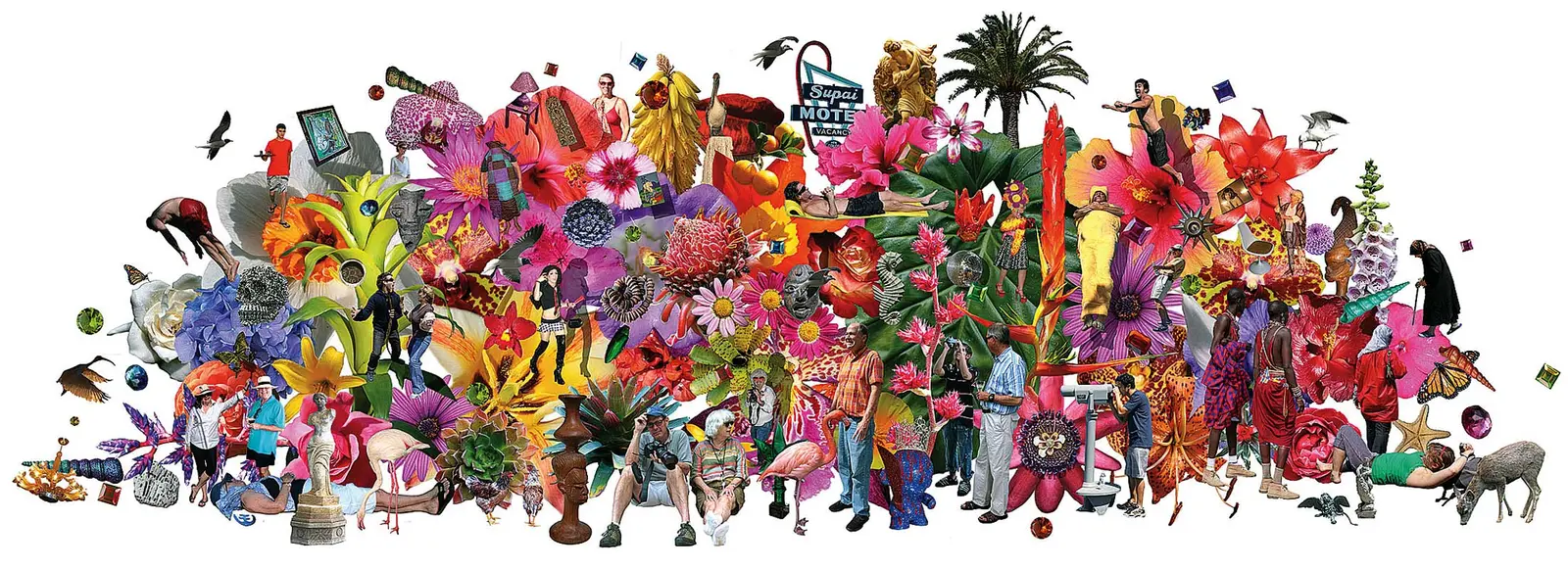
His series titled Re-Collections (2008) is emblematic of this entire process. To start, the elements that constitute each of his works is extracted from its original context in order to be extrapolated and re-inserted into a new cosmogony. We are witness to stereotypical and embellished notions concerning the Caribbean: flowers; exotic seashells; strident colors; exuberant nature, and sensual bodies.
From a formal point of view, a sort of horror vacui prevails in Betancourt’s images, but the harmony of the dominant global composition is nonetheless comforting. The proclivity toward accumulation, vibrant colors, shiny surfaces, exaggeration, and, on occasion, the grotesque, in Betancourt’s images establishes close connections with U.S. pop culture and kitsch. These influences bring vital energy to his work that is always closely associated with urban culture.
The characters appearing in the works by Carlos Betancourt bring to mind works by U.S. artists such as Duane Hanson and Jeff Koons. However, if approached from a conceptual perspective, Betancourt’s works are more closely tied with artists such as Ana Mendieta, José Bedia, and Arnaldo Roche-Rabel.
The exhibit Re-collections, presented at The Molloy College Art Gallery, is a fascinating and magical journey that shares many of the elements of Magic Realism so central to the region.
JANET BATET