
The exhibit titled Carlos Raúl Villanueva y la Ciudad Universitaria de Caracas that was presented at the Fomento de las Artes y el Diseño (FAD, its acronym in Spanish) in Barcelona celebrated both the 50th anniversary of the FAD Awards for architecture and interior design, as well as the anniversary of the construction of the Aula Magna Auditorium of the Central University of Venezuela, the centerpiece of this house of studies’ architectonic complex.
This exhibit represents a current revision that evaluates the important role that the University City of Carácas plays in the history of architecture after the second half of the Twentieth Century, in that the complex is an essential referent of modernity on the American continent.
This great project was conceived by Architect Carlos Raúl Villanueva during a crucial moment in the history of Venezuela when the positivist and progressive segments of society were obstructed by a decisive process of industrialization, a pronounced nationalistic sentiment, and the impatience of a well-established dictatorship, as these attempted to steer the country in the “correct” direction. The insistence on projecting a “modern and monumental image of Venezuela” justified, with reinforced concrete, the architectonic rhetoric of the regime, an assignment that was splendidly interpreted by Villanueva.
Villanueva placed his vast theoretical knowledge – a product of the academic education he received in Europe that saw the emergence of historical vanguards and modern architecture – against the tropical environment he encountered upon his arrival to Venezuela in 1929. Here, he found himself in a completely different universe, immersed in a sort of American utopia that he was able to exploit masterfully.
One of the most important aspects of this exhibit was to expose Architect Villanueva to a new public. Although he is usually well known and admired in many places, he is not very well known in Europe.
An impressive group of architects, curators, and producers was in charge of successfully conceptualizing, selecting, documenting, and gathering together the enormous amount of material necessary for the completion of this colossal project. The team included Juan Pedro Posani, Javier Cerisola, Valentina Salcedo, Igor Peraza, Beth Galí, Eugenia Fuenmayor, Silvia Hernández de Lasala, as well as Catalina Pons and Andrea Griborio, among others.
While there have been more than a few exhibits dedicated to the City University of Caracas – proclaimed a World Heritage Site in 2000 by the United Nations Educational, Scientific and Cultural Organization (UNESCO) – this exhibit, in particular, is relevant because the vast majority of the pieces included in it have never been brought together under the same roof, because they originate in various places.
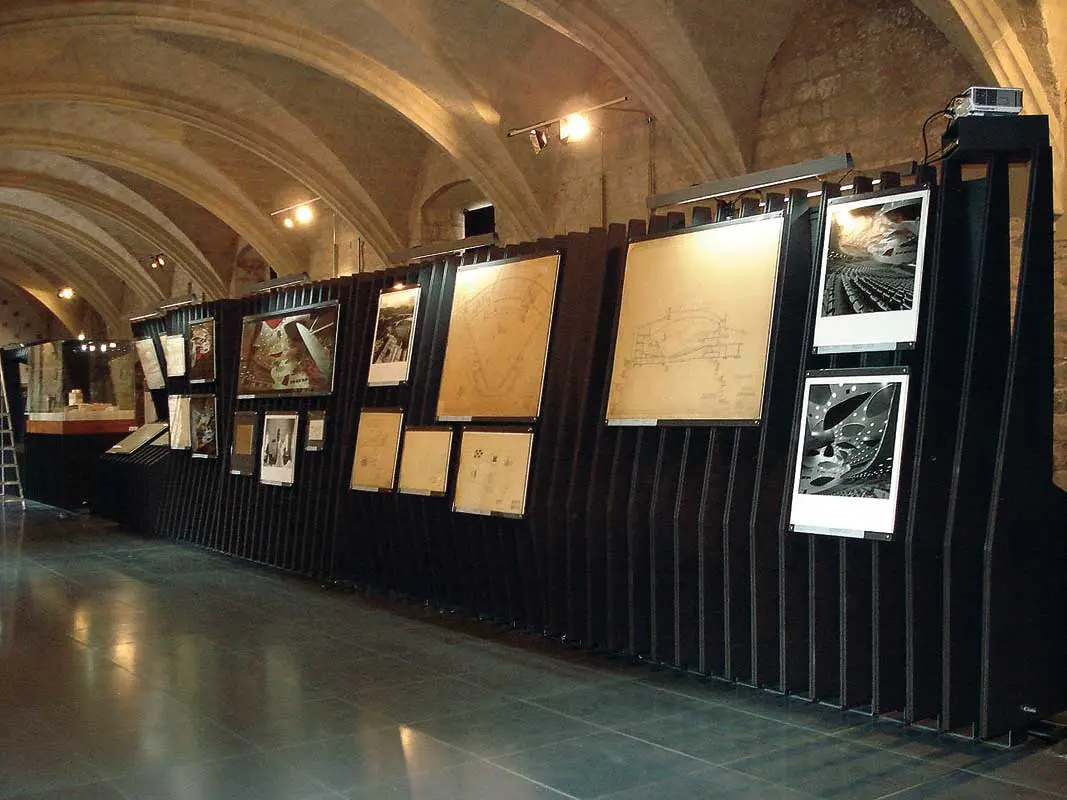
This exhibit at the FAD includes three mockups, 25 photographs, 49 plans, and two sketches. These materials not only derive from private or public collections subjected to strict security controls but also come from Villanueva’s personal archives and are presented to the general public for the first time.
The nearly archeological result brings together extremely precious pieces. These include pencil-traced plans signed by Villanueva, mockups created as far back as 60 years, and sketches, as well as plans signed jointly by Villanueva and other artists, which illustrates this architect’s ability to surround himself with the most select group of leading European and U.S. artists and to incorporate them into the same purpose while permitting their active participation in the project and the expression of their personal artistic visions.
Paolo Gasparini’s photographs reveal the emblematic spaces that belong to the University City of Caracas. They establish dialogues within a modern framework that ultimately yields to a much more organic and free form of expression – as can be observed, for instance, in the Plaza Cubierta complex. Villanueva’s vision of this structure is one of the spaces replete with areas cooled by shadows, while he also intertwines the tropical natural light to create radiant warps, which render a versatile open-air museum, an emblem of modernity. This complex – a synthesis of the arts filled with sculptures and murals, and in which we find artworks by Vasarely, Léger, Arp, Pevsner, and Laurens, among others – never stops surprising those who experience so many works of arts in the same place as they enhance the surroundings.
Another photographic series captured the large buildings of the complex, with façades complemented with colossal open-air sculptures by national and international artists.
This exhibit also includes exceptional scaled-down copies of the impressive clouds by Alexander Calder, which served as screens onto which audiovisuals about Villanueva were projected. Similarly, plans and photographs of the Aula Magna Auditorium convey the true merging of the arts that this structure represents, whereas, in a lava lamp, the clouds appear to be suspended as they expand over an overcast sky that serves as both a decorative and an acoustic purpose.
It is noteworthy that the stamps on some of these documents – yellowed by the passing of time – which rendered these as the “definitive” versions of the project. The discrete wine stains they also reveal are a reminder of the celebratory mood that accompanied the successful completion of what became such a colossal and unique project, not only for the generation that witnessed its construction but also for other later generations that have had the opportunity to experience it.
The exhibit Carlos Raúl Villanueva y la Ciudad Universitaria de Caracas was well received by the public in Barcelona. The response exceeded all expectations and prompted plans to transform into a traveling exhibit that will continue to present this important architectural landmark to new audiences.
ELISA RODRÍGUEZ-CAMPO