Ernesto Leal is a sort of “scientist of art,” as his interest in that field and its representational system has demonstrated. This past May 8, the Galería Habana inaugurated the exhibit titled Trastornos del Lenguaje (Language Disorders), in which Leal has once again shown his deconstructive and cynical gesture toward the system of relationships that move a work of art forward. Intervening the space with writings by art critics – who had written about his work – was the exercise presented by the artist, an exercise that also works as an environment by creating an atmosphere of suspense, as if the artist was testing us in the face of the perceptive and procedural disorder of the diverse connotations that we find in his work. He manipulates us by placing his sui generis works, written in English, on a granite floor that makes reading the works difficult, or on a circular column that compromises our efforts to decode the images placed there.
Despite the solidity of his artistic trajectory, Leal remains one of the most ignored artists on the national scene. What has prompted such a reaction? Is it possible that his questioning of the mechanisms that intervene in the circulation, promotion, and consumption of art, is problematic? It is, perhaps, because of such a reaction that he is dubious about a certain arbitrariness that can turn works of art into indifferent or revealing entities.
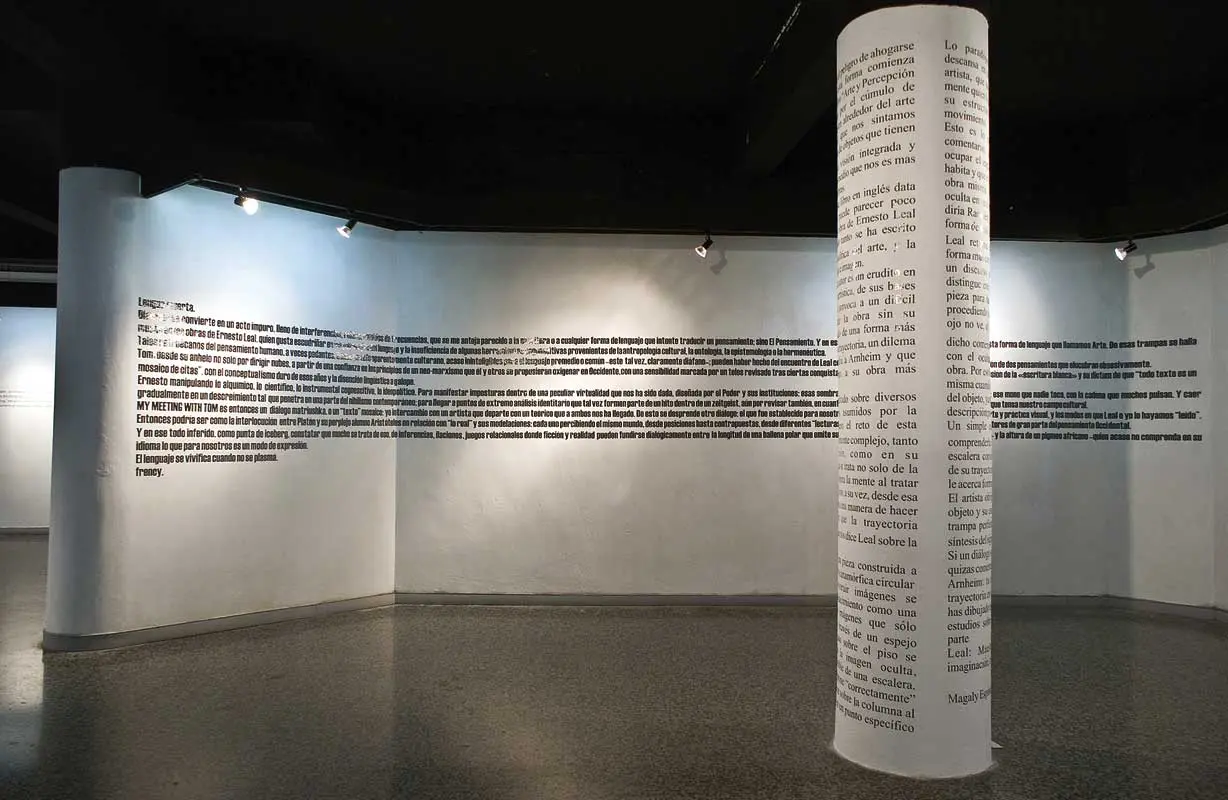
It took Leal nearly a year to obtain a total of six texts from an equal number of art critics, who wrote these after each had received certain materials – the sketches, schemes, and gallery plans of six artworks that included installations, video installations, and photographs – from the artist. The result of this interaction became the actual exhibit, in which the art critics’ thoughts occupy the same space and dimensions in the gallery that the actual works would have occupied. These texts belong to art critics Frency Fernández, Elvia Rosa Castro, Corina Matamoros, Cristina Vivés, Magaly Espinosa, and Tim Wride; the latter a curator of photography at the Los Angeles County Museum of Art (LACMA). As I mentioned earlier, Ernesto’s modus operandi and appearance are those of a scientist who has decided to practice without fanfare, an oblique cut with aseptic instrumentation into the artistic scene, in order to shed light on the constructions that can derive from language.
Each text in the exhibit reveals the personality of the art critic who wrote it, as Leal also manages to transform these into accomplices of the paraphernalia that are often abundant in some of the works. Corina Matamoros, in her text on the piece titled El libro del Arte (ó el Hueco en el Discurso) (The Book of Art [or the Void in the Discourse]), expresses in the final part: “Instead of a live-work, you present me with an electronic sketch and a 400-word opinion space. You perceive my stuttering and lie in wait for my hesitations: I am your void in the discourse.”How much irony does she propose upon accepting a challenge of this kind?
Pisapapeles (Paperweight) is Cristina Vivés – known for her associations with collecting art (another of the proposal’s disguised readings), who takes on another installation by Leal. Her interpretation centers on her perspective as a collector, which supposes a mentality dependent upon financial aspects. Is she interested in Leal’s work to such an extent that she would include it in her private collection?
The most provocative of the texts stems from Leal’s interaction with Elvia Rosa Castro, who describes a performance-installation titled Llame Ahora (Call Now), which reads as follows:
“Power is exerted through writing.
The proposals by Leal put writing into question.
Ergo: The proposals by Leal question power”
Ernesto explores the external forces that intervene in the completion of the work – art critics, curators, specialists, gallery, promoters, collectors, or dealers. More often than not, it is the art critic or a specific powerful institution that “launches” certain artists to stardom. Those who do not observe the prerequisite of being “correct” in cultural, political, or economic terms will probably never become part of the circuit of promotion and consumption.
According to his own statements, Leal through the years has not been interested in being identified with a certain style or tendency. He dominates sophism, syllogism, tautology, and plays on words. This is why the artist is sure when he denounces the manipulations driven to exert an influence in his work. As in any other postmodern operation, Leal’s discourse carries the seed of the meta-discourse implicit in its deconstruction. As he affirms, “My interest is that people see all the texts as if they were images,” for he knows that this is precisely what critics do when they write: they create an image about the artist. In addition to these, the work is also “intervened” by other social scales. The dematerialization of the art presented at this exhibit is associated with action practices, with performance, happening, intervention; for the process here – the interaction and the participation by the viewer toward completing the idea – is more important than presenting a self-complacent exhibit of a given product, as is often the case.
In Cuba, art professors, art critics, curators, students, and the artists themselves are frequently exposed to original works in a referential manner (through commentaries, magazines, videos, or books), because the possibility of traveling is very limited. Leal addresses this inconvenience – that oftentimes exerts an influence on a thorough understanding of art as it applies to our context – by providing the art critics with only the descriptions of the artworks, thus establishing an allegory as to the manner in which those who write about art or who produce art can sometimes be deceived.
Three other texts complete the exhibit: The Sooner the Better, by Tim Wride, addressing a digital photograph, My Meeting with Tom by Frency Fernández, and Segundo Piso (Second Floor) by Magaly Espinosa; these latter two were elaborated to address installations. From each of the texts, one is able to extract very different reflections that point to the reluctance of a creator confronted with a system of relations in which talent, or the true intent of discourse, is often blurred by ineptitude or convenience.
Leal appears to take advantage of the powers-that-be standing between his work and the public. He achieves this with the exquisiteness of a meticulous researcher who knows how to work with several layers of meaning to prompt our reflections: How can we speak truth to power? What influence can a disorganized language wield? There is an abundance of ideological-political, social, philosophical, and even religious (refer back to the description of the Cristina Vives) subtext in the exhibit. Leal’s commentary is all-encompassing; it ranges from art to art history, from history to power, and from power to destiny, while at the same time settling in no man’s land as an allegory for intervened, vilified, exiled knowledge difficult for us to exalt.
AMALINA BOMNIN