
A couple of months ago, the Kurimanzutto Gallery in Mexico City inaugurated the gallery in a space that had previously been a lumber yard. Space was built out, and the gallery now includes an exhibition room, and ample office space, as well as a library, a storage space, and a small garden.
This gallery was ranked number 20 of the 100 best galleries in the world, according to a group of artists who annually publish this list in the FlashArt magazine. The selection criteria for the list extend beyond the considerations present in the art market. The relevance of this gallery directed by Mónica Manzutto and José Kuri resides in the type of artists that it represents, all of whom are internationally well known.
After many years of not presenting his recent works in a solo exhibit, the artist Gabriel Orozco displays his latest works in an exhibit named after himself. All the works are untitled, and the simplicity of the presentation renders the encounter with each piece in the exhibition room more powerful.
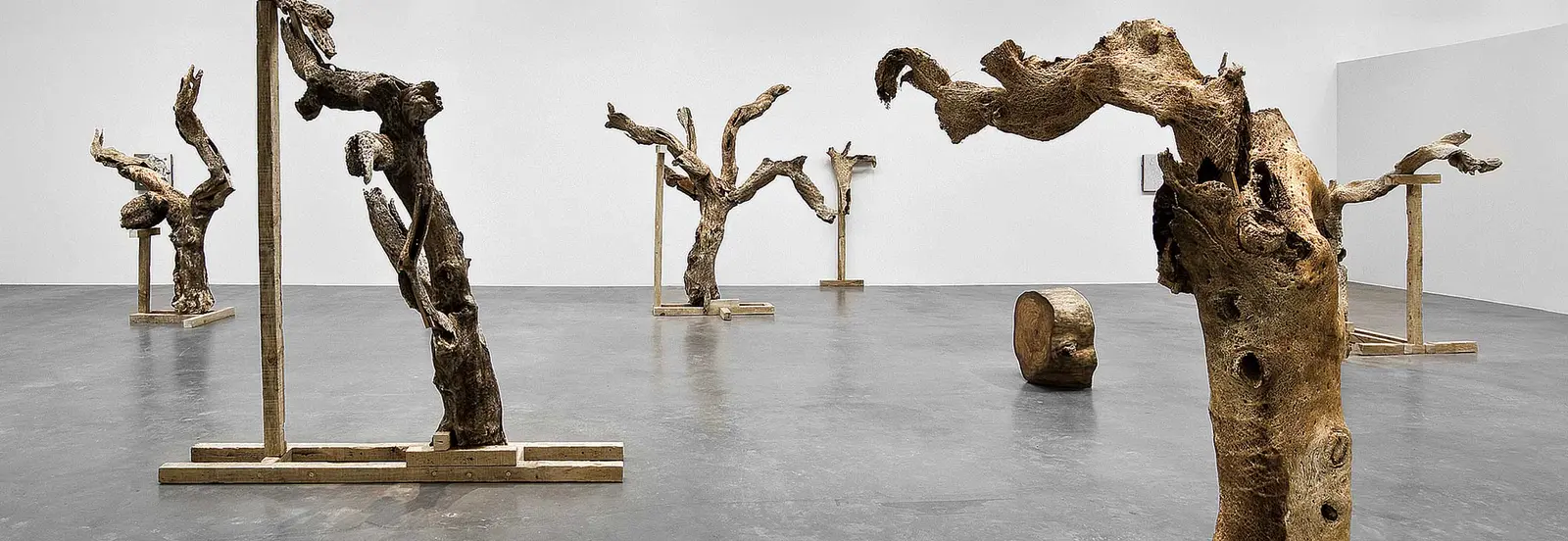
Throughout the years, Orozco’s personal style has evolved into a quest for simple, everyday found elements that are transformed into unique and multidimensional objects that narrate specific moments and that are vessels for his memories.
Many of the aspects of the works created by Orozco at the beginning of this year represent the continuation of previous searches. In general terms, the exhibit is a reconstructed landscape that transports remnants of nature into the gallery; the fibrous skeletons of a dried prickly pear together with a few hearts from the agave plant constitute a withered landscape within an inert environment filled with the same organic elements that appeared in an unvarying manner in Orozco’s previous work. Whether wood, water, sand, clay, or plants, the presence of nature remains a constant in the work of this Mexican artist.
These natural objects were found during trips to the Mexican states of Puebla, San Luis Potosí, Querétaro, and Oaxaca. On his journeys, Orozco collected fibrous skeletons from the dried patches of prickly pears and turned them into a material that when dried look like sponges. Due to the actions of the wind, they also contain small branches and other materials from the area where they were found.
On addressing this aspect of his works, Orozco has defined his artistic endeavor in the following terms: “In these spaces of friction between the countryside and the city, between the organic and the inorganic, between the ‘artificial’ and the ‘natural’, this is where a great part of my work is generated, and it represents what I find in my wanderings.”
His endeavor becomes multidisciplinary the moment the artwork moves beyond what is represented in the exhibition. The few photographs shown in the exhibit, which consists mainly of installations, are testimony of his travels, of the discoveries made in these specific areas, and of the reconstructions elaborated upon by the artist. The installations reproduce the landscape of these places, and their interventions possess a sculptural quality that renders each object as more than a collection of mere remnants.
The smaller sized pieces in the exhibit comprise a pair of hearts from the agave plant – with graphite or gold leaf at their tops – combined with another recurrent element in Orozco’s work: circles and geometrical ellipses, which are also repeated in two planks fashioned with similar materials.
Orozco has been creating these types of works since the Nineties. In them, he resorts to specific geometries, primary colors, and gold leaf. These are pieces that are very representative of his work and that have afforded him recognition from the international art world.
The essayist and curator of contemporary art Francesco Bonami have mentioned Orozco’s influence on the current art world. With regard to this series, Bonami has stated: “The stain and the geometric circle are constituted in the end as symbols of the artist's ability to dislocate his identity, as he filters out the surroundings while maintaining a role within the genealogy of contemporary art.”
Adding to his accomplishment as a participating curator at the 53rd Biennale of Venice, in 2005 – for the section exhibiting – and to his numerous exhibits during the present year at several venues, the Museum of Modern Art in New York will present a vast retrospective of his work. The same will occur at the Kunstmuseum in Basel, Switzerland, at the Centre Pompidou in Paris (in 2010), and at the Tate Modern in London (in 2011).
ISAURA RUIZ