
The visionary optical proposals by Marcel Duchamp embodied in his rotoreliefs during the 1930s paved the way for a new direction for the earlier artistic inquiries by Kazimir Malevich. Such aesthetic preoccupations will find singular answers in works by Víctor Vasarely, Jesús Soto, Julio Le Parc, Jean Tinguely, and Carlos Cruz-Díez – among other kinetic artists – that were created during the mid-1950s through the end of the 1970s. The research associated with the perceptive phenomena generated by contrast, vibration, color, and the inferred or real movement, took the creations by these artists to dimensions unknown at that time in the world of art.
Nevertheless, inquiries related to optic art were not put to rest with the work of these great masters; contrariwise, they comprise an ongoing creative preoccupation to this day. Such inquires are now alternative responses to these earlier discourses. They explore the expressive possibilities of a language that defines – like no other – the art of the Twentieth Century.
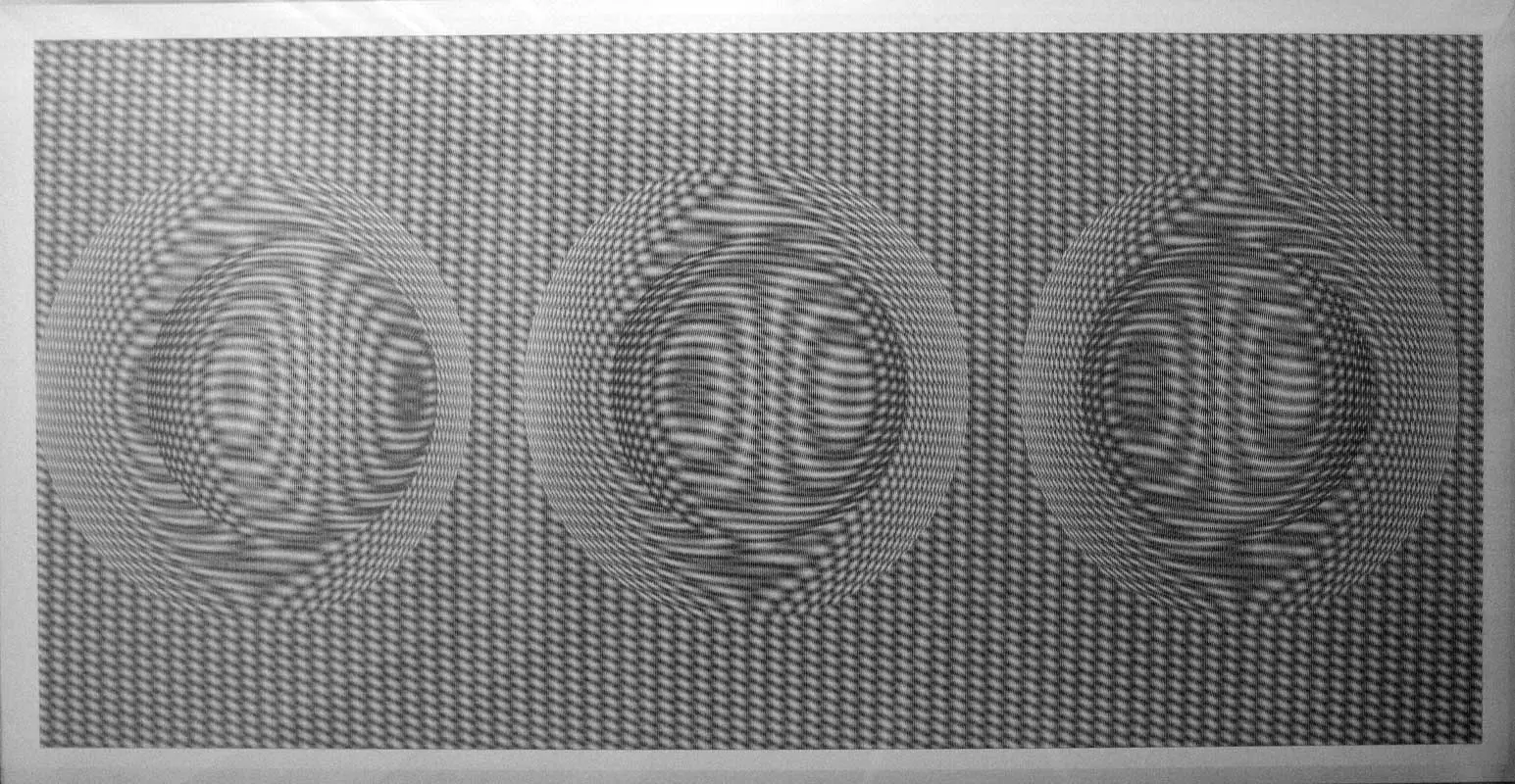
The work by Héctor Ramírez exhibited at the Galería ArtTepuy in Carácas, Venezuela, from April 10 to May 17 follows the same route of these new inquiries. An artist with broad artistic research experience, Ramírez has focused upon the impeccable incorporation of objectual creations into his work, along with certain notions related to contemporary aesthetics, such as the dialectic of appropriation. This type of creative endeavor essentially consists of the construction of new languages that are based on reformulations and reinterpretations of modern discourses. These are proposals that offer to present audiences with other realities within a sociocultural context that is dominated by the visual. In the end, what matters are the results; the power of images as elements for communication, and therefore, their impact on the public. It is more important to perceive the artworks as phenomena than responses to theoretical reflections.
This is the approach by which Ramírez’s compositions adhere to a formal strategy that skillfully combines the experiences of Vasarely and Jesús Soto. They are experiences that represent two “tools” that could be observed as essential to their respective languages, as well as devices that have been thoroughly explored by these two artists: namely, the suggested three-dimensionality that Vasarely achieved in his work through geometric resources, and the phenomenon of vibration that defines Soto’s work and that basically consists of the superimposition of two planes, at once, fashioned with lines and that slightly reject each other.
What differentiates Ramírez’s images from those created by Victor Vasarely and Jesús Soto is his utilization of other rendering techniques, although he does share with them the same perceptive results. The images by Ramírez represent intensely vibrating situations that are restless as forms that are suddenly projected before the spectator and disappear as quickly as they appeared.
In pieces such as Esfera en Giro (Sphere in Rotation) of 2008, the phenomenon of vibration guides and validates optical experimentation. More than merely experiencing three-dimensional forms, the audience is able to appreciate grids that intertwine to structure more complex relationships, until these are transformed into warps in the space that will eventually become floating and elusive volumes.
In other works by Ramírez, such as Esfera Nova (Nova Sphere) and Esfera Geodésica Negra (Black Geodesic Sphere), both done in 2008, the artist’s approach is markedly closer to vasarelian inquiry. The former would appear to be floating between the viewer’s gaze and the subtle installation on the wall of a sphere, a celestial immaterial entity articulated by the contrast established by a white grid superimposed upon a black one. In the second work – very similar to the other one – the relationship is inverted; thus, black becomes the dominant tone of this “palette” that is reduced to the non-colors – a fact that, to a certain extent, conditions perception of the work as it relates to the other pieces in the exhibit. The volume, which is merely perception, has become nearly real before our eyes that canvass a space saturated with immaterial forms.
Esfera de Espacio Continuo (Continuous Space Sphere), 2008 – more prominent visually than the majority of the remaining works in the exhibit – consists of three spherical forms placed in a continuous manner. Here, by rendering the front plane only in white and by superimposing it on a black background of black and white horizontal bands, a visually suggestive vibratory phenomenon is achieved. The spheres appear as autonomous pieces within the group of elements, apparently unattached to the support that “creates” them, so each can vibrate independently in the space. It is, nevertheless, a fleeting moment that can only be calmly appreciated with a still photograph.
FREDDY CARREÑO