Hernan Bas: Works from the Rubell Family Collection at the Brooklyn Museum; Hernan Bas: The Dance of the Machine Gun & other forms of unpopular expression at Lehman Maupin Gallery.
Narcissus, blessed with renowned beauty since birth, was not only punished for his cruel arrogance of denying all those who fell in love with him but he was also—at least in Ovid’s version—stupid. He didn’t recognize he had fallen in love with his own image. Hernan Bas knows that he does not love a faithful reflection but rather his own re-imaging and re-imagining. He remarked he was torn between visual art and writing. He shouldn’t be. They’re the same for him because he rewrites his own history through fiction suffused with reality.
The Rubell Family Collection traveling exhibition contains about 35 paintings and five large video projection pieces that provide a good summary of his strengths and weaknesses. Almost simultaneously a smaller exhibition of paintings on view at the Lehman Maupin Gallery marked some much-needed new directions. The Brooklyn works present the well-known Bas; the world of mostly isolated gay young men cast within both mundane and mythic worlds as dandies whose tone is characterized variously as new romanticism, Victorian reveries, neo-Goth, fantastic, exotic, decadent, etc.
He works in series, like a writer with book chapters that here construct the sections of the exhibition design. What brought him his first critical attention was the untitled, small Slim Fast silhouette paintings of 1999-2000. Typically the three male silhouettes had pencil and ink outlines filled with gestural strokes of different flavors (pastel colors) of Slim-Fast, a brand name weight-reduction supplement. The series is far more skillful in its intuitive understanding of the economy of means than in the several black and white small oil sketch series that will follow.
Bas locates himself within the pedestrian walkways of everyday popular culture but uses its references as symbols of ideas and conditions. In this case, the weight that was removed typifies not only those concerned with how they look but Bas’s social location. According to interviews, Bas was among the cadre of young, skinny pre-pubescent sissy males born at a time when male “beefcake” was the ideal. Then the fashion world of the late 1980s-90s embraced the “waifish” models and “heroin chic.” As Bas said: “Calvin Klein was scrolling images across the TV screen of potential me’s…My body type…suddenly became an object of desire.”
The eight paintings from the series It’s Super Natural, 2001, are typical of his early work. Most are small sketches in a black and white water-based oil on paper, using one or two young males, often shirtless, involved in mysteries and secrets, frequently taken directly from his reading of juvenile literature, such as the teenage middle-class brothers who solve mysteries, The Hardy Boys, but interspersed with relatively polite secret acts of masturbation, kissing and discrete fellatio.
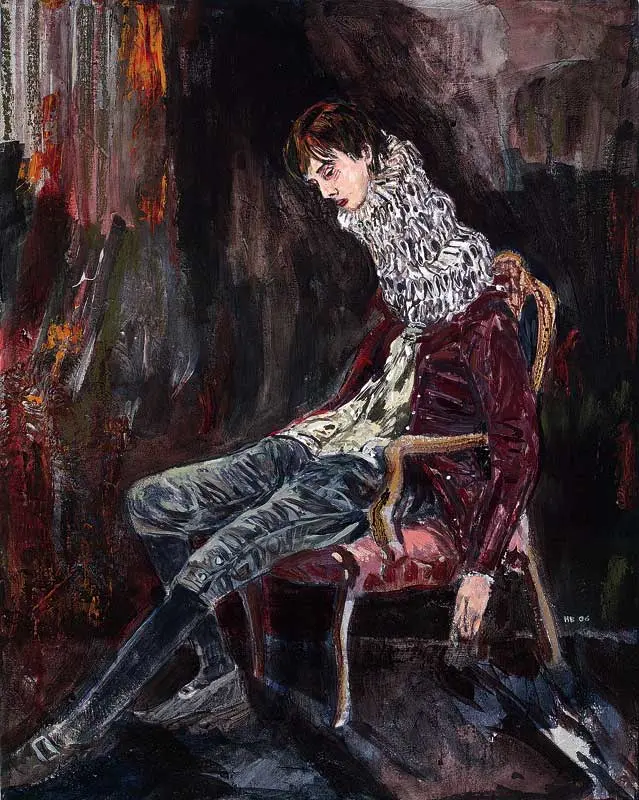
By 2005-6 the paintings from the series Dandies, Pansies, and Prudes are thick, richly colored mythological scenes with neo-expressionist gestural surfaces, as in the acrylic overlaid gouache of The Ribbons After the Party. The lonely young men, here as prudes and dandies, continue their appearance but the emphasis is more diffused. In The Burden (I Shall Leave No Memoirs) an impossibly long-necked young dandy in layers of neck ruffs seated in a chair can be read as existentially forlorn or simply a night of no action, but also brings us into the fold. Bas’s romanticism and the melancholy and nostalgia associated with distant times and culture help negotiate between his somewhat contrived young gay male fetish of life both lived and desired, into a larger sense of yearnings we all share.
The title of the concurrent Lehman Maupin exhibition The Dance of the Machine Gun and other forms of unpopular expression refers to the Italian Futurist Marinetti’s 1917 Manifesto of the Futurist Dance. It aligns Bas’s exuberance with the Futurist celebration of energy and the meaninglessness of “old mythologies” when faced with the dynamism of a new life; to remain mythic and modern. The isolated young men remain but in various new roles, engaged with the world defined by cubo-futurist painted environments. The critique comes only within the series in the largest painting Ubu Roi (The War March), 2009, where Alfred Jarry’s 1896 irrational main theatre character, Ubu, leads a group of dancing followers from town to tunnels. The central character continues the anti-heroism of infantilism that Bas has chosen but now, like Jarry, conjured as burlesque as well as an opinion on the nature of modern humanity where life is inherently a repetition of useless gestures.
Bas’s recent expansion into video, five of which were shown at the Brooklyn Museum, ironically does not yet work as well as the paintings. Ironic because one expects floating fragments of dreams, imaginative narratives, mythological references, and especially odes to the transience of reverie and memory to function more strongly in film/video. But Bas has not yet found himself in this medium. Several collapses into blind narcissism with little ability to communicate even at the forgivable level of the poetic. However, they are stronger when combined with installed objects, which, under the influence of growing up in a Latin family surrounded by “little shrines of saints” and “earthly possessions” provide historical energy lacking in the videos.
The grandest was the five-screen projection of Ocean’s Symphony (Dirge for the Fiji Mermaid), 2007. The weaker video component of mermaids and bubbling blue waters are offset by the soundtracks and the objects, which include a mockup of the Fiji Mermaid and its storyline. The mythical mermaid has been a collectible component of “natural” history known as “cabinets of curiosities” for several hundred years but popularized under this name by the mid-19th Century US impresario P.T. Barnum. The torso he displayed was actually the body and head of a monkey combined with a fish and its legacy survives in sideshows and carnivals as unnatural naturalism. Surrounded here by old apothecary bottles, megaphones, lobster traps and assorted paraphernalia from the 19th C. Bas’s installation rises to the level of a curiosity in its own right; not un- or super-naturalism but curiosity for that which cannot exist and is now wished into existence. After all, it was not vanity that killed Narcissus but life lived according to images he could not understand but desired.
*My thanks to Marcus Romero, Associate Publicist, at the Brooklyn Museum for his help and generosity.
RICHARD LESLIE