The decision of the members of the International Jury for the Certamen Iberoamericano de diseño de la escultura monumental conmemorativa del quinto centenario del descubrimiento de América: Encuentro de dos mundos, was announced in San Juan de Puerto Rico in September 1991. An 18-year perspective allows assessing with greater rigor their critical and historical acumen. It gave the competition’s top honor to the project presented by Puerto Rican architect and ceramicist Jaime Suárez, above all local and international invited participants.1 The decision had been made under the wise and distinguished guidance of Damián Bayón, the dearly remembered art historian and critic from Argentina. The Tótem Telúrico, a reinforced-concrete column, 12m in width, and 1.2m in height, entirely covered with ceramic reliefs (its 2.5-meter base is made of black granite) was to preside over a privileged space reserved for the future Quincentennial Square2.
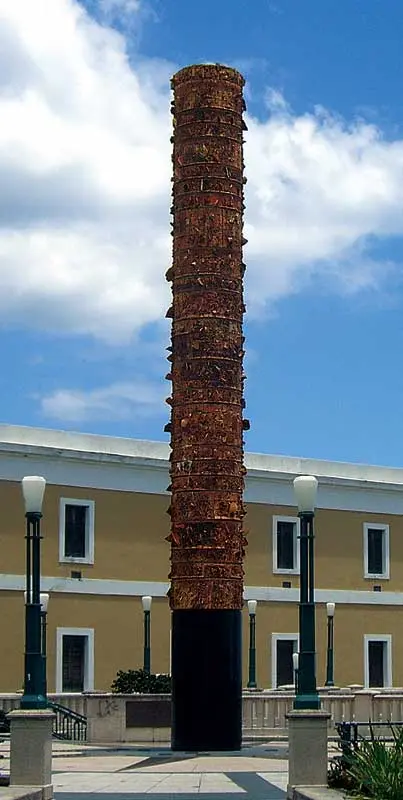
This space, opening to the North and facing the Atlantic Ocean, was to include complementary sculptures, grand staircases, and fountains at different levels of the square. This recognition of ceramics as an artistic medium for use in a large-scale public monument elevated clay to the status of noble material, next to stone, marble, and bronze, and normalized its use in monumental sculpture. It was a personal landmark of great importance for Jaime Suárez, who had set that goal for himself two decades before: his work in painting, sculpture, and large architectural murals was entirely in clay.
There was a shift in the historical focus of the events celebrated at Quincentennial Square; it subsumed the concept of a Spanish Conquest of the New World into one of an encounter between two cultures: the Spanish/European and the Indigenous/American. In the descriptive memory and justification of the prize-winning monument, Suárez commented: “A ceramic column-totem rises like a monument to the clay and earth of the Americas, which in its vowels and in fragments holds the secrets of who we are. Like Trajan’s Column, it tells us its story.”3 This is how Suárez baptized his monumental clay column designed to commemorate the birth of Iberian America; with these words, he acknowledged the millenary tradition of the Roman column with storied reliefs, which begat the commemorative aspect of his; at the same time, he proclaimed his newly minted concept of the non-figurative ceramic relief, which even incorporated fragments of pre-Columbian clay vases, boasting an archaeological past as testimony of the indigenous cultures of the Americas. At a personal level, the Tótem Telúrico encloses great aesthetic and conceptual significance, elaborated by the artist throughout two decades: a monument that marks an exceptional triumph for the architect turned ceramicist.
Jaime Suárez received his Architecture degree from the Catholic University of America, in Washington, D.C, in 1969, and the following year he added a Master’s Degree in Design from Columbia University to his academic resume. During his last year in school and after returning to Puerto Rico, he had taken two ceramics classes, the second one at Universidad de Puerto Rico, a decision that revealed already the interest that would drive him to radically alter the course of his career as an artist. Since 1970 he began collaborating with his mother, Maribel Toro, in research works on Clay’s aesthetic and formal potential. He had no interest in what was to be found in Puerto Rico in terms of artistic ceramics, pre-fab, mold-based works decorated in various ways. Suárez and Toro founded, in 1972, Estudio Caparra, characterized by its mission to experiment with clay, which is a short time brought its products to the competitive and commercial level of painting and sculpture. By 1977, the ceramicists were sending their works to the 1st Muestra Nacional de Pintura y Escultura, sponsored by the Instituto de Cultura Puertorriqueña. At that time, there were many prejudices against the use of new genres, materials, and techniques in the creation of objects considered artistic, and they were particularly strong against ceramics among the ignorant and those stuck with theories of art that had been obsolete since the early days of the last century. Ceramics topped the list of these theoretical aberrations—found in Puerto Rico, Latin America, and the United States—because it was considered a handicraft with strictly functional or decorative/folkloric purposes. It goes without saying that such prejudices clashed with the liberal visual-arts canons of the Twentieth Century.
The struggle to bring down the walls of this unsustainable categorization was underway on the island since the 1970s, led by a group of collaborators who, like Suárez, represented the guild of artists committed to raising ceramics to the status of a “noble” art. In 1973, members of Estudio Caparra triumphed at the 3rd Annual Exhibition of the Asociación de Cerámica Artística de Puerto Rico, at the Instituto de Cultura Puertorriqueña. Suárez won the event’s overall first prize for a hand-made full-body sculpture, Sylvia-Raku, that represented then-popular celebrity Sylvia del Villar, and another first prize in the wheel category for a vase in the shape of a primitive jar. These were the first in the long catalog of honors and awards that were to follow, at the national and international levels, in subsequent years.
The Estudio Caparra Gallery opened in August of 1975; two years later, after moving to the Puerto Rico Convention center, it changed its name to Galería Manos. The name change identified a growing group of Masters of artistic ceramics engaged in a collective effort that integrated them into the cultural network of galleries and the contemporary art market. Despite the embrace it received, Galería Manos was to last only three years because of the weight that operating it imposed on the collective. Four of its main artists decided to found Casa Candina, which was a gallery, workshop, and school. Soon, Casa Candina became a meeting place for art lovers from all corners of life. Susana Espinosa and her husband Bernardo Hogan, Toni Hambleton, and Jaime were the founding quartets of Candina, as it was known through the years.4 Casa Candina was founded on what had already been a dynamic of experimentation and work shared in an always professional and generous manner among all its members. Jaime Suárez has always been an artist with the vocation of teacher, open of hand and mind, and he has a long teaching career in the ceramics workshop and in the country’s architecture schools —at the Universidad de Puerto Rico and the Universidad Politécnica de Puerto Rico, where he continues to work as a professor of Design.
The 1970s, as Suárez expanded his discipline and his mastery of the craft in order to make concrete his rebellious and revolutionary creations, also saw achievements and advances by several other ceramicists. This contributed to making possible a special exhibition at the Museum of Fine Arts in Springfield, Massachusetts (June 1980), titled Sculpture in Clay from Puerto Rico. The affirmation of ceramics as a non-artisanal art on the island is taken to the US, where the legitimacy of the ceramics invasion of the sacred circle of art with a capital A. The title, Sculpture in Clay from Puerto Rico rather than Ceramic Art from Puerto Rico, signaled that there remained barriers to overcome before a Tótem Telúrico achieved recognition in equality of aesthetic and commemorative conditions with the fine arts established through the Nineteenth Century. The year after that national exhibition, Jaime Suárez was given a targa at the Concorso Internazionale della ceramica d’Arte in Faenza, Italy. His Vasija Alada, which won him that honor at the famous competition, at the time a Mecca for ceramicists, made him a member of the select seven-member group of Manos artists who received similar distinctions before and after him.
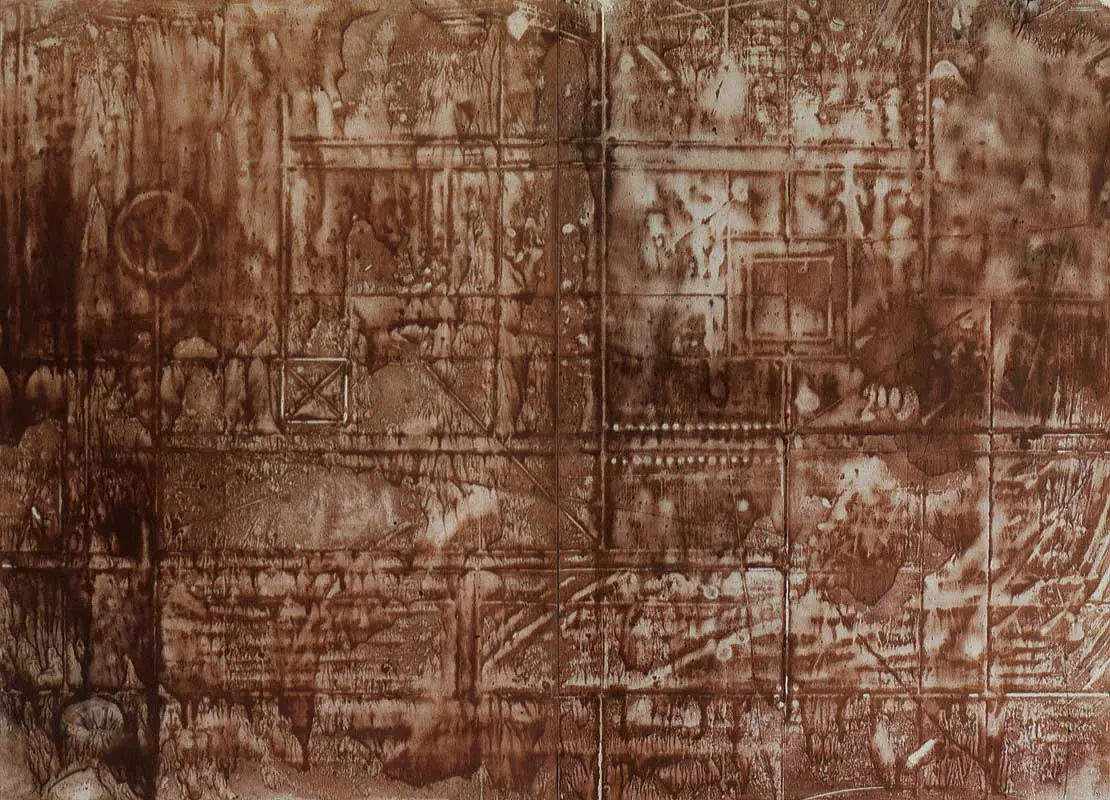
The year 1976 saw the irruption of one of Puerto Rican art’s most original contributions: the barrografías (exhibition at Galería Santiago, in the month of May). This is how Rodrigo Gutiérrez Viñuales, historian of Latin American art, referred to the happy accident that served as the cornerstone for Jaime Suárez’s future work.5 The discovery of this accident resulted from observing the red clay imprint left on a sheet of paper placed on a clay surface, part of the common ceramic-arts technique of encrusting white clay on the surface and pressing down with a roller. The novelty of Suárez’s discovery made possible an inexhaustible range of technical approaches and a plurality of artistic expressions throughout his career, all the way to the present.
De las ciudades perdidas, 1990, illustrates the print effect that characterizes them, close to the traditional monotype technique. These are exhibited framed or as lighter-weight works elaborated into constructions or installations. Their appearance, which is infinitely variable, reminds us in its basic shape of a palimpsest — a codex or papyrus document that has been scratched to write again — that in this case acknowledges clay as its foundation and accepts the tracings, marks, and lines the artist imprints as its last text, perhaps a mano a mano between artist and medium.
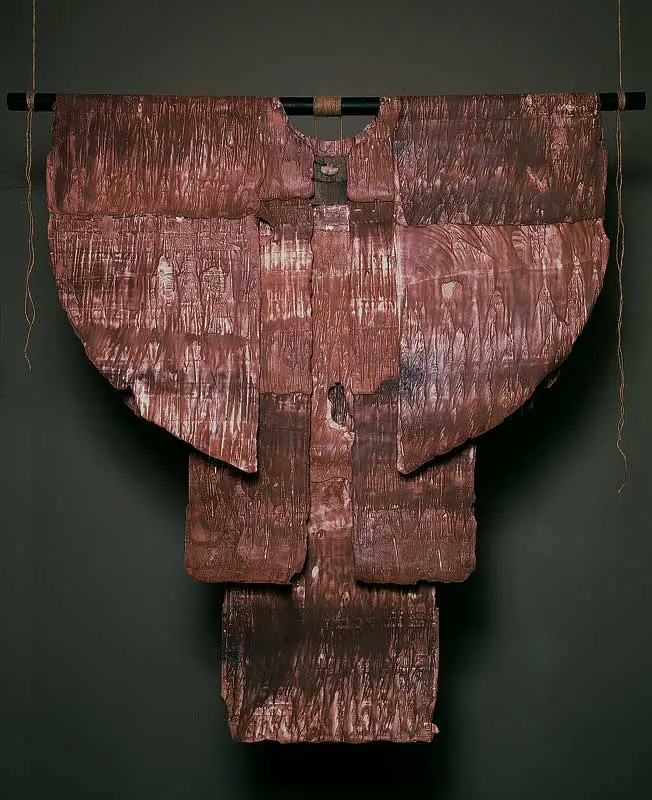
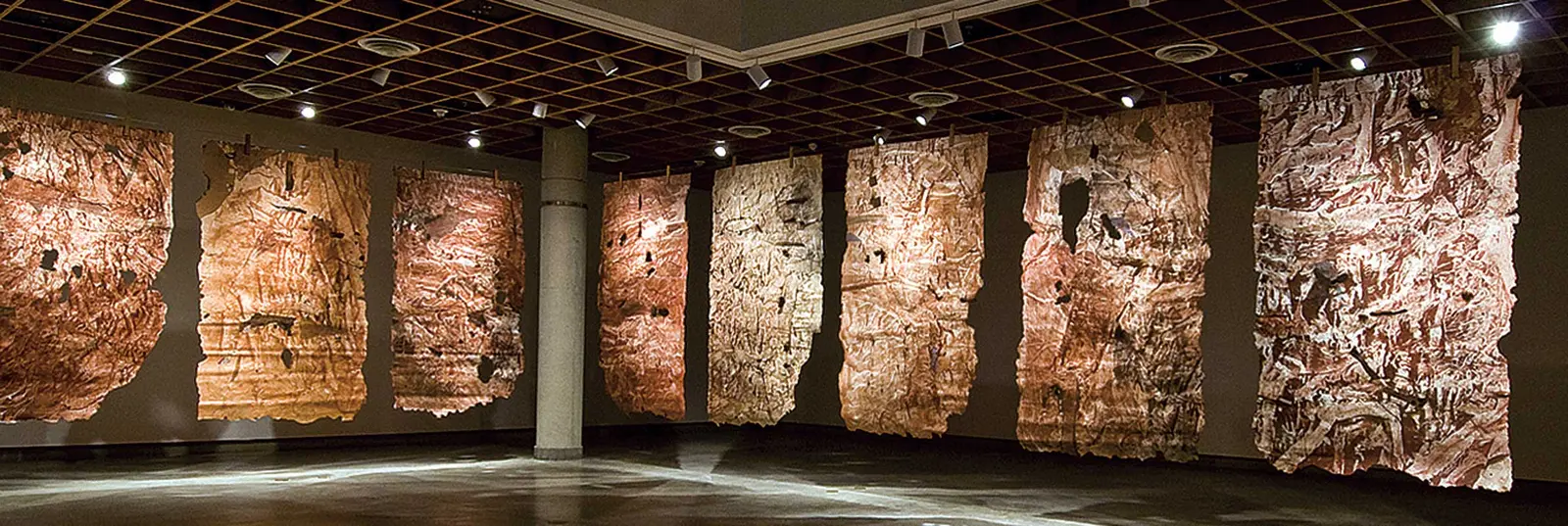
The barrografía would become the essential unit for works that function as sculptures, vestments, and shields. Their horizontal accumulation results in a sculptural object, suggestive of ancient folios or documents from a remote past, archeological in origin. By using large-size papers, the barrografía is able to approach the reality of a textile work, with which it is possible to create fabulous hanging works like Vestimenta de Tierra y tiempo, 1986, or impressive shields, used to create installations like Galería de las Tierras, 2004, both spectacular in the scenic presence.6 The hanging works in paper imprinted with clay, and the vestments, are part of the series of works grouped under a theme that the artist calls the ritual, which includes tables, walls, and vases. These works were the central topic of his individual exhibition at the Museo de Arte de Bogotá in 1987, later moved to CDS gallery, in New York, in 1988. These were Suárez’s first two individual shows outside Puerto Rico. Galería de las Tierras, installed last year at the Museo de Arte de Puerto Rico, was originally created for the Kennedy Center for The Arts, in Washington, D.C., as part of the Americartes: Espíritu de Puerto Rico festival. These shields, developed after the barrografías that were limited to using clay as a printing material, use liquid clay mixed with polymer as gouache on paper. From there emerges their aspect of landscape or map, eroded at a large scale.
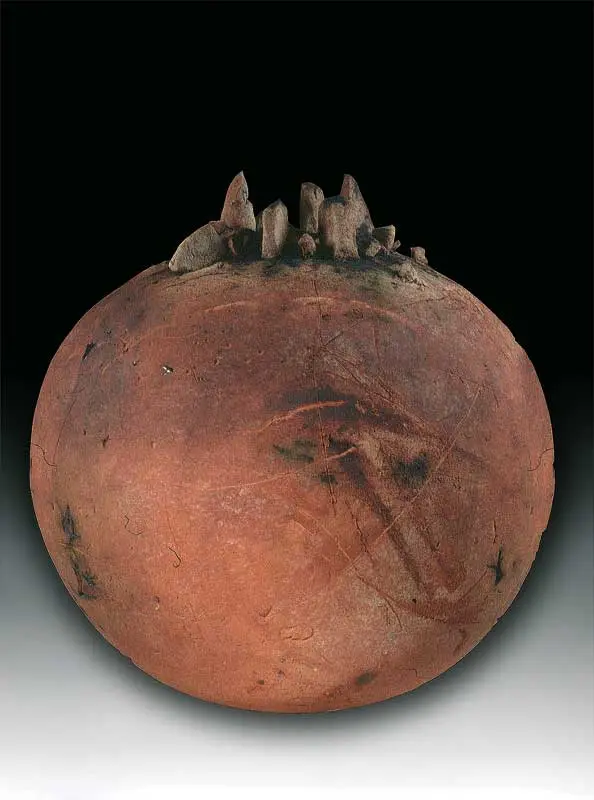
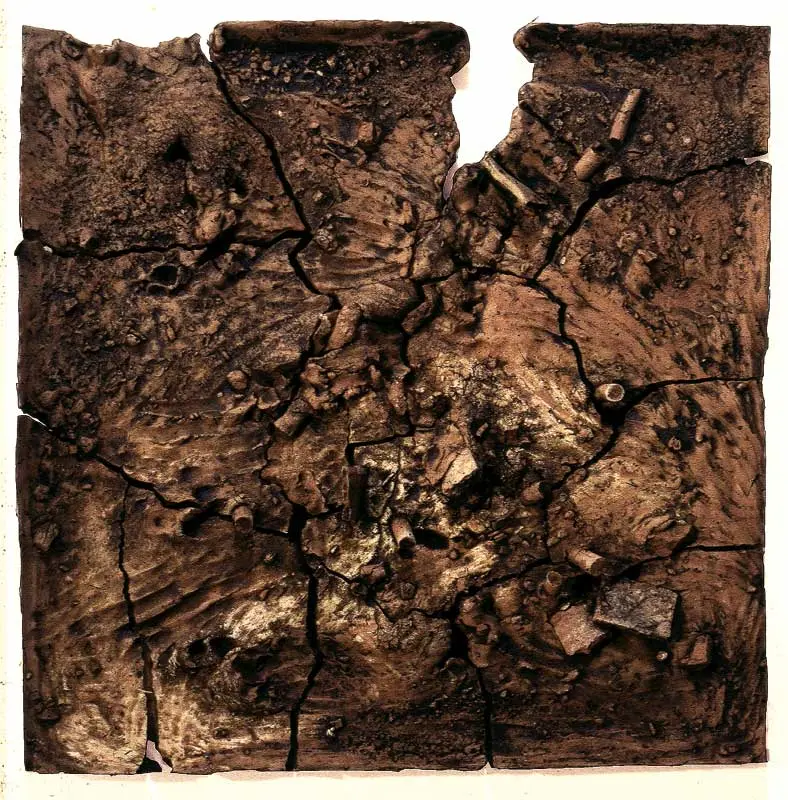
Another creative accident — the inclemency of weather ad the elements, the rain and sun that modify the appearance and the texture of what had been left out in the open in a yard next to the workshop — suggested other expressive modes of wearing and weathering that the artist provoked using vinegar and oxides to achieve texture and color effects. The metaphor of an archaeological reference that emerged from the clay thus distressed and manipulated in the present time by the artist’s hand reasserted the dialectic of destruction/construction in Suárez’s work. Topografía interior, 1989, and De tierra y tiempo: vasija, 2000, exemplify in a singular way the possibilities of these new expressive textures. According to Suárez, such inner topographies are works that vehemently comment on the erosion and devastation of the landscape, a recurring topic in his oeuvre. His extensive series of inner topographies, inspired on the similarly titled poem by the illustrious Puerto Rican poet Luis Palés Matos, include cracked wall-mounted plaques and vases with intervened surfaces. De tierra y tiempo: vasija is a forceful reaffirmation of the vase genre, which is central to Suárez anthological visual repertoire. It represents a connection with ceramic arts’ millenarian traditions and techniques, which he refuses to discard and which place us at the liminal border between art and craft.
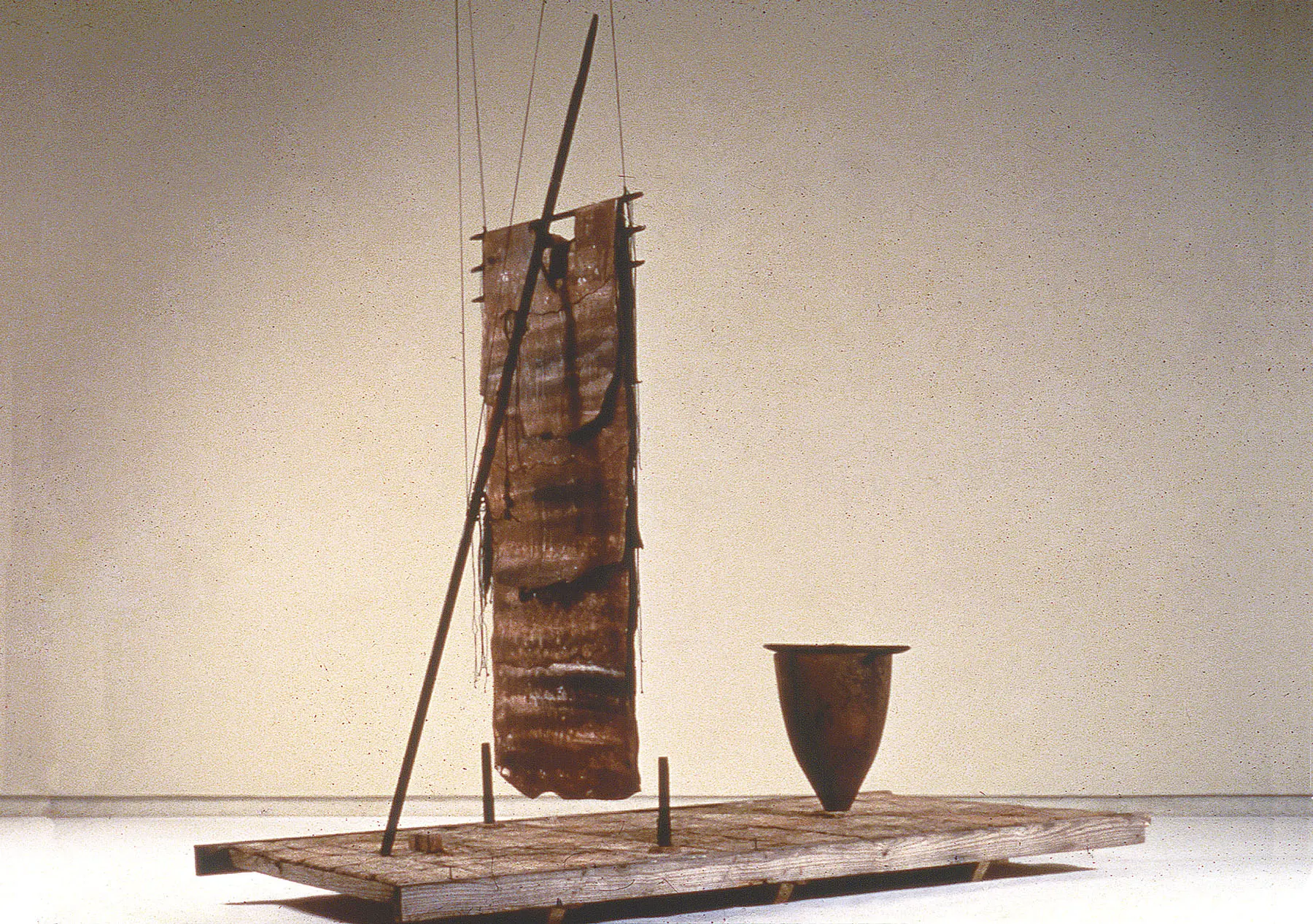
One work with a brilliant synoptic nature regarding Suárez’s multifaceted oeuvre is De lo ritual, 1986. It was created for the exhibition Encuentro de ceramistas contemporáneos de América Latina at the Museo de Ponce, and it later traveled to several museums in the United States, Mexico, Colombia, Venezuela, Brazil, and Argentina. The installation brilliantly synthesizes Suárez’s ideas and techniques. A horizontal surface eroded by the effects of water and vinegar, a vase intervened on its surface, a hanging of fire-charred barrografías, and the use of found materials, are integrated visually and conceptually into a unique whole. A fusion of boat and ceremonial table or ritual altarpiece, it evokes a magical, ancestral time when Man has disappeared and only the presence of his objects bear witness to his fleeting passage on Earth.
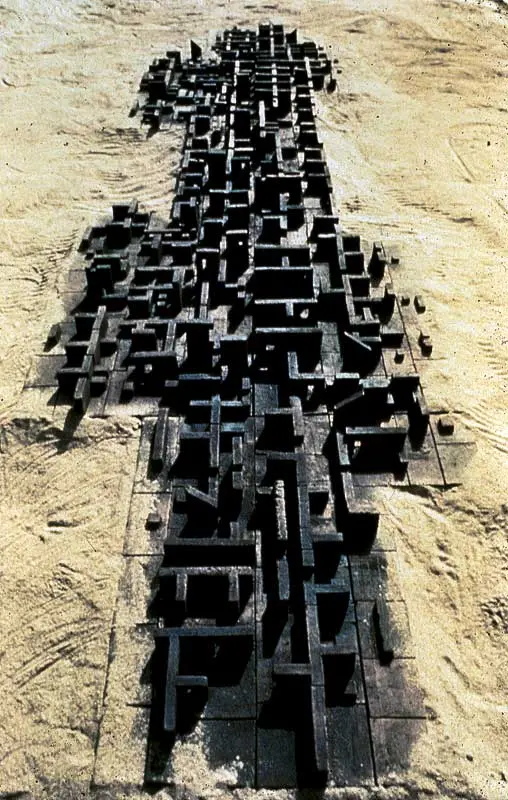
Laberinto de tierra y tiempo (1987), which was included in the Puerto Rican delegation to the 19th São Paulo Biennial, is “… (Jaime Suárez’s) first horizontal installation, where the work in clay is surrounded by sand in a horizontal/island format,” according to the Puerto Rico show curator, Doreen Colón Camacho.7 There, the theme or the archaeological remains is built up by the artists through the simulation of the architectural model for a real city. It is a three-dimensional trope of remembrances of ancestral cities, such as Tikal, a ruin in the Guatemalan region of Petén, a center of Mayan culture (300-950 b.c.) that Suárez had visited in his journeys to archaeological sites
The two visual discourses brandished in De lo ritual and Laberinto de tierra y tiempo are exceptional extended metaphors: the former is an elegiac configuration of magical symbols and the latter works as an evocation of the passage of time and its inexorable destructive nature. These are the vast conceptual parameters of Jaime Suárez’s work.
While an architecture student at the Catholic University, Jaime Suárez attended a conference given by the great architect Louis Kahn, who, in a greatly theatrical moment, grabbed a brick and hit the podium with it, asking it what it wanted to be. In this way, Kahn explained the beginning of one of his great projects, the city of Daka, in India. It was around this time that Suárez first read Gaudí’s famous aphorism: "originality consists in returning to the origin." Kahn’s question and Gaudí’s statement became the intellectual compass for future ceramicists. As an answer to the question of what clay wanted to be, his quest would drive him to formulate the idea that his interest lay in the transparency of clay rather than its opacity. This posture helped him return to the millennial origins of the use of a material that served humanity to create its earliest tools and build its oldest walls and cities.
The felicitous metaphor of the transparency of clay, at first sight, a complete absurdity, was the title and main topic of Doris Shadbolt’s master conference at the 4th International Ceramics Symposium in Toronto, Canada, on October 17th, 1985, which Suárez attended.8 The date of the event coincided with a critical moment in the debates then taking place in the US, Canada, and naturally Puerto Rico, around the idea of accepting clay, like any other material — marble, bronze, wood — as a vehicle for aesthetic ideas or concepts that went beyond its established artisanal domain.
In Shadbolt’s mind, there was no doubt that clay was “…another medium through which the perception of reality, or any insinuation of our being part of the universe, can flow…and thus become transparent.” The paragraph I am quoting ends by warning us that by finding that transparency in clay “…where something flows through the material, or where forms tell us something (we reach) the condition of all vital art.”
The maxim contained in these thoughts is also one of the main postulates in one of the books read and respected by Suárez during his architecture studies: The Book of Tea, by Okakura Kakuzo.9 “It is true that, if we cultivate it, our sense of art appreciation widens and we become capable of enjoying many expressions of beauty that up to that point we did not recognize” is one of the many quotations that could illustrate the aesthetic and critical affinity between Shadbolt’s, Kakuzo’s, and Suárez’s thinking. And if we add to these revelations — made in long generous conversations with me — the fact of his attachment to a more recent book, Wabi-Sabi, for Artists, Designers, Poets, and Philosophers, by Leonard Koren,10 then we understand some of the paths followed by Suárez’s innermost thoughts
It has been said that his art is characterized by being rustic, that it shares aspects of primitive art; this is to say, with objects that are telluric, simple, non-pretentious, made of natural materials. Crude as my references or textual citations might be, I think they explain Suárez’s fascination with that philosophy/aesthetic as he, let’s say it in passing, is intimately involved with the Tea Ritual and its history, from the objects needed for it, including the origins of Raku, and the architecture of the place where it is held.
All of the above brings us back to Tótem Telúrico
Some of the monument’s earliest admirers were the workers who labored with Suárez in the construction of the square, a process that was interrupted with a certain frequency by the archeological finds in the excavation nearby for an underground parking garage. Although humble in historical importance, every piece of pottery was removed by the authorities. When the column was about to be installed and the workers contemplated the results proudly, there began to appear small ceramic pieces that had been stowed away surreptitiously. Suárez thanked them for the gesture and immortalized them by including those pieces alongside others by his Casa Candina associates, Susana, Toni, and Bernardo, and by himself, in the column’s highest rings. The archaeology of the pre-Columbian world was fused to that generated in the present. The artist joined the archaeology of the remote past to that created in the present in a real and mythical symbiosis.
Although he is no longer with us, rereading Roberto Guevara’s eloquent words we can feel his presence in the incisive lucidity of his observations. “Jaime Suárez has been among the most convincing creators by proposing work in sculpture and ceramics that is, in essence, a form of personal archaeology of the land…but this affiliation with the origins possesses the lucidity of the Age of Reason and the Age of Doubt; it reminds us that under our feet there is an unending story that also describes us.” This is what the then National Director of the Museo de Venezuela, in Caracas, wrote in 1990 for the catalog of an individual Jaime Suárez exhibition at Casa Candina.11 Written before the Tótem was built, these words are valid as a definition of Suárez’s entire oeuvre. Yet, it is important to note that since the start of a new millennium and through the present date, two new genres have invaded the spaces and silences of clay: the use of collage and of concrete as a construction material.
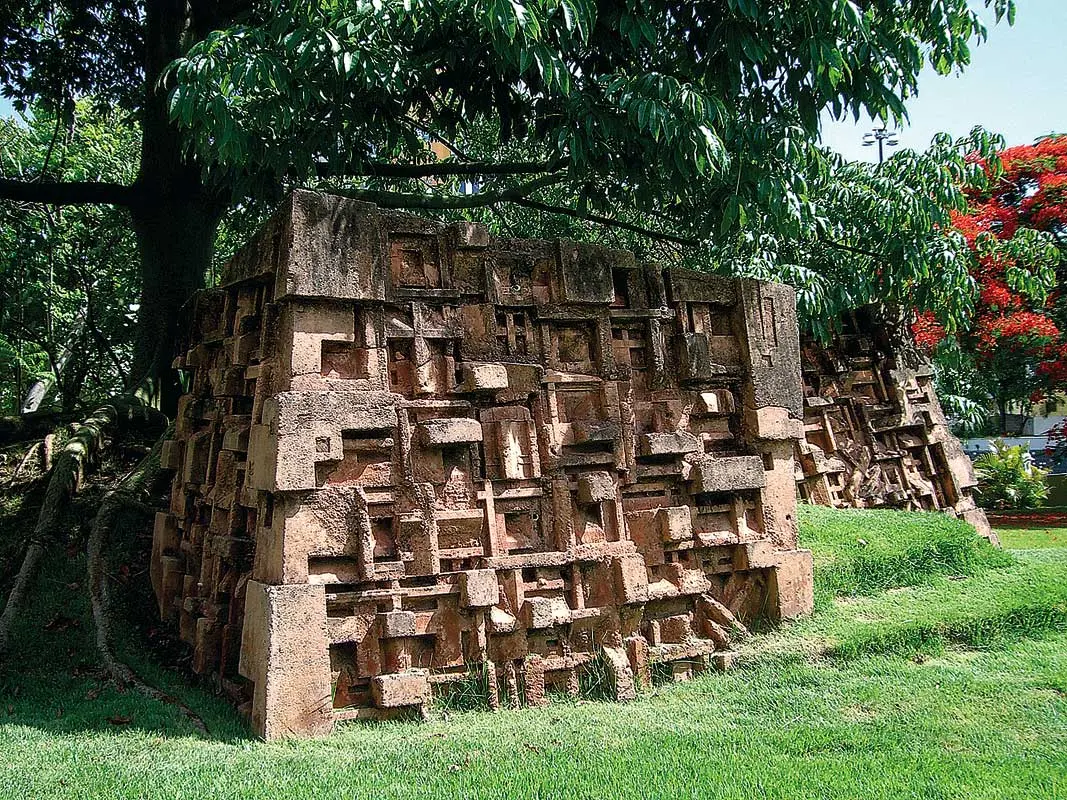
The Sculpture Garden at the Museo de Arte de Puerto Rico includes …de los muros derruidos (2000), a work by Suárez comprised of two 2.5-meter high modules in pigmented concrete. They respond to interest on the part of the architect/ceramicist to explore another everyday material. The series has expanded and includes sculpture groups at the Universidad de Puerto Rico’s sites in Bayamón (2006) and Cayey (2007), and in Paseo del Río in the city of Caguas (2007). Visually, they propose built/unbuilt remnants of hole-relief in concrete that simulate a contemporary archaeological ruin. If it seems I am writing in curlicues of words and concepts, it is true, because this is the only way to be faithful to the inversions of constructive material (concrete for clay) with their equivocal references to time and place and in its paradoxical historical sense of archaeological pieces made in the present by an artist. Paisaje estratificado (2006) is a good example of a collage made on wood with pieces of barrografías and common paper. Organized vertically in most cases, the composition evokes an underground or archaeological stratification the topic of the landscape and of archaeology, present in its diverse incarnations, is embodied as a mosaic in the shape of fragments of his own barrografías alongside other paper fragments. The results are infinitely variable and offer an aesthetically persuasive parietal object.
Among the anecdotes shared by Suárez as I interviewed him, one seemed as extraordinary as revealing of the kind of dialog that his work requires from the viewer. Again, it was a conversation, similar to the one he had with the workers building Plaza del V Centenario, where they confessed their identification with the column. This time it was a waiter who stayed with Suárez in the exhibition gallery at the Museo de Arte Moderno in Bogotá, Colombia, after the opening night cocktails of his 1987 show De lo ritual. “Sir, faced with your work one feels a very deep silence,” the young man said to the surprised and rather pleased artist.12 The best of all art critics could not have chosen a better compliment. This spiritual and aesthetic perception and appreciation that simple people expressed in their intuitive and deeply felt words revealed that the transparency of clay sought by Jaime Suárez had been found. His ceramics are myth and reality that speak to us in silences and intervals of centuries and millennia, and also in the immediate present.
NOTES
1. Ted Carrasco (Bolivia); Patricia del Canto Vargas (Chile); Álvaro Diego Gómez (Colombia); Rolando López Dirube (Puerto Rico); Víctor Ochoa (Spain); and José Ramón Rotelline (República Dominicana), were among the participants.
2.) The Ballajá Fort, a homonym of the neighborhood where it lies, Cuartel de Infantería, 1874, with a rectangular plan (7,716 meters), with one of the most beautiful interior courtyards built by the Spanish government in the island of San Juan (2,422 meters), is located to the west of Plaza del V Centenario, as is the Casa de Beneficencia, today the Instituto de Cultura Puertorriqueña. To the east lies the Dominican convent (Sixteenth Century), and to the south, the Bishop’s palace. It is, thus, Old San Juan’s most monumentally significant area. To the north, as we said, lie the sea and the promontory.
3. Descriptive memory submitted by the artist.
4. Susana Espinosa had been a student at the Academia Nacional de Bellas Artes in Buenos Aires and had an excellent mastery of draftsmanship; she had worked in ceramics for years before the foundation of Casa Candina. Her fable-like work in painting and sculpture is especially notable. Bernardo Hogan is known for his wheel-made vases and other techniques as his preferred genre; he is a student of clays and enamels unparalleled in Puerto Rican ceramic arts. And Toni Hambleton, a disciple of Jaime Suárez’s, has distinguished herself with her sculptural ceramics of an architectural bent. Aileen Castañeda, a disciple of Bernardo Hogan, joined the group later.
5. See Rodrigo Gutiérrez Viñuales (Director), Arte latinoamericano del siglo XX. Otras historias de la HIstoria, Prensa Universitaria de Zaragoza, 1ra Edición, 2005. His essay "Barro y conmemoración en Puerto Rico, el Totem Telúrico de Jaime Suárez" 167—189; p. 168. This excellent essay written by a titular professor in the Art History Department at the Universidad de Granada, Spain, is a rich study of the artist and of Puerto Rican ceramic arts and includes an extensive bibliography about Suárez’s life and work.
6. The nature of this article impedes us from including much about Suárez’s work as a stage designer for the theater and the ballet, or his other incursions in large scale muralism (i.e. Topografía Interior, 1992, at the Seville Expo). This documentation and study will come out soon in a monograph on the artist.
7. Catalog for the show.
8. Conference by Doris Shadbolt, The Transperency of Clay, 4th International Ceramics Symposium, Canada, Keynote address by Doris Shadbolt, October 17th, 1985. The document is in the artist’s possession.
9. The quotes are translated from El libro del té, traducción de Esteve Serra; Los pequeños libros de la sabiduría, 2000.
10. Stone Bridge Press, Berkeley, California, 1994.
11. Catalog for exhibition, cited in the text.
12. Both anecdotes were related by Jaime Suárez in interviews for this article.
ENRIQUE GARCÍA GUTIÉRREZ
History of Art Professor and Member of AICA.