
New York’s Guggenheim Museum has launched a new series of individual exhibitions titled Intervalos and devoted to the newest production. Taking the Museum itself as her workspace, Julieta Aranda inaugurates the progression. Two converging lines emerge from an analysis of the artist’s work and the Guggenheim’s program. On the one hand, a drive to mark the speed of time and the element of the physical in the placement of a work of art. On the other, an acknowledgment of the fact that spaces and costs demand a dynamic rethinking of art projects and the uses of the environment. Both observations have an indisputable global character. Artists of the youngest generation share non-traditional temporal experiences. To intervene and leave, to possess the gift of ubiquity through electronics, to live “plugged in” —with the reading of the cable to the sound-reproduction device like an oxygen line, in some cases replaced by a drug-dispensing IV, or perhaps the medicine of the second HIV generation. If these artists are “connected”, many of their works seem not to be, although they are but in a different way. Rupture and isolation come through as unconnected events and phrases. At the center of all this, one needs to take into account that temporality is no longer thought of as linear.
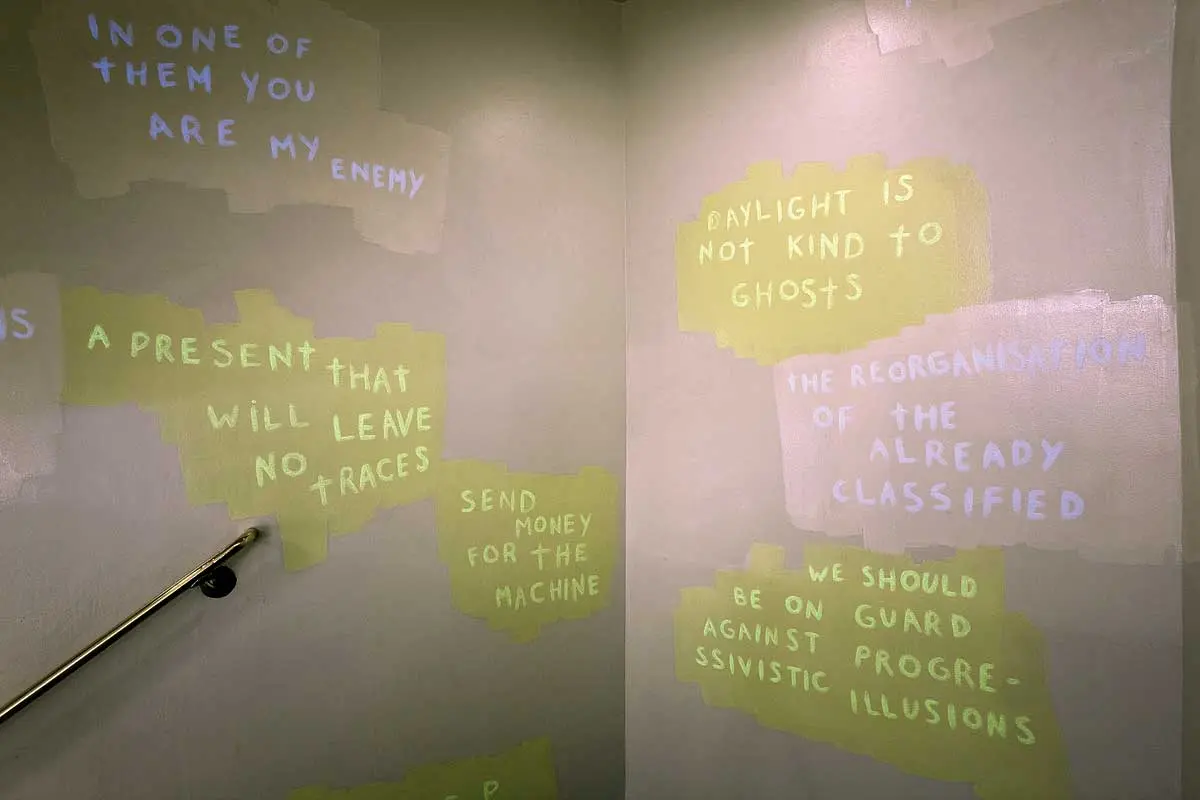
Julieta Aranda (Mexico City, 1975) inaugurates this series with ten nano-interventions in the museum. The artist outlines a triangular architectural zone inside the institution, a conducive communication zone: the interior staircase. At different levels, there are references to time, to life, to the history of art and photography. The artist uses texts, a wall clock, and other elements. The experience happens on more than one floor, and part of it goes by unnoticed and is expressed through isolated elements, unattached to any exhibits, especially in an institution that is as contemporary as it is formal.
Walking inside the Guggenheim, some go up the ramp and some choose to take the elevator and descend from the top. Aranda’s show became even more invisible as the Museum was holding its anniversary exhibition; invisible and surprising, approaching time in the opposite way than the celebratory event. Katherine Brinson, the assistant curator at the Guggenheim, was in charge of the work on this occasion.
Our first encounter with Aranda’s interventions is a large-sized wall clock, its quadrant altered to divide the day into 10 hours. The already mentioned alteration of time into non-linearity is accompanied by other modifications: one historical and one organic. The former reminds us of the old French Revolution scheme to use the decimal module to divide time: a day would contain 10 hours; each hour, 100 minutes; each minute, 100 seconds. This short-lived plan reappears in one of the clock’s hands, while the other registers Aranda’s heartbeats in the course of a day. Located on the wall, an audio device allows us to hear the sounds of a human heart.
Aranda belongs to a generation known as Millennial, or the Me/I Generation. Each subject is inserted in the world on an individual basis, as well as globally. One floor down, tiny perforation on the wall revealed an hourglass. Using an inversion of the camera obscura the grains of sand moved in the inverted direction, up. (For an association, let’s remember Joaquín Torres García’s inversion of the map of Latin America). The small sections of the wall located in the area around the staircase, which connects with the building’s central area and wraps the column that encases the elevator, presented certain anomalies. Something seemed to have been scratched, not repainted after the previous exhibition, or perhaps someone had made a graffiti and it had been covered on the fly. Investigating into a 2000 year history, Aranda left some of her references noted on the wall. With attention and patience, as the area’s lights were intermittently dimmed, we were able to read some quotations referring to the time that the artist had written in phosphorescent paint. The degree of stability in the installation is sensitive to the degree of instability in contemporary life.
GRACIELA KARTOFEL