
The exhibition currently at Marlborough Gallery of Julio Larraz’s works is a comprehensive reunion of themes familiar to his oeuvre: Landscapes by the sea, Mediterranean islands, and the half-hidden figures that own and inhabit them.
What continues to draw most interest in the development of his work is a series of precise depictions of contemporary power structures and the mechanics around the people that inhabit them. Some of these paintings carry a lot more intelligent criticism and information about our world than can be found spending days watching newscasters and media. It is in both cases, the negative or unseen space that counts, for while important information is now cleverly hidden behind an elaborate camouflage of pseudo-events in the news, in Larraz’s pictures the important subject is off the canvas and we only see traces of its presence in sharp detail.
The world that Julio Larraz is observing with such insightful painterly delight is one that has its own mysteries and veiled relationships, but that nevertheless does not disappoint the observer, for there he will find the keys to the behavior of the power-seekers and the power holders as well as the infinite variety of creatures that rotate in their habitat.
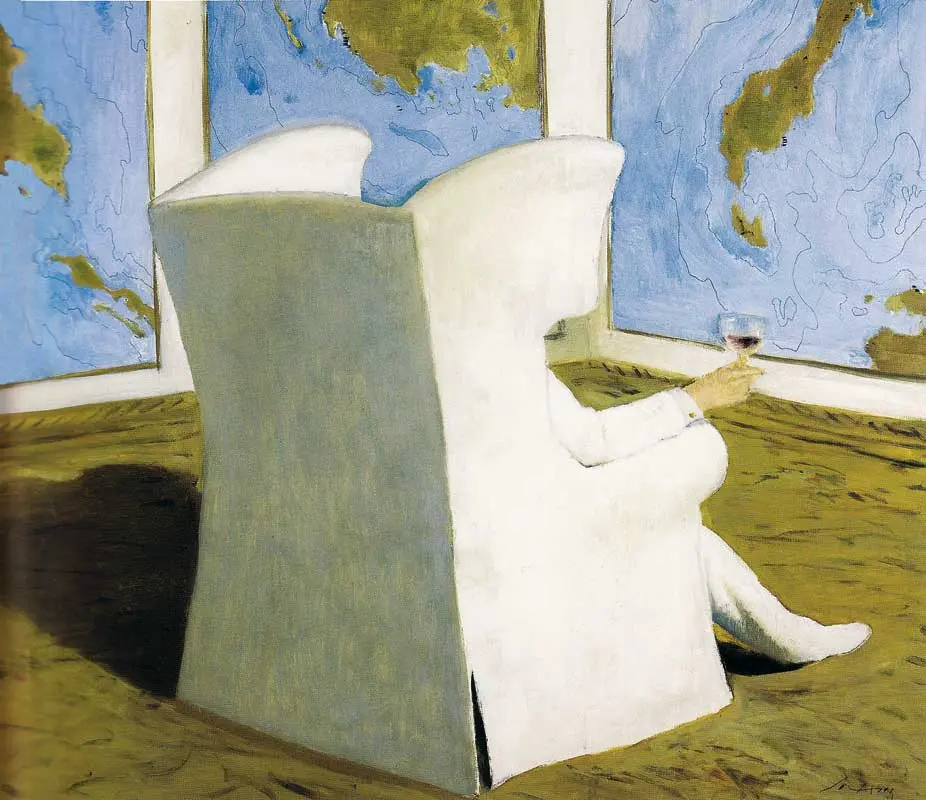
Global Operations demonstrates the anonymous face of contemporary power by having us look directly into the back of a huge armchair with wide enfolding arms; all we see of the seated figure is the extended arm and foot, of a man, covered in the same dull white of the chair’s upholstery. The foot extends into the rug with the supple weighted power of a large feline, the arm ends in a hand, yellowed by age, almost feminine in its underdevelopment, a hand made for writing memos, pushing electronic buttons, or typing into blackberries. It now holds a bit of expensive red wine in a goblet with the gesture of ceremony pertaining to a chalice holding sanctified matter. This theme has been developed by Larraz in other paintings from the past; I recall one similar painting, in which the sitter held a falcon, but this one is much more effective at conveying that sense of uncharted grandeur accumulated in one half-visible entity. The seated viewer is looking into large maps in the walls within his viewing range. We understand they form part of a set that can include all continents, although the parts that we see are not immediately recognizable. More importantly, we immediately perceive, from the viewer’s perspective, the sense of isolation, detachment, and exclusion that is an integral part of corporate executive suites decoration.
The same isolation of power is conveyed in another painting, Maria Maria. Here a small plane is parked atop of a very large yacht. We only see the tail end of the gigantic ship in the painted space, which makes the plane look like another naval accessory. The small flag at the tail of the vessel is not indicative of any nationality, and as the deck of the yacht is deserted, the viewer is made to feel like an intruder in a James Bond movie scene, where the proximity to the yacht would be ominous.
The yacht could easily sail to the house depicted in another canvas, The Bay of Mirrors. Here a palatial villa is perched atop a rocky cliff jutting out to sea. The view is painted as seen from a plane, a small aircraft perhaps, like the one in the yacht. The Memory of the Lotus is another view of the same structure, this time from more level ground and we can see clearly there are two stories and a major, central cupola that dominates the architecture of the villa. It could actually be a pavilion; there are marks on the ground indicating traffic from another source, the main house perhaps, that would be the equivalent in volume to this construction to the big yacht holding the small plane, but just like in the naval picture we only saw a portion of the vessel. Here we are not seeing at all the main house, the center of power is hidden, though presently represented by its shadows, the smaller structures.
Perhaps no portrait has ever been more revealing of corporate power prancing than At the War Room, a picture that directly confronts the viewer with a female version of the seated grand seigneur of Global Operations. The woman portrayed is at close range, her positioning in the canvas brings her uncomfortably close range to our viewing space. She is perched on an armless, very functional office chair that barely exists as a shadow to her ample form, covered in jewels, her arm folded at the waist in an iconic gesture of impatience while her jaw juts out a half-opened mouth ready for verbal bombardment. Her classically done hair and grandiose form vaguely recall an ancient goddess, while something in the tautness of the facial skin speaks of the agelessness that plastic surgery has granted on this executive deity. Her eyes, although widely opened and alert are covered by emerald green glasses, adding a reptilian quality to the face, reminiscent of Francis Bacon’s repulsive executives in the Men in Blue series, and behind her, a similar grand sequence of gigantic maps completes the scene, though this time we also see panels that are attached to a table and that may be part of an elaborate computer security system.
In Sugar Business we get a feeling for the corruptive environment that surrounds the privileged magnates of the maps, here again, present as the tapestry of choice for the background. On the side of the picture, stepping on a red sofa, a single feminine leg in the high heeled shoe and flowered garter contrasts sharply with the two conspiratorial figures on the left, two old-timers so concentrated in their whispered conversation they fail to notice the temptation in their vicinity. They are as comfortable with that element as the serene figure in white in On the shores of Casabianca is with the vicinity of lions, here walking at her side like two tamed pets on the beachfront, the umbrella hiding her identity from possible spy photographers. These scenarios are only half of the story, but they draw us in with the gravitational pull of the black hole of excess, and we want to see in the pictures more than we possibly can.
ALBERTO BARRAL