
Genetically Modified Organisms (GMOs) pose for our civilization yet another one of the many paradoxes that arise from the discovery and applications of the new technologies brought about by scientific exploration during the second half of the Twentieth Century, which are starting to undergo massive application as the new, globalized and hyper-connected millennium begins. A GMO is a living organism (virus, bacteria, plant, animal) whose genetic material has been manipulated in a laboratory with the purpose of giving it some specific characteristic. They are commonly called transgenic and are created by genetic engineers through the isolation of strands of a living being’s DNA and their introduction into the genome (hereditary material) of another living being.
For several years, Lucía Madriz has devoted an important part of her work — mostly within the framework of her installative practice — to analyzing the conflict and disjunctive we are faced with from the use of biotechnology in the production of food and in agricultural practices. Those installations, which she builds using grains and cereals that are essential to the human diet in many Latin American nations and cultures (beans, corn, rice), Madriz formulates fundamental questions “that many people share, around alimentary sovereignty and genetically modified food,” as the artist said in her personal statement for the Third Auckland Triennial (2007), where she presented her installation Red Alert.
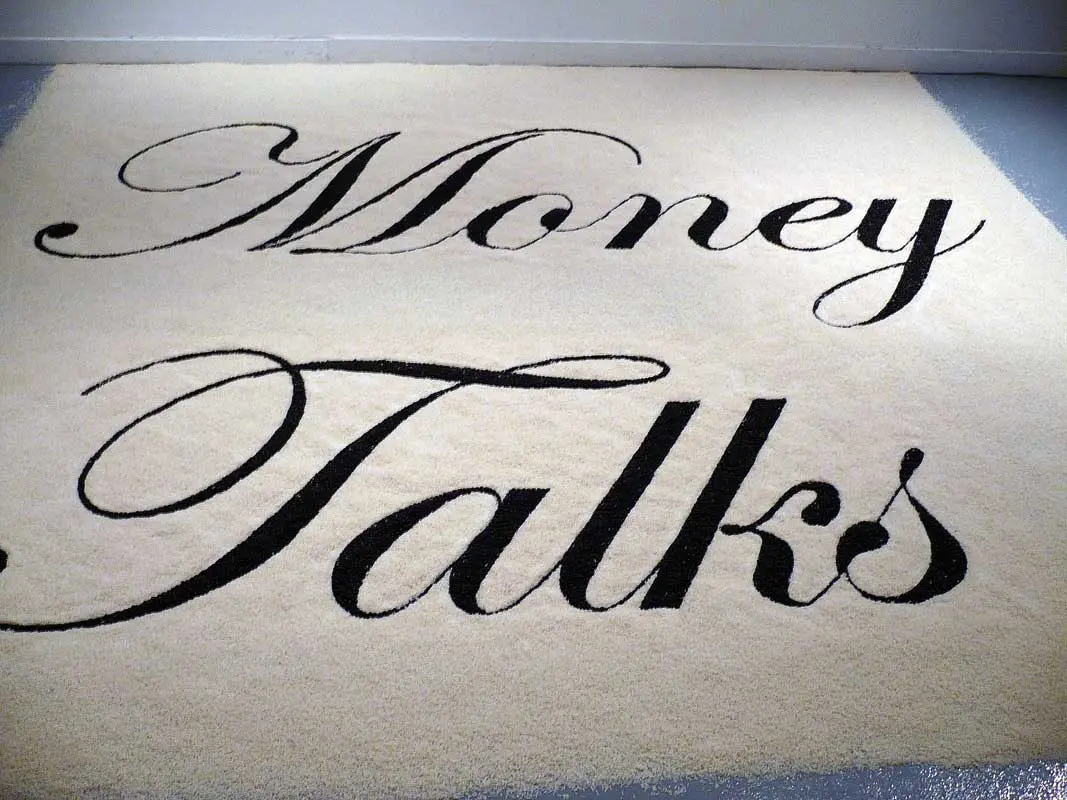
Lucía Madriz’s solo exhibition at dpm Gallery in Miami’s Wynwood art district, the gallery’s sister space to its Guayaquil, Ecuador headquarters. The show comprised a floor installation and five wall works that I would be inclined to define as paintings-objects. The installation Money Talks is a version of what Madriz presented at Art Basel Miami Beach in 2006, now incorporating a video recording of different phases in the production of the work. The design basically consists of the text of the title, elegantly inscribed in Edwardian Script font; an image that, if seen out of focus, would seem printed in China ink on rice paper, although in reality it is made using black beans on a bed of white rice, arranged with Cartesian precision — the artist glues to the floor a large number of grains to serves as guides and form the letters — in order to communicate the surprising and paradoxical sensation of encountering a magic gastronomical carpet that is nevertheless destined to never fly, and to never be stepped on or ingested.
When Lucía Madriz “sows” her grains on the rough gallery floor, she is committing what any Third World person would recognize as the sacrilege of “playing with food,” but at the same time, her game is serious enough to become a veritable statement in defense of food and of greater public control over its future. In that sense, Madriz’s installations can be seen as altarpieces (the formal similitude with Tibet’s sand mandalas might not be an accident) where the artist offers nourishment to the supposed gods that govern public opinion, the legislative, judicial, and executive branches of government in all nations, and also — no less important — the FAO (the UN’s organism in charge of these issues, the Food and Agriculture Organization), asking for food to be protected from the irresponsible and excessively selfish use of genetic technology. The work’s very title, Money Talks, seems to emphasize the point by referring to the popular English language saying (“money talks, bullshit walks”) —which in this case Madriz is perhaps paraphrasing as “money talks, foody walks,” suggesting the implication of large financial interests in the transgenic food industry, controlled mostly by private concerns.
The show’s remaining five works are paintings-objects in that their simple, frameless mounting, as well as their plant-based support and the haphazard shapes it creates, are as important as elements in the composition (in both the visual and the semantic sense) as what is presented in them. In these five works, resolved in acrylic on wood (55 X 55 cm — 21 ¾ x 21 ¾ in) and produced in 2009, Madriz contrasts the whimsical design and natural shapes produced by the veneers, fibers, and knots of polished wood, with the geometric-shape tracings she creates using instruments in order to achieve architecture-like symmetries that evoke the outline of our contemporary megalopolis, countered by the various shades of green and earth tones that suggest naturalness and a rural ambiance, resolved through veilings and layers of acrylic on different planes that give density to her compositions. A visual metaphor that attempts a subtler and more indirect approach to the topic of the installation that heads the exhibition: the need to reorder our relationship with nature, guided by an ethical code of conduct rather than by primary monetary greed — a profit that, besides being spiteful, will be proven inconsequential over time, as it will in all likelihood become one of the costlier and most ephemeral boom periods in human history. Money that will have nobody to tell its regrettable story.
RAFAEL LÓPEZ-RAMOS