The North Miami Museum of Contemporary Art, MOCA, presented this summer Luis Gispert’s first large-scale retrospective. The show is a compilation of Gispert’s work from 2002 through the present and constitutes, undoubtedly, a mandatory point of reference for the study of the artist’s work.
It would seem that the history of Western culture plays between two essential sensibilities: the Renaissance and the Baroque. The Renaissance, defined by order, symmetry, proportion, a taste for straight-line shapes, and, from a conceptual standpoint, the inner peace dictated by the natural order.
Opposed to this sense of balance there always arises the Baroque spirit: excessive, outsized, eclectic, laden with fury, colossal. The Baroque likes juxtaposition, movement, extreme contrasts, artificiality, intertextuality. The Baroque is the spirit of disenchantment and unconformity; a fear of solitude translated into horror vacui, and fear of disillusionment that, paradoxically, prompts us to leap into the unknown.
The Baroque is that inner pulse telling us we are still alive and must do something and can’t take it any longer. It is the irreverent beat we all carry inside. It is a shame, though, that more often than not we silence it.
Contemporary urban culture is one of the most genuine expressions of the drive towards transgression and irreverence marked by the Baroque spirit. Clustered under the umbrella term of “urban culture” are the practices of a variegated roster of groups and minorities: punk, hip-hop, youth culture. African-American culture, Latino immigrant culture, etc. As a constant, and despite each group’s specificities, what we encounter always is a cultural expression of dissatisfaction and inconformity with the reigning social contract. This dissatisfaction, connected to the vindication of identity and belonging, finds its battlefield in the street and the city — a city that belongs to each of these groups and yet often seems to exclude and ignore all of them.
It is precisely in the interstice where urban culture and the Baroque spirit come together and struggle to come to the surface that we find Luis Gispert’s artistic proposition. The child of Cuban immigrants, Gispert was born in New Jersey in 1972. His childhood was spent in Miami — in the suburban expanses of Kendall — during the bloody years of the Cocaine Wars, which transformed Miami into the US’s most dangerous city during the 1980s. Like most adolescents during this period, Gispert was a bro, passionate about automobiles and music, and became a whiz at installing stereo systems in his friends’ cars. Difficult for him to imagine at the time that this ghetto culture could translate into art: “We and my friends, when we were working on our cars, we were definitely making aesthetic decisions, but we didn’t really know what we were doing. It didn’t have any connection to anything else… [At Yale] I learned a language that let me go back and re-examine things".1

Gispert’s work, which gravitates towards urban culture and within it Hip-Hop, the Latin ghetto, youth culture, and the Cuban-American heritage, is forcefully and decisively marked by his adolescent experiences. Deemed Baroque Hip-Hop by Gispert himself, his proposal stands out for its degree of inclusion and pastiche, where the superposition of eclectic quotes progressively composes a complex conceptual weave that isn’t always entirely accessible to his viewers. This sense of intertextuality, so dear to Gispert’s work, is typical of Baroque compositions, dominated by multiple levels of narration that, by means of quotes, repetition, parody, and pastiche, coexist at the same rung of the textual hierarchy.
Gispert’s proposal installs itself in the slippery terrain where the values of marginal and/or emerging cultures permeate standard middle-class taste with their perverse nature. This is what Gispert calls a dysfunctional aesthetics, where the commonly accepted values of the US white middle class are revisited and challenged. This dysfunctional sense connects with Baroque’s fragmentary logic, where the loss of linear or hegemonic discursivity creates a space for bifurcating or open narratives, typified by polyphony.
Luis Gispert’s work is filled with exuberant iconography. Appropriated urban-culture signs distill power, a sense of belonging, and speak of status or hierarchy. Gispert explains that both in immigrant and hip-hop culture, the preoccupation with status reaches the level of an obsession: “The signs appropriated by hip-hop represent the wealth, power, and sophistication associated with the white middle and upper classes (...).This is also a condition of immigrant cultures. Starting over from scratch, immigrants strive to conform to an idea they have about America, whatever it is. I am very interested in that tension, in the space where these signs and signifiers from other places synthesize and scatter, reentering mainstream culture only to be appropriated again."2
Three essential emblems thus stand out in his career: cheerleaders, car rims, and boomboxes. Each one of these elements is in itself a carrier of other signifiers and symbols.
The series of the Cheerleaders is from the years 2000-2002. In it, each element is carefully calculated to the point that, in fact, these capricious models seem to belong more to the world of advertising than to the world of art. Gispert invariably uses a monochrome background, emphasizing in that way the idea of a commercial, alienated product, offered forward in its per se nature.
His cheerleaders, obviously Latin in their ethnicity, stand out for their outfits, where heavy bling-bling, ostentatious fingernails, overdone makeup, tattoos, and aggressive gestures impose themselves as essential communicative elements: barrier and shield at the same time. Everything in them is pose and artifice, and even the atmosphere that surrounds them appears rarefied.
This central pop symbol of American culture, which incarnates frivolity and the desire for popularity among adolescent girls, acquires a new slant in Gispert’s proposal, where violence and female submissiveness are articulated as elements of integration into and belonging to the ghetto.
In his subsequent series, Urban Myth Part I (2202-2003,) the cheerleaders seem to transform into Madonnas. The ghetto’s suburban culture connects now with a new symbolic component: cultural baggage as a legacy. Gispert starts with his own family history. The background, far from being neutral, acquires now vital energy that makes it another character in the story. Urban Myth Part I takes place inside the home. The series, of a certain autobiographical bent, is a commentary on the myths, fears, and ideals of the Latino family, taking as its models the artist’s own: a typical family of Cuban immigrants.
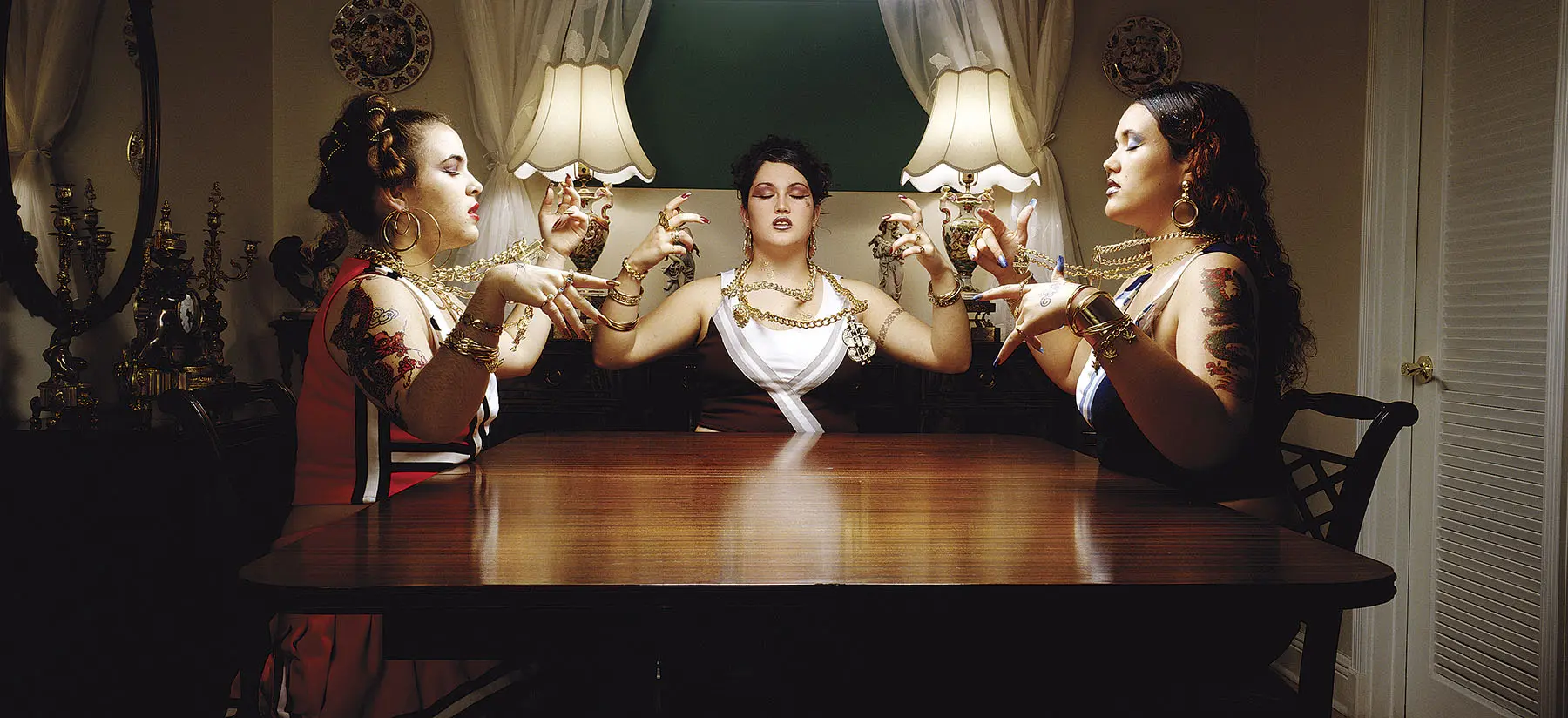
Dinner Girls (2002) is a clear representative of this series. Inside a typical dining room in a Latino home — which, by the way, is the place where everybody comes together to chat about their day — three adolescents seem to be engaged in a séance. The furniture is overdone, dominated by a taste for gilded features, volutes, and serpentine lines. Among the decoration elements, we see chandeliers and porcelain figurines representing bucolic scenes and pink-cheeked baby angels. The work is greatly harmonious and, despite the clash of styles between the décor and the characters, dominated by a taste, beyond the generational gap, for the gaudiness and the accumulation of material possessions as anchors of identity.
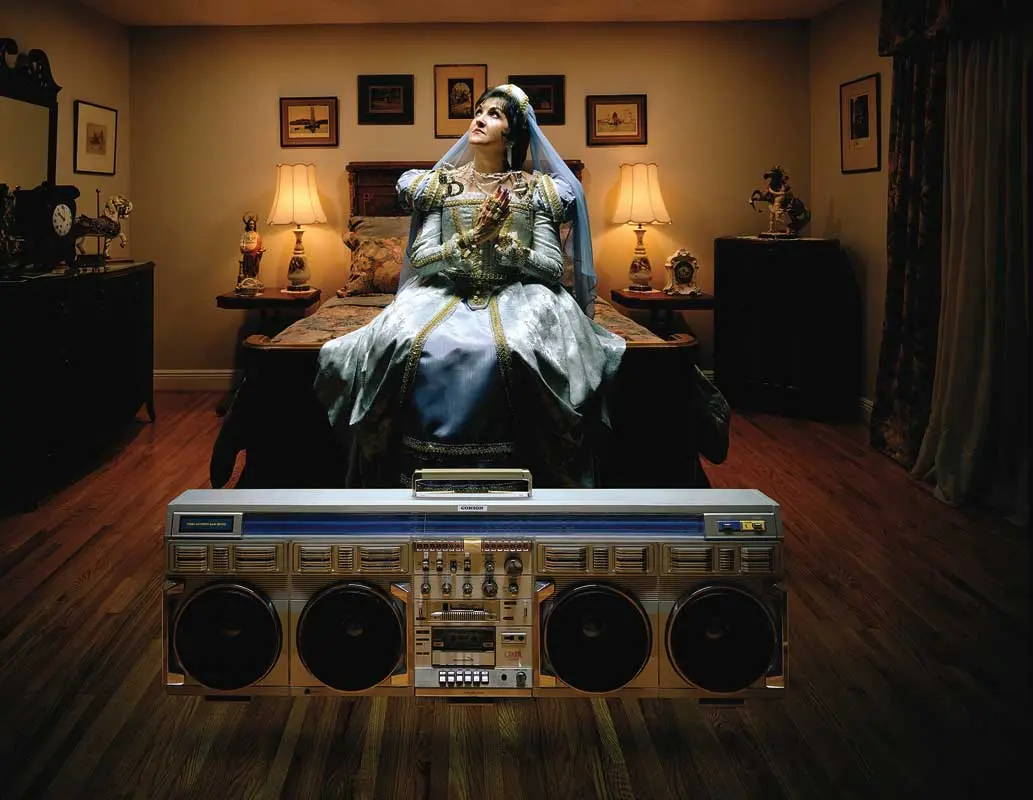
In Bedroom (2003), the artist’s mother sits at the edge of her bed and prays while eyeing the windows in search of a divine sign. The perfectly symmetrical composition is loaded with tension for the high degree of artificiality in an image that becomes incongruous at first sight. The work incorporates a new essential element of Hip-Hop and Latino culture: religiosity and the venerated image of the Mother as Virgin, a sacred being to whom we owe life.
In 2005, Luis Gispert joined forces with an old colleague (Jeffrey Reed) for an ambitious purpose: Stereomongrel. This exhibition project is a two-handed orchestration composed by Gispert and Reed, like DJs of contemporary culture, based on the most dissimilar elements in search of a Baroque harmony with cultural clash as the central melodic thread.
A standout in the show is an experimental video of the same title, written and directed by both artists. In it, Hortensia, a girl who in the course of the story mutates into a deer, seeks vengeance against her absent father. The story takes place inside the Whitney Museum of American Art, where Hortensia’s father is a security guard. The video is filled with quotes from cultural pastiches, dominated by the sense of self-referentiality given by references to the history of art, and cinema in specific, through genre archetypes like horror, sci-fi, and martial-arts films.
The sole inkling of salvation in the exuberant composition that is Stereomongrel is the hybrid: beings in a permanent state of mutation, ready to devour it all as the ultimate transcultural mechanism, which allows for the survival of the "I" in the "other", a new entity. The notion of the hybrid can be extended also to the relationship between the human and the artificial, especially the boombox. We witness thus the birth of the cyborg as the incarnation of contemporary urban culture.
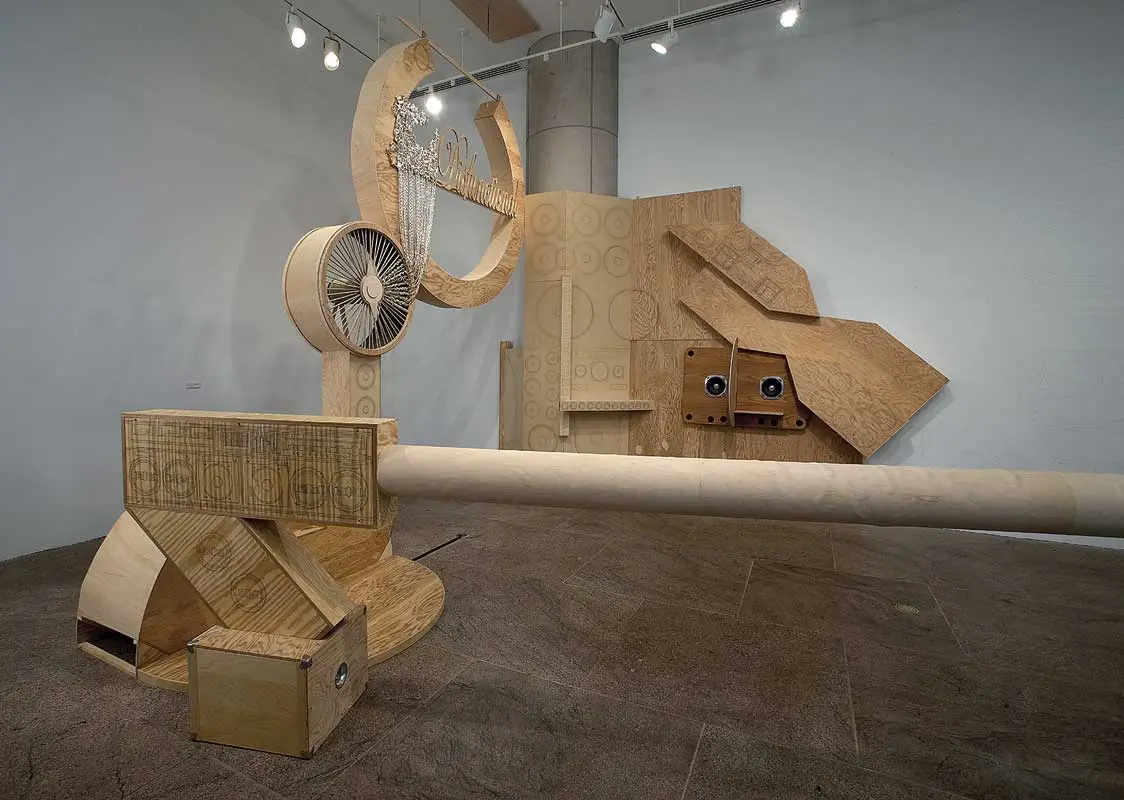
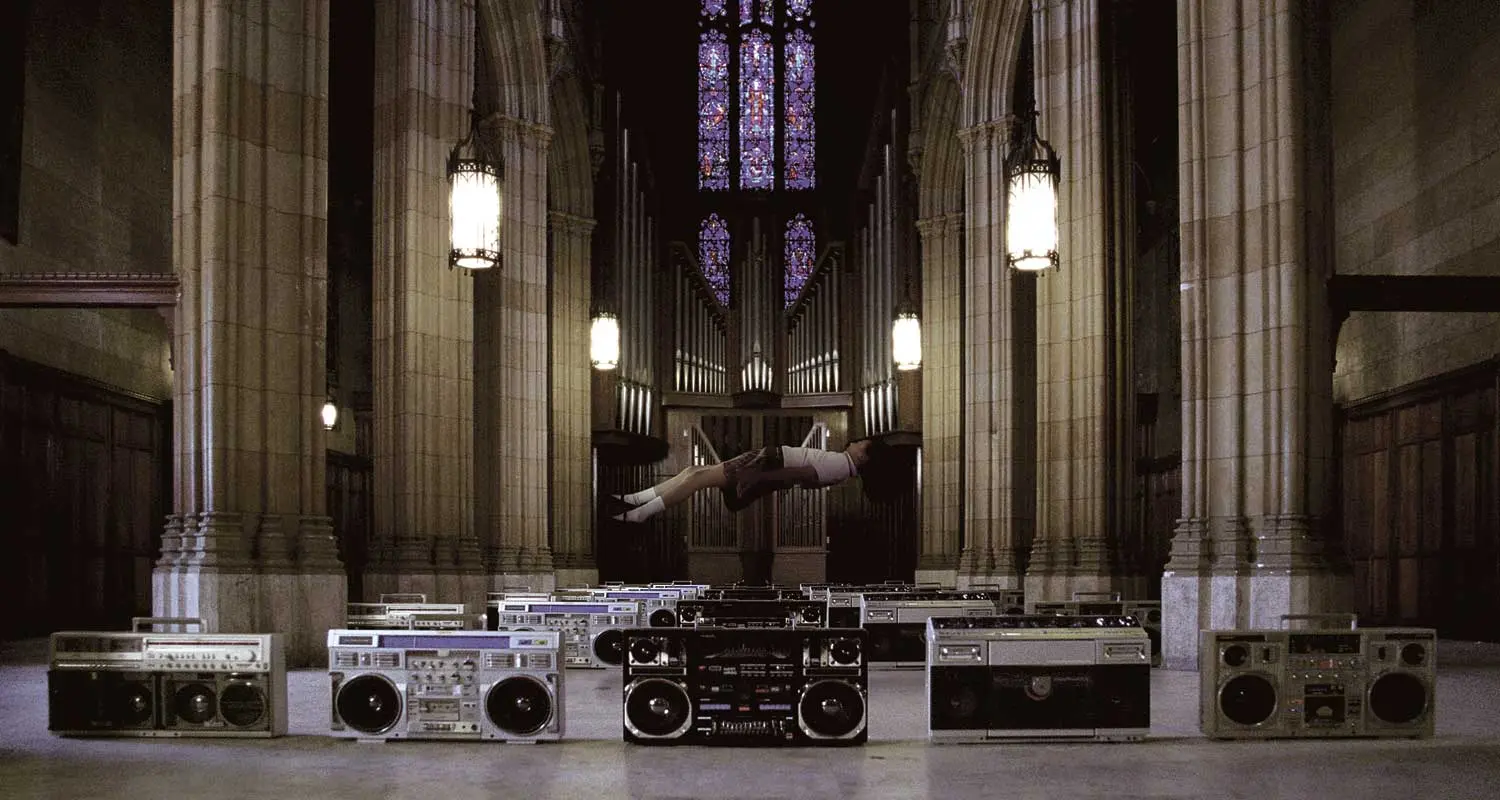
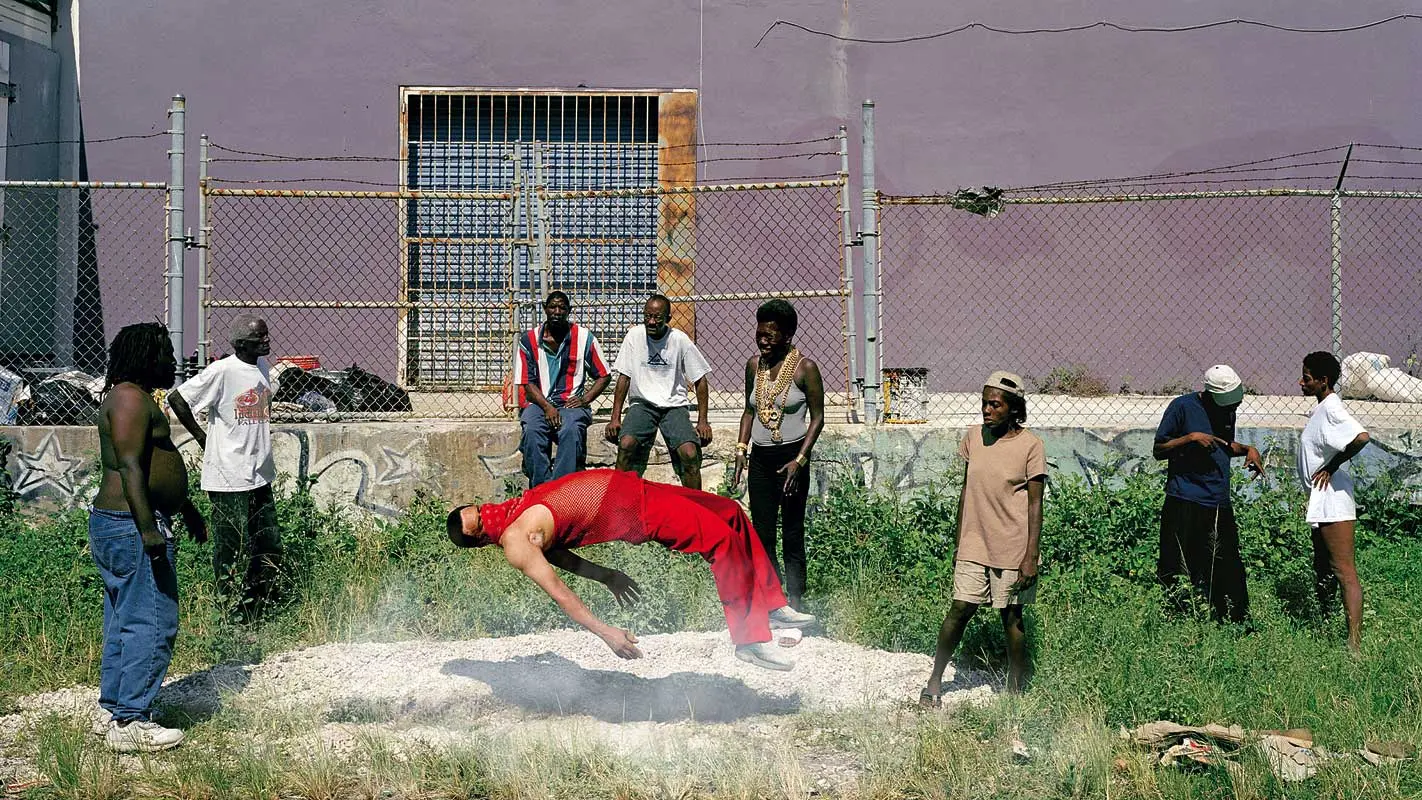
The cyborg in Gispert’s work is associated with tire rims and car horns, elements we already noted as emblematic in his art. The empathy between these elements is so great that it drives his characters to repeated ecstasy. Such is the case with works like Chapel and Grave (both from 2004 and conceived in collaboration with Jeffrey Reed) where the beat transports the characters to an intangible dimension.
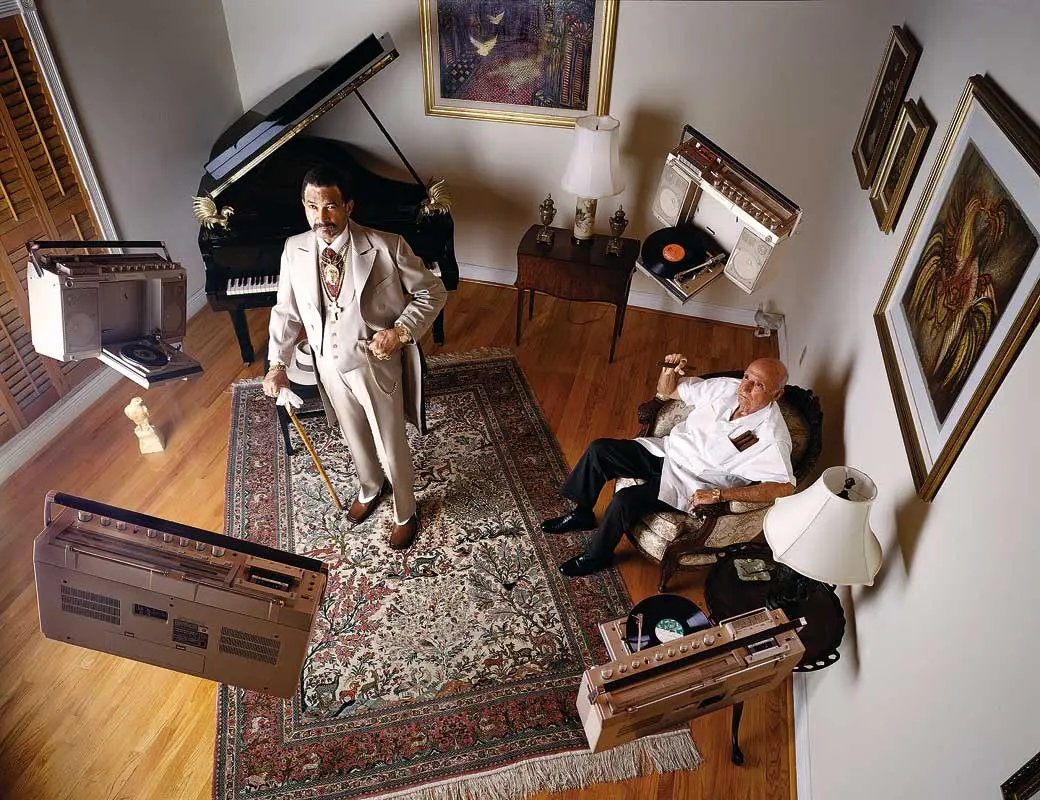
At times, it is the peaceful tranquility of immigrants trapped in their past that is visited by the new interlopers who, now, in the guise of their children and grandchildren populate their homes. Flying Turntables (2003) is symptomatic of this angle of reality. There, a grandfather observes, sitting in his recliner, clad in an impeccable white guayabera and holding a cigar. An individual from a younger generation, still frozen in the idyll of a Republic disappeared already half a century ago, poses standing up, dignified, wearing a tuxedo, gloves, watch chain, leggings, walking cane. The room’s décor reasserts the rarefied idea that paintings are essential for their emphasis on the most clichéd elements of Cuban-ness, such as stained glass and roosters.

In 2008, Gispert presented two solo exhibitions: The World is Yours (Zach Feuer Gallery, New York) and Heavy Manner (Fredric Snitzer Gallery, Miami.) The presence of the boombox and the automobile is key to both, as emblematic figures of contemporary urban culture.
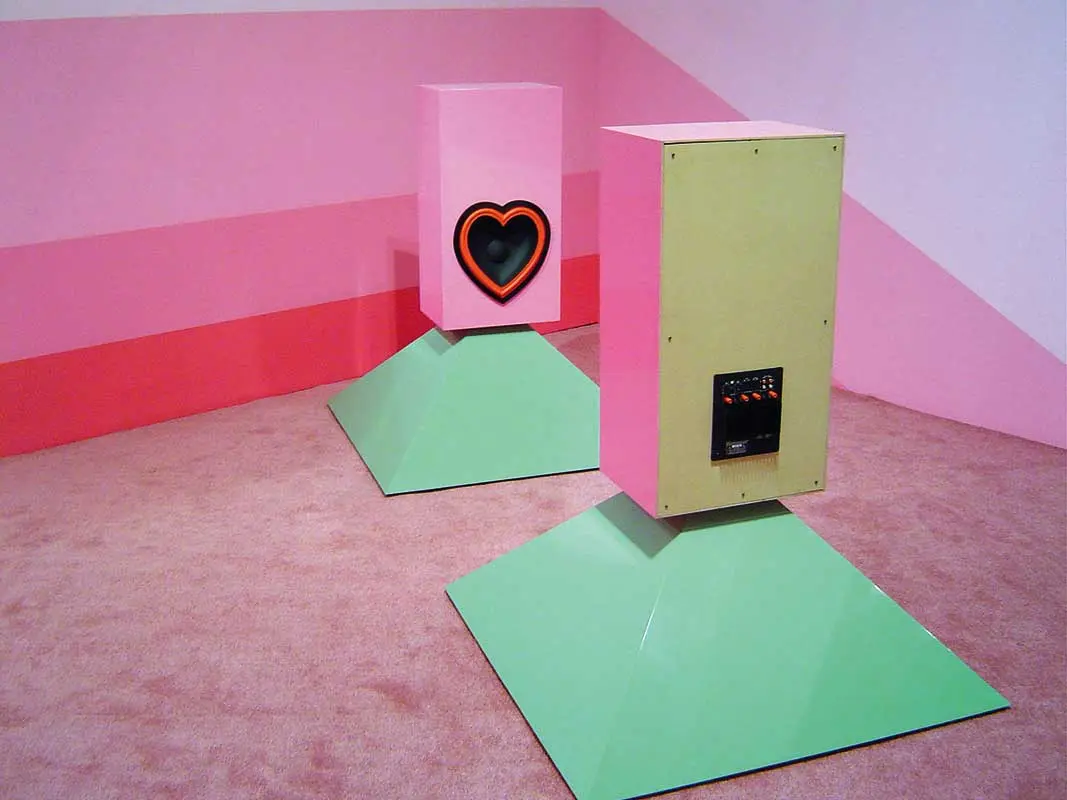
In Like Ships in the Night (2008,) the car horn is idealized, sublimated. Dignified atop pedestals, both horns — obvious parts of a pair — question and challenge each other. We seem to be witnessing a courtship, a kind of dance, or combat where both contenders size each other up and measure their strength. The sound element, the intense pink hue, and the heart-shaped horns are essential notes in this courtship of unabashedly kitsch style.
The car becomes a carapace, a home in movement, armor, center of operations. The dysfunctional aesthetics that is central to Gispert’s work is eloquent in series here complicated blackboards, overfilled with buttons, reveal behind their windshields the most controversial scenes: desert-like suburban landscapes, sunsets at the beach, among others.
In his video Smoother (2008,) included in both shows, Gispert presents us with an allegory of a surrealist atmosphere. Inspired by the turbulent years of his Miami childhood, the short film narrates the anodyne relationship between Waylon, 11, and his young mother, lost in a world of barbiturates. The oneiric vision by Waylon’s dream, which opens the video. Later, the demarcations between the imaginary world and reality are blurred in the child-like gaze and, above all, because of the absurdity and cruelty of the reality of which the characters are a victim.
Dominated by a rarefied and decadent atmosphere, the boombox becomes at once paternal icon and idyll. As in Stereomongrel, the vulnerable child is the mutating entity and the story’s connecting thread, transforming this time into a dog and later into a boombox: a kind of all-devouring dream.
Luis Gispert’s artistic proposal stands out for the dialog it establishes between high and low culture. The interplay of cultural stereotypes that function as a unifying element at one level and as a segregating element at another. Sophisticated and unbiased, his proposal deals with racial differences, social prejudices, profanity, violence, sex, and beauty. His work is founded on an insatiable exploration of the visual codes of urban culture. Codes that once recycled by the artist are returned to us to make us participants and accessories — now from the comfortable space of the gallery — of the worn-out compartments that fragment culture into categories like high and low, ghetto or mainstream, art or mass culture.
In the midst of the postmodern logic of the post-industrial city, Baroque feelings become immanent logic. Their historical origins coincide with the culminating moments of the conquest and colonization of the New World, which might perhaps explain, in a way, the Baroque nature of a continent where no sooner a cultural stratum has settled itself than a new one is already breaking through.
The spirit of Hip-Hop has moved beyond a mere musical expression. Its worldwide influence makes it the most important cultural force at the dawn of the Twenty-First Century, permeating with its unmistakable Baroque beat every sphere of our culture: from fashion to politics.
A final critical element is required here: the imperative need for a critical gaze given the banalization that the dominant culture effects as it appropriates marginal or peripheral expressions. Everything becomes simply a cultural product, its mercantile value brought to the fore, and in that process, there occurs a process of de-ideologization that hollows out the meaning of the most irreverent proposals. In a way, Hip-Hop is an expression of this very phenomenon. We enjoy its music and its aesthetic contributions as mass-cultural elements from a comfortable living-room couch, yet, more often than not, once in the streets, we carefully — or fearfully — avoid any contact with the ghetto itself.
NOTES
1. Lydia Martin. “Urban Myths bring the street home.” The Miami Herald, Saturday, December 6, 2003.
2. Rina Carvajal. American Baroque: A Conversation with Luis Gispert.”Exhibition catalog, 10 Floridians, MAC 2003.
* Images courtesy of Zach Feuer Gallery, New York.
JANET BATET
Art critic and independent curator with a BA in Art History (University of Havana) and a Master's in Multimedia (UQAM University, Montreal).