
The anthology show at the Centro Cultural Recoleta’s Cronopios gallery included more than seventy works covering the career of Luis Tomasello (1915) from its beginnings to its most recent period. Adding to the renown of an artist internationally acknowledged as a key figure in kinetic art was the interest of an impeccably mounted exhibition and a careful selection by curator Jorge Taverna Irigoyen, art critic and president of the National Fine Arts Academy.
The works on exhibit come from the collection of the Museo de Arte Contemporáneo (MACLA) to which Tomasello left a substantial part of his production; proof of his pride in his native city, La Plata, where the museum is located.
Tomasello traveled to Europe for the first time in 1951 and reached Sicily in order to know the land of his forebears. In Europe he discovered, sur place, geometric abstraction. Mondrian’s work had an impact on him, as did the Chartres Cathedral, where he had for the first time the intuition of color-light, which was to be key to his art.
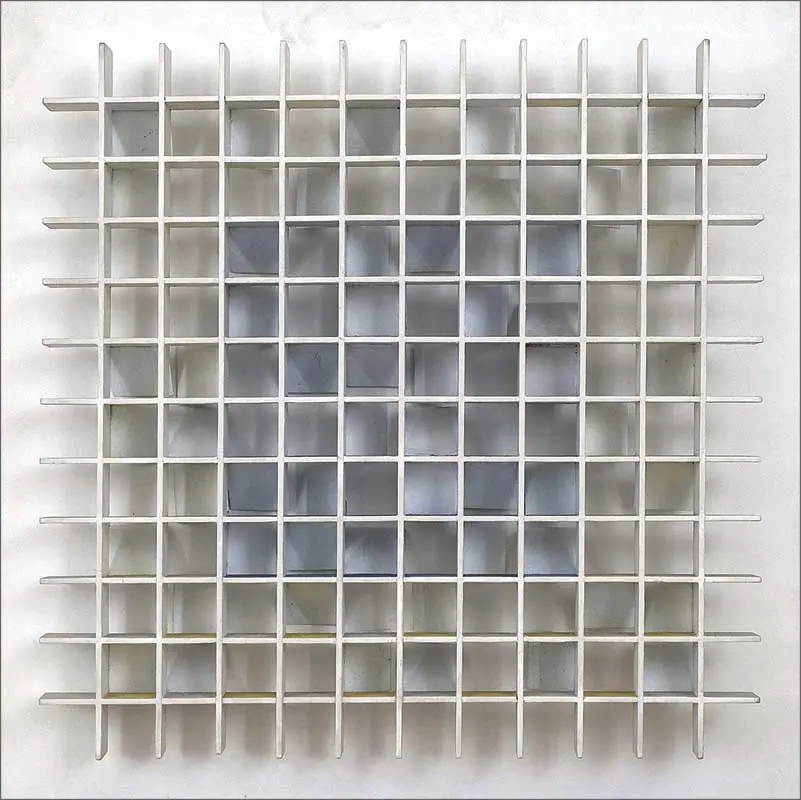
In the Dutch master, Tomasello found an obstinate struggle to keep colors on the plane. “I verified the drama of color,” he said. The only option then was to move out of the plane and take over the third dimension, through relief.
In 1957, having settled in Paris, Tomasello started his quest in the kinetic path, which continues to the present—at the age of 93—with the same original enthusiasm. His contact with the Denise René Gallery, a leader in the international kinetic art circuit, was undoubtedly a great stimulus, as was the fact that Paris was the epicenter of the movement, the point of a coincidence for artists from several countries, and in particular from Latin America, interested in incorporating movement into their work.
A large number of Latin American artists (30% of the total) participated in the great group exhibition Lumière et Mouvement, held at the Musée d’Art moderne de la Ville de Paris in 1967. This and other instances are proof that Latin American artists have contributed to the glory of the “Paris School” and to the neo-avant-garde in general. Let’s take the example of Pintura cinética N°4 (1957), where Tomasello uses color squares that repeat in the entire surface to produce an (optical) movement effect. This is an early contribution to optical kinetic art, a trend that was to expand internationally in the 1960s.
To fully understand the importance of Tomasello’s contribution to Twentieth-Century Art it is necessary to cite the concepts of “chromoplastic atmosphere” and “color sensation.” His reliefs are atmospheric because color, located on the face of the geometric figures that confront the background surface, dilutes on the latter, and shifts subtly as external light is modified. What is important is the “color sensation,” which is none other than the color that reflects against the background without touching it. It is the color that stains the background in a constant and unpredictable “magical” movement.
In summary, Tomasello’s main contribution to kinetic art is the wise use of the color shade against the white background, as well as the recourse to incidences of light to provoke tonal shifts in the different planes of his geometric shapes. In more recent times, the mystery of black in its different shades is added to the mix. Tomasello is able to make the color black live more or less intensely according to the way—direct or indirect—in which light hits it.
To say with his friend Julio Cortázar, Tomasello “painstakingly brushes the hair of light” and in this way unveils “the emotions of matter.” An alchemist of light, proof that in order to incorporate movement into a work of art, real, mechanical movement is unnecessary. It is enough for light to dilate into color, making space vibrate.
Since the mid-1960s, Tomasello’s work began to receive well-deserved recognition. In 1970 he won First Prize at the Coltejer Biennial (Medellín, Colombia), and in 1967 he was selected by Frank Popper—a deep student of kinetic art and author of one of the earliest treatises devoted to the school Paris (Naissance de l’art cinétique, Gauthier-Villars, 1967)—to join the group included in Lumière et Mouvement already mentioned. In 1976 he was named Knight of the Arts and Letters in Paris, France. Among his most recent honors is the Grand Pix Tribute given by Argentina’s Central Bank (2008).
Because of its heightened poetic power and general excellence, this anthology exhibition will surely leave an imprint on the consciousness of all involved. For young artists, it will be a model of conceptual coherence and faith in sustained work. Work fueled by the pleasure that arises from the liberation of energy in material matter, in this case, light when it transforms into color.
ELENA OLIVERAS