The exhibit titled Una Frágil Conspiración (A Fragile Conspiracy) was presented during June and July of this year at Galería El Museo. It included paintings and drawings by the artist from Barranquilla, Marco Mojica. The works exhibited referenced other paradigmatic contemporary artworks that Mojica reinterpreted in painted or drawn images, which displayed different ways of approaching and decoding the originals, as the new versions are entirely heterodox, critical, and humoristic.
Marco Mojica is interested in images that can lead to other images, and he pays careful attention to the mechanisms used by art to represent itself. This is why an exhibit catalog, a book, or a magazine may actually generate more interest in the artist than the “original” works themselves because these publications include an interpretative context and also highlight a validation process. Additionally, Mojica, by presenting artistic projects through his works that contain art critics’ views on “the institution of art,” he sheds light on the reasons behind the art world’s efforts to curb or neutralize him. Betting on a hypothetical “lost cause,” such as pictorial illusionism in order to define an artistic position, inherited from the conceptual explorations and appropriationist strategies of the past, implies thinking that the evolutionary development of art is improbable. It also leads to the realization that painting remains a relevant endeavor that is also intellectually dynamic.
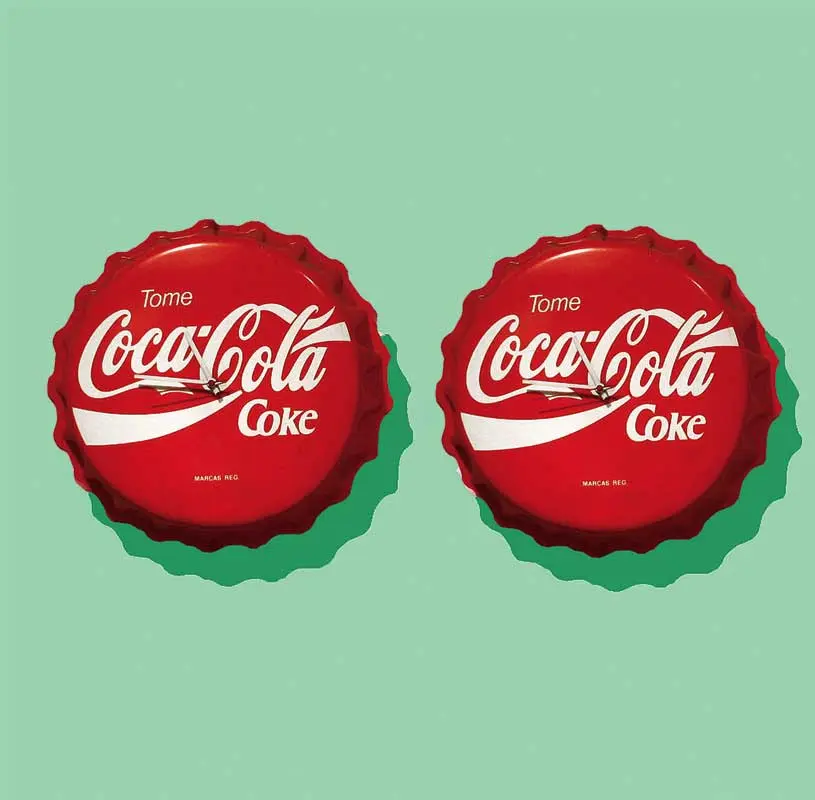
In the pieces exhibited at Una Frágil Conspiración Mojica has chosen to reference, through his paintings or drawings, other works of such powerful conceptual and critical gravitas that have become so canonical to the contemporary art establishment that they appear to be losing their ability to project signification. Thus, the aesthetic conventions projected onto these images act as an institutional framework that reconsiders the relationships between such works and the entities, institutions, or discourses that utilize them as established emblems of worth. In his installation titled 6 AUG 1992, Reloj de Pared (Aug 6 1992, Wall Clock), Mojica paints twelve of the steps, indicated in a monographic book about On Kawara, necessary for the realization of one of the famous Date Paintings by this Japanese conceptual artist. The making of Mojica’s installation involved replicating, to a greater or lesser degree, the same painting twelve times. Each of the paintings represents a stage in the process to create the original Date Painting. Mojica arranged these paintings to form a circumference that surrounds a small clock. It takes Kawara’s idea – of establishing the present through the pictorial inscription of a date – further by pointing out the several moments that were needed to complete the entire image.
Prominent among the works included in the exhibition are those that unsettlingly decode the images that they reference. Such is the case of the drawing that merges the famous photograph of Marcel Duchamp displaying a star-shaped tonsure with the logo of a teenage magazine that also includes a star. The name of the magazine appears to be winking at other duchampian projects. Something similar occurs in Mojica’s drawing of one of the most famous photographs taken of the performance by Joseph Beuys with a coyote – titled I Like America and America Likes Me. Mojica juxtaposes this image by placing next to it a painting of the cartoon character Wile E. Coyote, which the other coyote in Beuys’s work appears to be observing.
In Metamorfosis de un Robot (Metamorphosis of a Robot), the Colombian artist presents two opposing cultural systems of modernity: art and entertainment. He carefully studied the work Recuerdos de Machu Picchu (Memories of Machu Picchu) by Colombian sculptor Eduardo Ramírez-Villamizar to decipher a way of internalizing – not the scenes of an ancient culture – but rather a character from a comic strip: a transformer. While it is understood that abstraction is the result of a natural series of formal transformations and alterations, Mojica attempts here to demonstrate that such a process can also include its nemesis, that is, “mass popular culture.” He parodies the formal modern game of transformations when he literally incorporates it into the image.
The very “nature” of the pictorial practice has never been transparent or reliable, in the strictest sense, because its referents are framed by reality. Thus, the cultural translation that occurs when an original iconic image is inserted into another painting or artistic project whose “nature” is different from the original is so important to Mojica. The presence of drawings and paintings in Mojica’s work reveals a paradoxical irony that challenges the notion of morphologic and mediatic progress of artistic practices – it is clear that Mojica does not want to be perceived as an advocate of the art market and, therefore, of cultural colonialism. He also reminds us that painting and drawing have been the main instruments of colonial domination throughout the history of Western symbolic expansion.
Appropriation is a mechanism that guarantees the adoption of the aesthetical and institutional conventions that dominate the art world; it subscribes to the cultural critiques that the original works have generated. It is also an essential device for Mojica to decode and to question. In this regard, Marco Mojica appears to fulfill the anthropophagic mandate established by Oswaldo de Andrade, who affirmed, “I am only interested in what is not mine.”
JAIME CERÓN