It is interesting the way the microcosm can, both at the formal and the conceptual levels, reveal itself as the key to understanding the macrocosm. Submerging ourselves in the blood current can take us on a kind of marvelous intergalactic voyage. In this way, the human body becomes from its most hidden corners the appropriate aphorism, the revelatory key to our existence.
Nela Ochoa’s work begins with an insatiable exploration of human beings. An exploration that takes the artist to the most minute scale in order to unveil our soul through the most accurate scientific details. This is because what drives her impulse as a demiurge is precisely a desire to unravel and understand.
Prolific and unprejudiced in the face of the creative act, Ochoa’s artistic range includes painting, photography, installation, video, performance, and interactive actions that procure the participation of the public, at times as co-creator of the work. Such is the case of Pidiendo Cacao (Give Me a Break) (2004). In other actions, however, the public as a participating agent becomes the subject of sensitivization. Support, I would say, of Ochoa’s work, since the action is directed towards raising awareness and provoking substantial change in the individuals that take part in it. I Could Be You. You Could e Me (2005) is paradigmatic in that sense.
Nela Ochoa: Genetic Portraits is the title of the exhibition presented at the Patricia & Philip Frost Art Museum, located at Florida International University in Miami. The exhibition includes key works from the past ten years in the career of this multi-media artist devoted to working with the intricate mass of genetic sequences, probing always into the designs of men. Her main interest is, precisely, to find in the midst of scientific rigor a cultural meaning that can be translated into a common heritage.
Ochoa’s desire to investigate the human through scientific means harks back to her works with medical images such as X-rays and magnetic resonance plaques, which the artist appropriates and integrates later to paintings, digital images, installation, and moving images.
Many of Ochoa’s works appear at first sight as whimsical abstract structures. Their inherent beauty stands out in a purely aesthetic perception due to Ochoa’s wise selection of colors (always in an animated quartet, responding to the structure of DNA) and a measured rhythm where a taste for serial works and for accumulation weaves a magnificent, barely suspected plot.
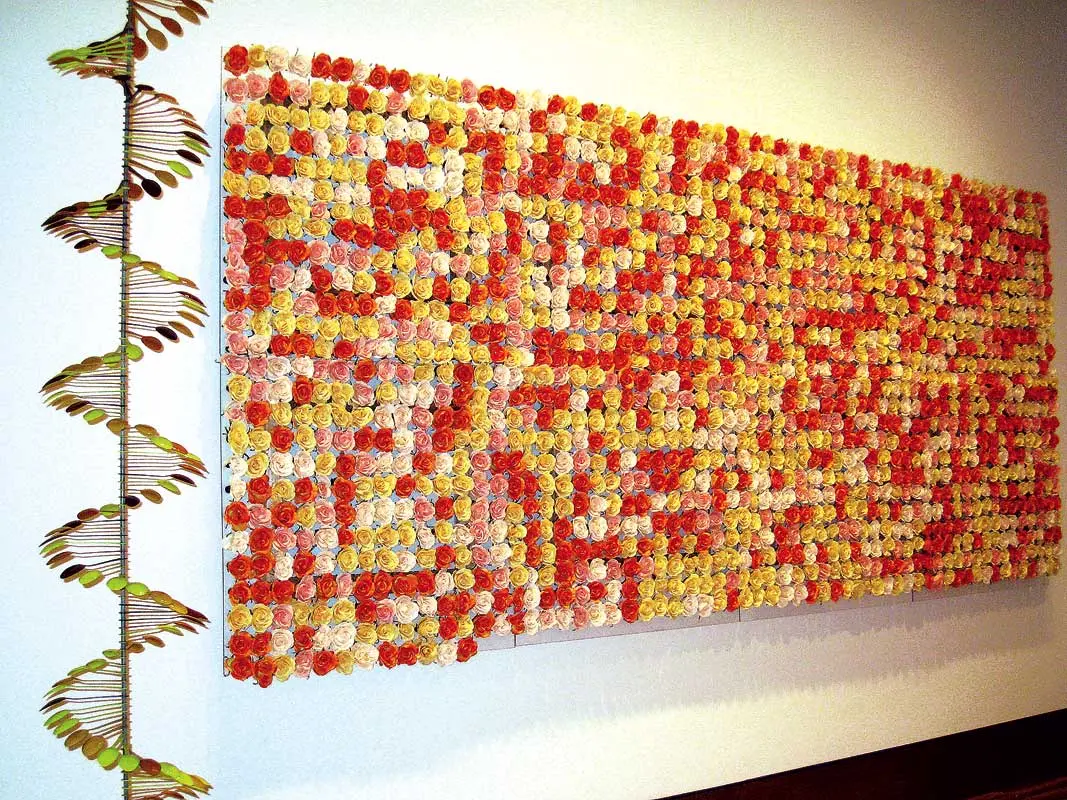
De todas maneras rosas (Roses Anyway) (2003) offers, as a painting, a majestic tapestry comprised of orange, yellow, light, and dark pink roses that recreate the genetic sequence of the rosa gigantea. While the colors used by Ochoa in this sequence respond to an interest in illustrating the genetic portrait, their connection with the rose’s general symbolism is evident. Moreover when we learn that the work was motivated by and created as a tribute to the general strike that, on April 11, 2002, shook Caracas and flooded with people the city’s colossal Autopista del Este — an expression of the Venezuelan nation’s political disappointment with the new path imposed by its president, Hugo Chavez.
The title appropriates a popular expression and emphasizes those feelings just like the colors (orange: passion; yellow: dying love; light pink: condolences; dark pink: gratitude). The mid-day vistas of the rally, where the individual is just a color dot, impose new associative meanings on Ochoa’s work.
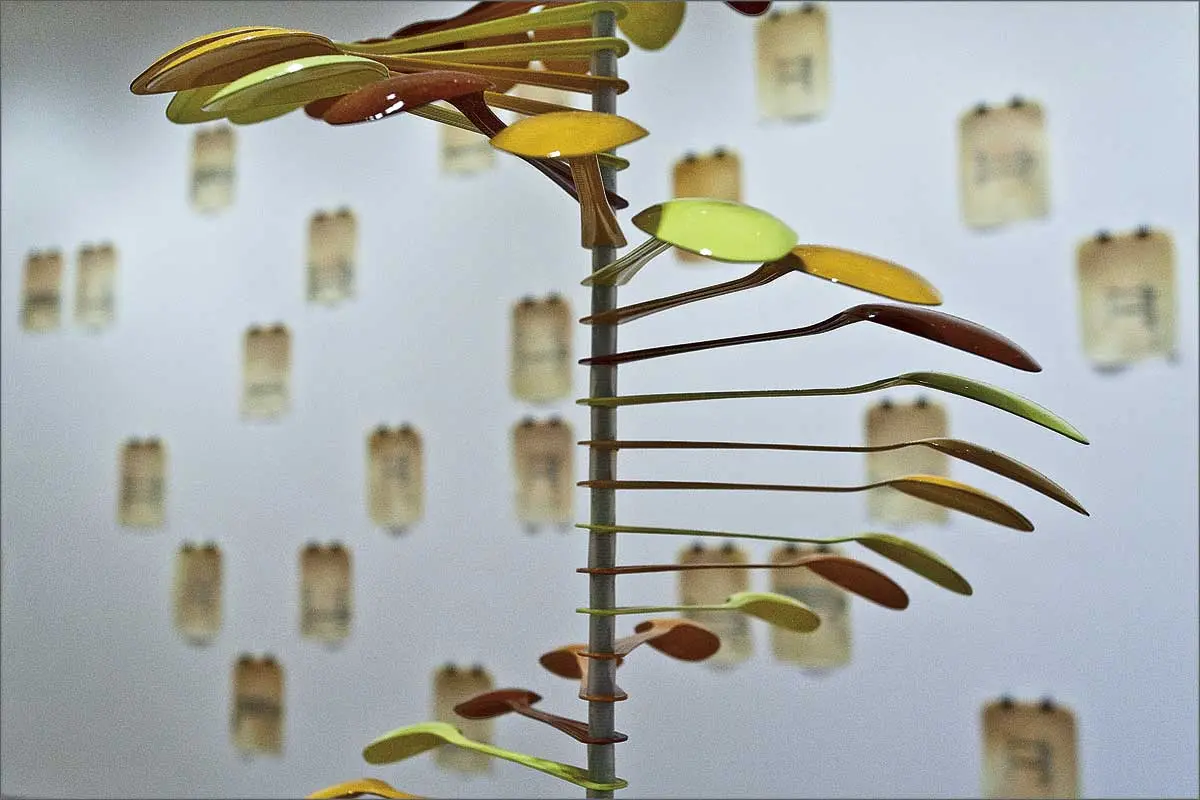
Anorexia Helix (2009) makes reference to one of contemporary society’s most acute problems. The artist begins with the morphological structure of the chromosome, formed by two strands connected in the shape of a curling staircase and popularly known as the double helix. The installation recreates in this way the tragic cadence of anorexia. The use of spoons, arranged face down, reaffirms the drama of the illness. The curling structure speaks of the fatal cycle in which the victim is trapped. A kind of narcissistic dream that turns into a nightmare. A cry of protest against the torturous symbols and the huge pressure exerted by Western culture on adolescent girls.
Desentierro (Unbury) (2001-2009) introduces new parallelisms. The work has two levels. On top, on the wall, the artist offers herself in an unusual self-portrait: blank ink on latex sheets that exhibit fragments of Ochoa’s DNA intended to encompass her personal identity in a language that escapes us. Under it, on the floor, fragments of asphalt, a petroleum derivative, generate a necessary analogy that from the present places us in a historical perspective — return to geology — and are thus transformed into the object of study of an unknown species whose legacy is rendered transcendent thanks to genetic reconstruction.
Provoking also a reflection about the ethical debate about the uses of the human genome, so dear to contemporary society, Nela Ochoa: Genetic Portraits is an intellectual exploration of some of our era’s most sensitive issues. The use of an apparent abstraction that reveals itself deeply realistic invokes perhaps a new kind of hyper-realism, where Chuck Close’s magnifying lens violates the surface of the individual with its implacable scrutiny in order to bring us, now taken by the hand by Ochoa, back to ourselves.
JANET BATET