According to Teresa Sánchez, her work represents the opposite of Colombia: it is harmonious. I agree with her. Without the pretensions of those creating chaotic and disturbing works that attempt to convey what is currently going on around the world and in Colombia, the sculptures by this artist born in Santa Marta, Colombia, appear calm and harmonious, and to have been conceived as the artist's notes: with devotion. They are achieved with affection, with the greatest of care and evident pleasure. But her wood carvings not only irradiate harmony; they also reveal clear relationships and, in all cases, a clear equilibrium. They entertain exact proportions.
The terms I have utilized here are true and are intimately associated with the artist’s production. They were elicited from observation. It is not an exaggeration, then, to say that Sánchez’s approach derives from the platonic conception of beauty, which is defined as the relationship between harmony and the proportion of the parts. The close to twenty sculptures in the exhibit titled Acoplamientos (Couplings) presented at the Galería Casas Riegner from May to July of 2009 are noteworthy for their admirable cohesiveness, which clearly conveyed the notions of co-existence, union, and correspondence; in other words, they possess harmonious and proportional characteristics.
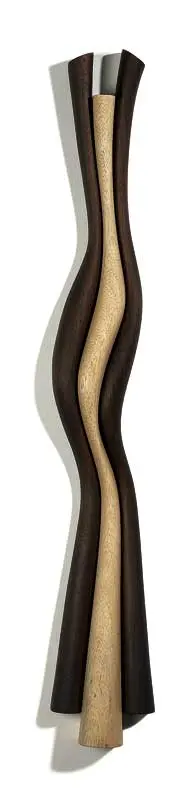
On this occasion, Sánchez grouped her works in three parts: Acoplamientos (Couplings); Volúmenes Lineales (Linear Volumes), and Ríos (Rivers). One of the works was created in 2007, and the remaining were produced between 2008 (the majority of them) and the present. The disciplined and articulated development of the artist’s abundant production during these last three years is remarkable. During the months prior to the inauguration of the exhibit, Sánchez focused on producing wall pieces. This group of works was splendid not only for its coherence but also because of the diversity of variations that could be easily observed. One could regard this group of works as a large family whose members have characteristics that resemble each other’s, but that are separated from each other by the variation in components, sizes, unions, separations, colors, etc.
The walk through the exhibition rooms – very well laid out by artist José Antonio González – where reliefs had ample autonomy, permitted the spectators to appreciate at once unity of forms carved in the manner of mounting waves, horizontally or vertically placed, which would remind us of a musical composition in which the themes reappear several times throughout the score. Individually, each sculpture consisted of many parts: its own color – the natural color of the wood used – particular streaks and stains; different size and thickness, and several couplings.
The exhibit revealed the creative process that has permeated Teresa Sanchez’s artworks during the past few years. The sculpture that represents this new departure in her artistic career is titled El Río (The River), done in 2006. It comprises fifty yellow wooden components arranged on the floor. This work is followed by individual pieces titled Volúmenes Lineales (Linear Volumes) and Acoplamientos (Couplings), which combine several linear volumes in a sole sculpture and are horizontally or vertically arranged. These sculptures were the most abundant of the exhibit and were truly eye-catching due to the perfect fitting achieved among its parts, but mainly because of their attractive undulations.
The artistic production by Teresa Sánchez occupies a notable place in the current Colombian world of sculpture. This is not only because of the undeniable quality of her creations but also due to her resolute intention of manually rendering truly high-quality works that also accomplish a sense of beauty, with clear and beautiful references to the always influential physical world that is perennially in a process of change, as suggested by the Greek philosopher Heraclitus many centuries ago.
GERMÁN RUBIANO CABALLERO