
Surrealism was a movement where for the first time ideas were born crossing borders, perhaps due to the cosmopolitan nature of the Surrealist formation from its beginning, which gave it great international impact.
Mexico, where the myth of being the quintessential Surrealist country expresses itself as an everyday reality, played a relevant role by becoming, thanks to its historical tendency to welcome others, the receptacle, and existential laboratory for the Surrealist movement to develop with unexpected force and originality. Impossible not to mention here the delirious paradise dreamt and developed by Sir Edward James in Xilitla.
Here, Wolfgang Paalen used the journal Dyn to relaunch Surrealism by liberating it from the baggage of any political implication, fostering the creative freedom provided by art-for-art’s-sake and privileging the artists on the basis of his or her transit through the world of dreams. Because of this, Surrealism in Mexico was practiced most fervently by foreigners, as Mexican artists were more involved with ideological concerns and themes of a political and social character..
Alice Rahon, a French-born poet and painter who was later to become a naturalized Mexican citizen, was already acclaimed in Paris by the array of celebrities who gathered at André Breton’s house, who liked to recite her poems.
In 1938 Rahon married Paalen and traveled with him to the caves of Altamira; before World War II exploded they reached Mexico following a journey through Alaska and British Columbia seeking prehistorical graphic signs.
In Mexico they found, who knows whether unexpectedly, a cauldron of cosmogonies where any new one, eccentric as it may seem, could be assembled in a fluid and natural way.
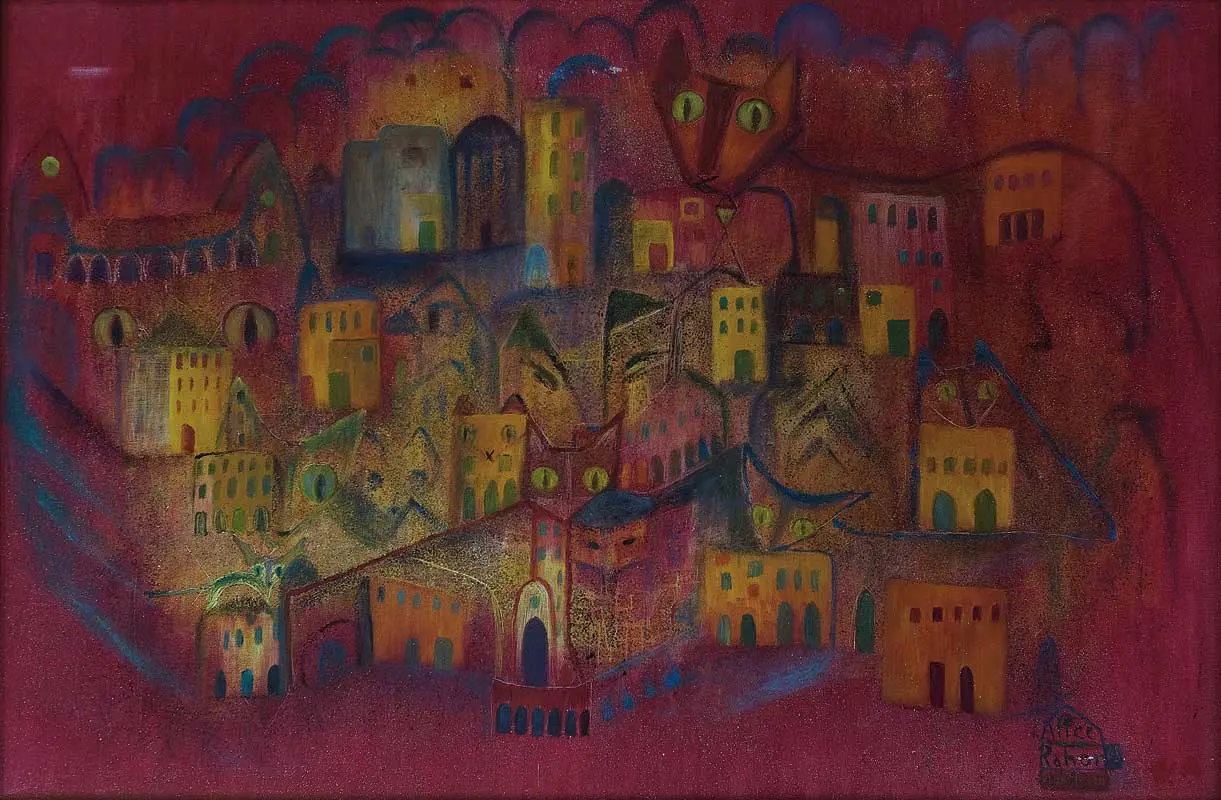
As they encountered Mexico’s rich indigenous traditions Rahon blazed a definitively personal path and established the initial points of reference for her work, laying the ground for a powerful and fascinating dreamworld built from sands, marble dust, and fragments of silvery or colored paper.
The itinerary proposed by this Alice Rahon exhibition at the Museo de Arte Contemporáneo confirms the fascination with the primitive, the unconscious, and questions about the creative act that marked early-period paintings such as the Ciudades interiores series, and even earlier ones, where Rahon uses a symbolic, child-like, poetical language similar to Paul Klee’s; she admired and paid tribute to Klee as well as Matisse and Miró, among others. To De Chirico she dedicated La sombra celestial and to Paalen, El tucán del arcoiris, and El país de Paalen.
More than on the line and on draftsmanship, like Remedios Varo or Leonora Carrington, Rahon materialized her poetry on the basis of lyrical sensitivity and sensuality, leaning on textures and on an extraordinary palette: “I was always fascinated by the idea of painting the air,” said the artist, who used techniques like graffito to give her paintings that ethereal feel.
To Frida Kahlo, she dedicated La balada para Frida Kahlo and El gato herido, the latter a clear allusion to Kahlo’s own Venado herido, which evokes the physical pain both artists endured throughout their lives.
Alice Rahon’s pictorial journey encompasses everything from primitivism to surrealism, and in the mid-1940s took an interesting turn towards abstraction without sidelining her symbolic themes, in a kind of integrative transition rather than a rupture. The fact that Rahon was a pioneer of Abstract Art in Mexico along with artists of Gunther Gerzso’s stature is often unacknowledged.
Rahon, a restless poet and artist, also explored theater and film, writing the libretto and designing characters for Ballet cósmico, Ballet Orión, and the exhibition includes wire-frame character prototypes and the original manuscript. She also made, with Edward Fitzgerald, a film titled Les Magiciens of which some still photographs remain.
A contemporary of Carrington and Varo, Alice Rahon nevertheless hasn’t enjoyed the same recognition achieved by these artists and has remained to this day a great unknown not only to the public at large but also to most researchers and critics, despite her prestige in life among her cohorts.
This vast show, with more than eighty works including paintings, photographs, poetry books, sculptures, manuscript letters, private photographs, and personal documents, should serve to give Alice Rahon the place she deserves in the History of Art.
RUBÉN BONET