The Venezuelan Arturo Herrera (Caracas, 1959) lives and works in Berlin, and is undoubtedly one of the most important creators of the XXI Century. His work – distinctive, heterogeneous, and multifaceted – has achieved an impeccable trajectory, having been exhibited at the most prestigious museistic institutions in the U.S. as well as in Europe, in MoMA collections in New York, and at the Tate Modern in London.
Although it may appear paradoxical, Herrera is also one of the most unknown artists in his country-of-origin, and it is only until now, with a fully legitimate career, that he returns to his birth country of Venezuela to show his work for the first time. Similar to his countrymen Meyer Vaisman and Jaime Gili, Herrera belongs to this expanding generation of creators formed in the diaspora. This list includes many other Venezuelan artists, such as José Antonio Hernández-Díez, Javier Téllez, Eugenio Espinoza, and Alexander Apóstol, who have faced voluntary or involuntary emigration as a globalizing experience of distancing that has reverted into a lucid and penetrating exploration into their local identities and survival strategies in art scenarios.
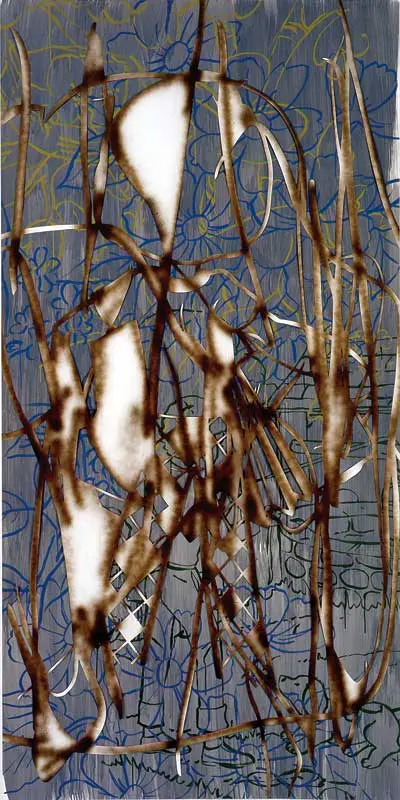
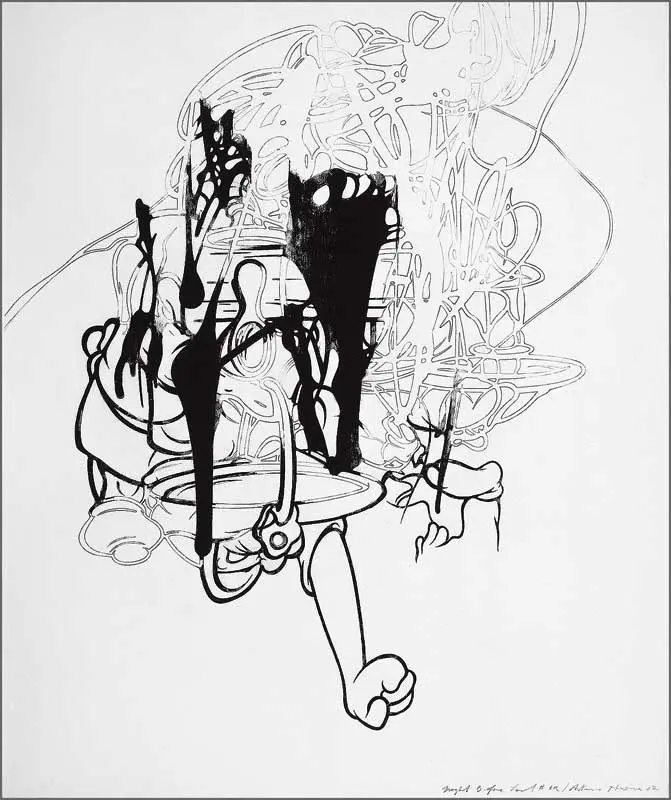
Herrera's work is highly complex and eludes categorization: some critics insist upon a post-psychoanalytic interpretation due to the artist's tendency to fragmentize consecutively cartoon silhouettes – through the collage technique – to create novel representations deriving from an abstraction that is at times gestural/mime and at others, more structured. The result is an imagined work of hybrid and mutilated forms that act as detonators of the viewer's memory and that would appear to emerge from his/her subconscious, displacing itself impetuously, as if it were a cinematic sequence. Notwithstanding this, Herrera's proposal appears to avert the surveillance of the abstract languages present in current art: recall that European and U.S. avant-garde demand the rigor and the esthetic purity of the form above the subjective content. What is noteworthy in Herrera's work is that which lies in favor of ambiguity, and the lack of precision that this represents. On combining the direct reading of elements of the popular culture with the entire enigma of Non-figurative Art, bringing together elements of Surrealism, Expressionistic dripping, and Minimalism, the artist sponsors the creation of a disquieting work, which is neither literal and understandable nor hermetic and abstract. In this regard, Herrera, as do so many other artists on the current scene, appropriates from Modernism to then reconsider and recycle it into a vital transforming operation.
Between the end of June and until mid-September, two individual showings of Arturo Herrera were exhibited simultaneously in Carácas. These aroused a collective extravagant outpouring of enthusiasm, nonetheless expressed in highly spirited local polemic argumentative forums, which must have been a great event on the museistic scale, divided as it was between two cultural spaces that, while not setting forth complementary proposals, and seeking as they did a premise to the utmost, achieved partial fulfillment of the deep and unfathomable vacuum that Venezuelan museums have created as a result of the erroneous cultural policies to which these have been submitted. The back has been given to contemporary culture, in its wake discouraging the achievement of the great individual expositions in a notorious and excluding ideological process.
With the exhibition Arturo Herrera/Ruinas Circulares, the D.O.P Foundation, in conjunction with Fundación Odalys, brings together in their spaces a set of 13 works belonging to distinct private and institutional collections; the curatorial proposal, a sort of brief anthology supported by a pertinent text by Lorena González, propitiated the adequate engagement of the reading of diverse stages of the artist’s production, building exclusively from the practice and view of collectionism. The Circular Ruins (1995), an exceptional photographic diptych, initiates the discourse of the exhibition in which drawings, collages, reliefs, and installations are shown, the latter carried out in distinct formats and spatially highlighting the mural paintings Untitled (Mural D.O.P.) and Forty Winks, both done in 1998. The exhibition included the apt interactive digital installation Almost Home, which belongs to the Dia Art Foundation collection, which focuses on the regional character of Herrera's work and the multiple readings on the structures and problematics proper to the contemporary visual culture.
At the same time, Arturo Herrera in the TAC Salon – in collaboration with Sikkema Jenkins & Co. in New York – and with the curatorship of Miguel Miguel, showed a broader set of the diverse series carried out by the artist in recent years. The catalog designed by Álvaro Sotillo is in itself another work, in that every copy is unique in an edition of 350 and includes an essay written by art researcher Gabriela Rangel. The exhibition was articulated by a series that incorporated the diversity of graphic and strategic construction techniques that the artist employs. The small collages and clippings of unpublished abstract forms on paper confront with their austerity the organic matrixes assembled on the five saturated and complex panels of the series Boy and Dwarf (2006), which defers to a wide modern inventory. The representations of their drawings acquire relief in a set of editions carried out in polyurethane on medium-density fiberboard (MDF), among which the work Wait (2008) is prominent; the latter is an interesting floor sculpture in which the characteristic profile of the arms and legs of a certain comedic protagonist undertakes a battle on raising his body or ending a tumble. Also highlighted is a series of dark felt cut-outs that are hung from a sole point to the wall, soft structures that between forms and backgrounds pulse the fragments in a frozen history, as occurs in Lucky, a mural painting created especially for this space.
Provocative and open to interpretation, the work of Arturo Herrera transcends, in its pathway through Venezuela, as a significant cultural experience for propitiating not only a revisionist reflection of agonizing art, exploded in the local debate in crossed polemics, recalling that even in its dynamics and impure abstractions in a fantasy world – a la Disneyworld – should be negotiated in the kingdom of the associations among the interstices of fragmented reality, desire, and utopian chimera.
RUTH AUERBACH