
To a great degree, the discourses that swirl around contemporary art tend to visualize and reveal a contradiction, and the exhibit by Barbarita Cardozo titled Made in is no exception. The Nueveochenta Gallery offers the following text as a referential framework:
“Made in is a structured project encircling a critical lens that focuses on the existing conditions of production in the fashion world. It is a research work that took Cardozo three years to develop in which the artist reveals the employment inequities and tensions generated between capitalist and communist schemes to remind us of the real sustaining force behind the sophistication and elegance merchandized by big Western brands.”
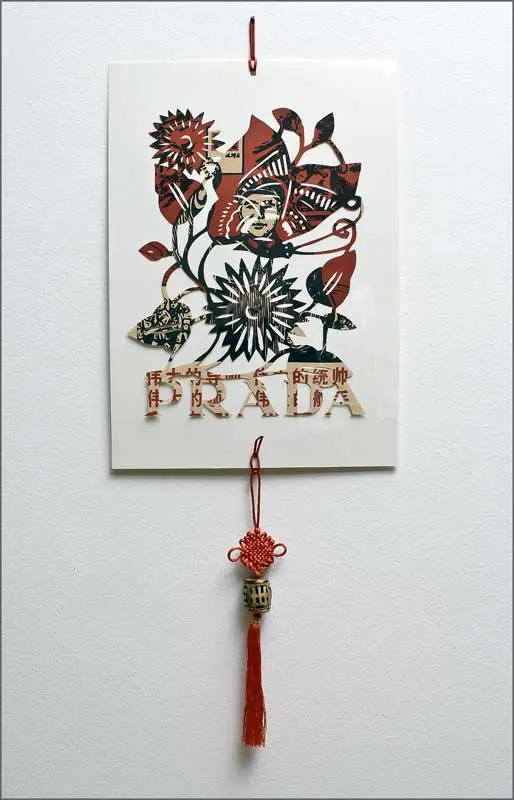
The elements highlighted by Cardozo touch upon nerves that generate tensions connected with the subtle feminine approach that it presents. They express a clear counterpoint between work done by hand and those that are mass-produced, a discourse employed ad nauseum, particularly within the context of work by a female artist. Made in incorporates embroidery, sewing patterns, paper cut-outs – that appear to be created individually – and stamped silks, among other materials. These represent ways of disclosing a research process that was initiated concurrently with Cardozo's development as a visual artist.
The Paper Cut-outs series leads the exhibition. Formally speaking, it contains a balanced combination of aesthetical proposals implicit throughout the research: made in China; delicate, intervened. It is communist propaganda engravings – acquired in flea markets – that have been cut out according to instructions from a basic book on local handicrafts. These form patterns that reconstruct logos from different brand names of clothing and accessories, two formulas combined into a highly memorable object. And once they merged, two similar, but not identical, situations are exposed; nine of the selected brands are those most frequently counterfeited in China manufacturing, and the other 18 correspond to an important commercial thoroughfare in London: Oxford Street. This exemplary montage makes these the crown jewels of the exhibit. They work as installations, and as a way to showcase the individual qualities of each object.
In Made in, the series of silks presented as banners adopts a discursive tone that differs from the previous one. The embroideries created directly in China bring together the language usually utilized to promote a “sale.” These are intervened fabrics that rely on the format used in Chinese calligraphy that here, once again, are denunciatory of Cardozo’s findings on Oxford Street. With this series, the artist attempts to demonstrate that all of these internationally prestigious fashion houses share the particularity of having their products manufactured in China. Therefore, the language of the "sale" serves as the context that is targeted at uncovering the deception.
Aesthetically speaking, this series is more complex than the remainder of the exhibition, given the nature of its support. The fabrics acquired in several parts of the world share a saturation of colors and patterns, flowers and leaves, as well as motifs and decorations. Their presence is powerful due to this, although it actually departs in a different direction from that of the previously mentioned feminine subtlety that maintains the works' aesthetics under strict control.
It is essential to mention Nimble Fingers, the publication by La Silueta Ediciones that represents the formal record of the situations experienced by Cardozo on Oxford Street. Does spending 29 days trying on clothes and cutting off their care-instruction-care labels really comprise an action? Perhaps, although it is also closely tied with a purely feminine and hedonist pastime that is recurrent in Barbarita Cardozo’s work.
ESTEFANÍA SOKOLOFF