
One could say that Carlos Runcie-Tanaka’s exhibit at The Station was fifteen years in the making. Jim Harithas, The Station’s director, met the Peruvian artist at the 5th Havana Biennial in 1994. But since then many momentous events occurred that both impeded and molded it: Runcie-Tanaka’s plight as a hostage, his participation at the 49th Venice Biennial (2001), the opening of The Station (2002), his serious cardiac episode (2008), etc. In December of 1996, he was one of the hundreds of people taken hostage by MRTA subversives during a fateful dinner party at the Japanese ambassador’s house in Lima. That unsettling experience drove Runcie-Tanaka to produce one of the main installations of Fragmento, his current exhibit at The Station Museum of Contemporary Art in Houston.
Runcie-Tanaka is an artist who has found in pottery his preferred medium of expression and has worked within its usual utilitarian purpose and beyond it. In fact, his work sparked a lively discussion about the distinction of art and craft, artwork, and utilitarian object –issues that had found at least one solution at the Bauhaus. Indeed, in a pamphlet titled Exhibition of Unknown Architects (1919), Walter Gropius established his objective to be “to create a new guild of craftsmen, without the distinctions which raise an arrogant barrier between craftsman and artist.” These same issues, however, have often generated schisms in the Peruvian art community. It is not that Runcie-Tanaka aimed to resurrect the debate; it is just that his work simply does, in part because he has followed a path of artistic self-discovery that coincides with traditions of art somewhat at odds with common contemporary practices. His surnames bear witness to his diverse ethnic background: British, Japanese, and Peruvian. Although he has learned the craft of making pottery in Peru, Italy, and Japan, he has driven his art by responding to contemporary art, and the joys, enigmas, and contradictions of his Peruvian upbringing. Runcie-Tanaka does not have a nationalist or ethnic agenda, only an artistic one. Yet in his works, one recognizes the cultural tracks that belong to his homeland.
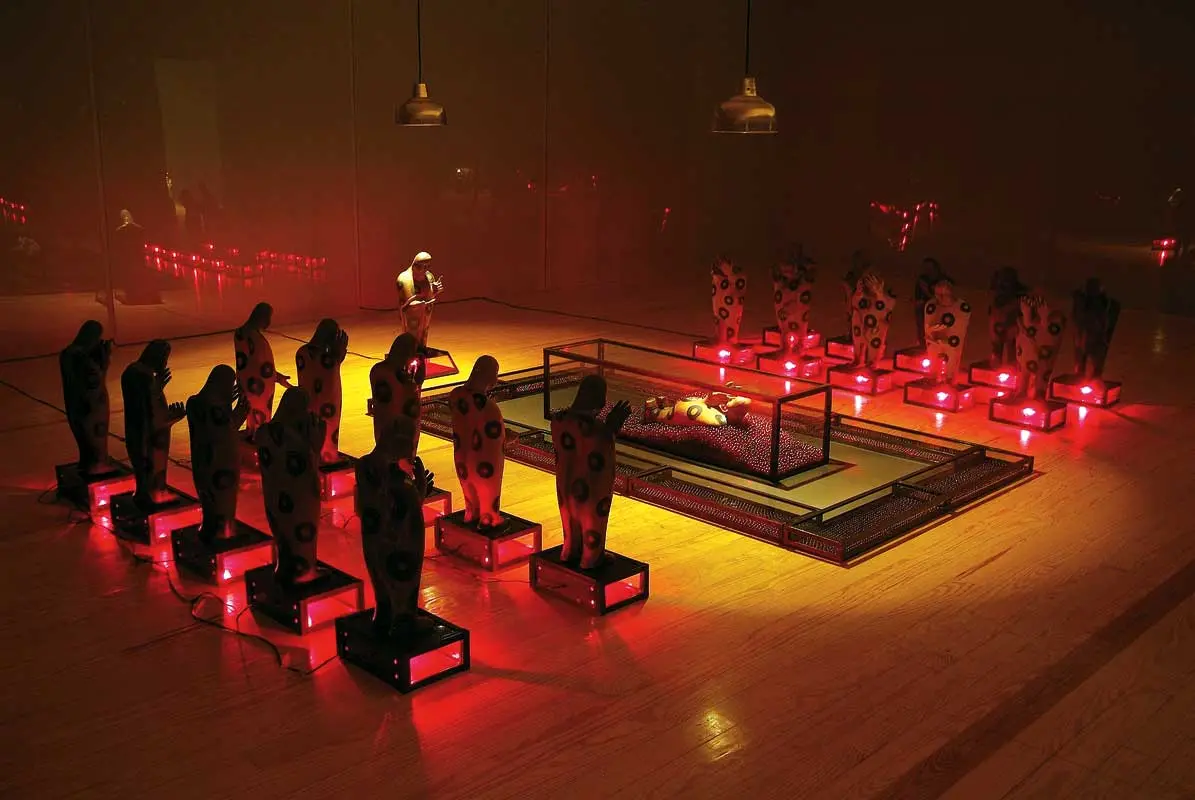
The installation Tiempo Detenido / No Olvidar (seized time, never forget) (1997-2006) is his artistic response to the experience of being held, hostage. It consists of twenty-two ceramic human figures about 60 cm tall. Their hands emerge armless from their trunks and their heads are egg-shaped. They are also peculiar in that only their hands express emotions while their faces are expressionless. They resemble cuchimilcos (1200 A.D.), clay figures from the Chancay Pre-Columbian culture. In works where Runcie-Tanaka has used a multitude of these figures, the ensemble resembles the terracotta warriors of Emperor Qinshihuang (220 BC). One of the figures lies inside a glass box on a bed of red marbles as if it were a corpse in a coffin. Another figure seems to head a ritual ceremony and to be absorbed by the red marble he holds on the palm of his right hand. The other twenty figures are aligned along with the glass box as if they were in a funeral.
Had the aforementioned connection with political violence not been drawn, what the viewer would see in this installation is some kind of exotic ritual. But because the work is connected to the acts of violence that occurred in Peru in the late 1980s and 1990s, the informed viewer may be inclined to see in this scenario one of the thousands of funerals of innocent victims; many of which circulated in the printed media of Peru and elsewhere. The red marbles on the hand of the “shaman” and under the prostrate figure become blood. The main figure with blood in his hands is both complainant and apologist of violence. Is the figure inside the glass, helpless by being boxed-in and/or by death, the artist himself?
The other works in Fragmento escape figuration and are composed of broken pieces of utilitarian ceramic pieces (plates, bowls, etc). Progresión Orgánica (organic progression) (1988-89) is an abstract log or body made from fused fragments. Runcie-Tanaka often tells the story of Japanese master potters who discard into the river every defective or broken ceramic piece, so that only the perfect ones survive. Rebelling against this tradition, Runcie-Tanaka keeps the pieces and recycles them into new works “in an attempt to keep their spirit from perishing and to give a new life to objects and things.”
Manto (1978-2006) is another such a work woven together by broken ceramic pieces held together in an enormous horizontal box with a glass top. This abstract collage of ceramics is reminiscent of Antoni Gaudi’s benches at Parc Güell covered with broken mosaics and of Julian Schnabel’s enormous paintings with broken plates. Similarities notwithstanding, in Runcie-Tanaka’s works, there are other angles to be considered. First of all, the word manto translates into something as poetic as “shroud,” or into something banal as “blanket.” Archaeologically interpreted it is also a layer in an excavation that surrenders invaluable information from the most ordinary objects. Indeed, Runcie-Tanaka’s Manto is composed of fragments of his most utilitarian objects. But Manto in Greek mythology is also the name of the daughter of Tiresias, derived from the Ancient Greek word (seer or prophet). So Manto is a work that reveals the past as much as it foresees the present and future as something solid and broken, diverse and chaotic, damaged, and reconstituted.
The Huayco / Kawa / Río (2003-2009) installation occupies a long corridor that suggests a riverbed. It is made up of twelve spherical boulders each of which is made of broken ceramic pieces fused together in the kiln. The word huayco is Quechua for “mudslide” –a natural phenomenon that recurs in the Peruvian highlands often with devastating effects and loss of human lives. However, Huayco is also the name of a Peruvian avant-garde art movement of the late eighties. So there is the negative natural calamity that is a huayco and a positive artful provocation named Huayco. Although Runcie-Tanaka was not a member of that movement it is clear that his title takes its positive spin from it and fuses it with his rebellion against the Japanese tradition of discarding imperfect pieces. Indeed Runcie-Tanaka’s whole exhibition is an attempt to infuse what is broken with a second life in and through art.
FERNANDO CASTRO R.