For five decades, Puerto Rican artist Carmelo Sobrino (Manatí, 1948) has been able to translate in his painting different facets of the complex reality of this beautiful but deranged Caribbean island. His mastery of drawing and painting, from classical figuration to the avenues opened by Latin American figures of the caliber of Torres García, from his colorful flowers to his discreet but intense dialogs with the New York School and Cy Twombly, his development of an original pointillism very much his own and his use of post-modern Pop have allowed him to freely move from portraiture and still life to provocative paintings of “rice and beans,” hamburgers and codfish fritters; from his vision/philosophy of the Puerto Rican “traffic jam” (in an island of 4 million people, there are 2 million automobiles), to his poetic aerial landscapes or his spectacular murals (where he freely converses, especially in his monumental work at the Museo de Arte de Puerto Rico, with Tanguy, Klee, Gorky, Miró, and Matta).
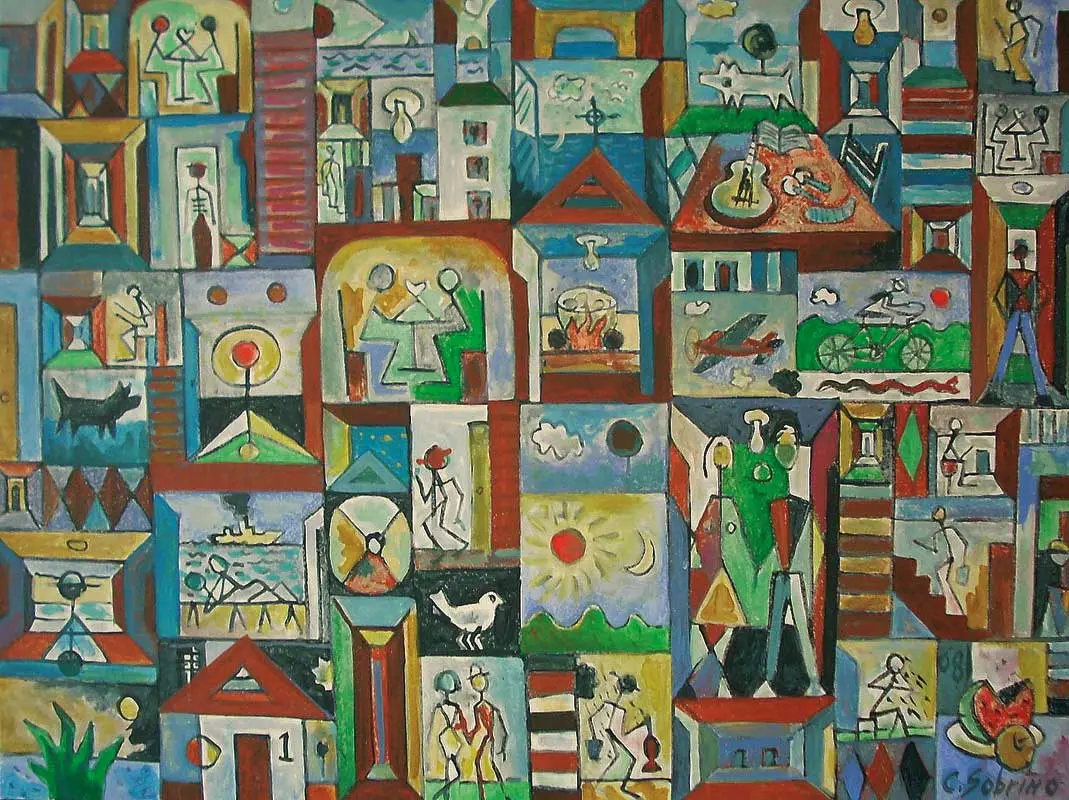
Four years ago, the artist presented some compositions in a graffiti vein, made using wires, and two years ago he offered a series of modernist sculptures in metal and industrial-grade rope, of an astounding lyricism. Now, however, Sobrino — forever in love with love itself, and a voracious reader of books on love, of those that deal with the new Existentialisms — presents us with a series of small-format paintings (18” x 18”) where he represents/”analyzes” the dynamics of heterosexual couples — compositions that have dazzled both critics and local collectors and interested the Museo de Arte de Ponce in organizing a future exhibition.
As we see, if there is an artist in Puerto Rico with the genius of reinventing himself every so often, it is Carmelo Sobrino. What gives unity to his work, however, is its iconography —an iconography he uses skillfully in his original pointillism, a discourse that has made him one of the most widely recognized among Puerto Rican artists residing in the Island or in the US. One can immediately identify Sobrino’s work —the same occurs with Domingo García, Arnaldo Roche Rabell, and now Melvin Martínez — and his works are not only part of the permanent collections of Puerto Rico’s most important museums — the Museo de la Universidad de Puerto Rico, the Museo de Ponce, the Museo de Arte Contemporáneo de Puerto Rico, the Galería Nacional de Puerto Rico, and the Museo de Arte de Puerto Rico — but are treasured by the country’s most discriminating collectors.
Sobrino’s “pointillism” is built around an iconography that is diverting and full of profundities — small houses, small zeros and crosses, rudimentary human bodies that could have been made by a child, imperfect geometric structures — that in the end produce swarming beaches in a beautiful Caribbean day, rural or urban landscapes, fruits, flowers, nudes, typical dishes, everyday scenes and, now, games among couples.
For Sobrino, human relations are as necessary as they are difficult — specifically emotional relations, and above all the romantic kind. According to the artist, “when we ‘fall in love’ — unrequitedly or otherwise — everything changes. The sun ceases to be and that planet that before was unimportant begins to define everything, every single orbit. Everything becomes a new ‘game.’” And it is here — between love, passion, and insecurity — where the artist is most successful in creating compositions that display the necessary balance between poetry and play. This is why this series of paintings have so much of the best love poems —specifically Neruda’s and Cardenal’s — and clear elements of the comic (and the influence they have exerted on art, from Lichtenstein to the contemporary “comic art.” For Sobrino, in these works “everything is possible. Everything can happen: just like in love. We see everything from a couple enjoying food to a couple dancing sensually, from the most evident eroticism to the ugliness of jealousy. From living your innocence to the most brutal manipulation.” The artist sets his characters/objectives to dialog. Seen as a whole, the series can be understood as a chorus of lovers — in the present, the past, or the future — of the most significant relationships, of that which gives life its meaning, “Because,” Sobrino says, “love is necessary, and fun, and frustrating, and painful, and we continue to seek it throughout our entire life.”
Asked whether this series is autobiographical, the artist laughs and says, “If human relations and love are not autobiographical, what is?” There might be those who see these compositions as something “light,” but they are the opposite. Sobrino wants his scenarios to be “light” at first sight so that realizes all the possible depths, “from my tribute to Torres García to my thematic similarities with artists like Fiscal or our Nick Quijano.”
I believe that once again Carmelo Sobrino has proved to be an excellent analyst of the images reflected in the multiple mirrors that capture Puerto Rico in an instant. His work, always provocative, always spiritually and sensually enigmatic — reveals a profound knowledge of the human condition. Although the artist started as a simple shoe-shine boy in his native town, Manatí, his scenarios and “radiographies” of his beloved island, his discourse, achieve what François Pinault said of all good contemporary art: “what I seek in good art is for it to surprise and define me.”
MANUEL ÁLVAREZ LEZAMA