
Christian Bendayán, a realist and self-taught Pop artist, presents the exhibition Luz (Light), thus titled because seven large-format pictures have light as their theme. They present different forms of light: natural light; the light of a bar; the intimate light of a bedroom, and light in funerals. The artist also wishes to show “the idea of the ephemeral nature of life and the passage of humans through it”. Bendayán, a native of Iquitos, the largest city in the Peruvian jungle and a current resident of Lima, traveled to his birthplace in search of the themes and inspiration for carrying out this exhibition.
Bendayán's images make one feel what one observed; they exert an impact. In the work titled Párvulo (Small Child), we see a baby's white coffin. The infant's gender is unknown because there are no pinks or blues that define the sex of the little one. The only thing that is seen is a photograph of the mother with the baby in her arms. The photograph, in an orange frame, comprising the strongest color of the work, hangs on a crucifix behind the coffin. Adhered to the photograph is a small stuffed lion that was the baby's plaything. Although the gender and the identity of the baby are unknown, the picture moves the viewer, it arouses pity, and one wishes it to be an invented picture, that it is not real. But with the inclusion of such a plethora of details, one becomes aware that the photograph indeed is real. It is a daylight scene, there are no shadows, and the light, although switched on, does not illuminate. The wall, the floor tiles, the curtains, and the coffin are white, to symbolize the pure spirit of the tiny creature.
Because this exhibition is on the ephemeral nature of life, Bendayán presents to us another work of a funeral parlor, titled Velorio (Wake). This work is life-sized and measures 2 × 3 meters. In this work, we do have more information, and we do know that the deceased is a male, because a soccer jersey is found atop the coffin. Also on top of the coffin is a floral arrangement with red roses and yellow flowers, and a note with an image of Christ that says: "You will always live in me, my son." It is a night scene because the lights are lit and the funeral parlor is dark. Contrary to the baby's funeral parlor, where the floor is dark, the walls are dark pink, the drapes are grey, and the bases of the lamps are black. At one side of the coffin, there is an elderly man with a baseball cap, playing the violin, with his eyes closed and his mouth pursed in a frown. One can guess that he is a relative of the deceased, perhaps a brother, and the pain can be seen in his face. One is nearly able to feel the music due to the tranquility of the scene; portraying the man with his eyes closed places emphasis on the melody that he is playing.
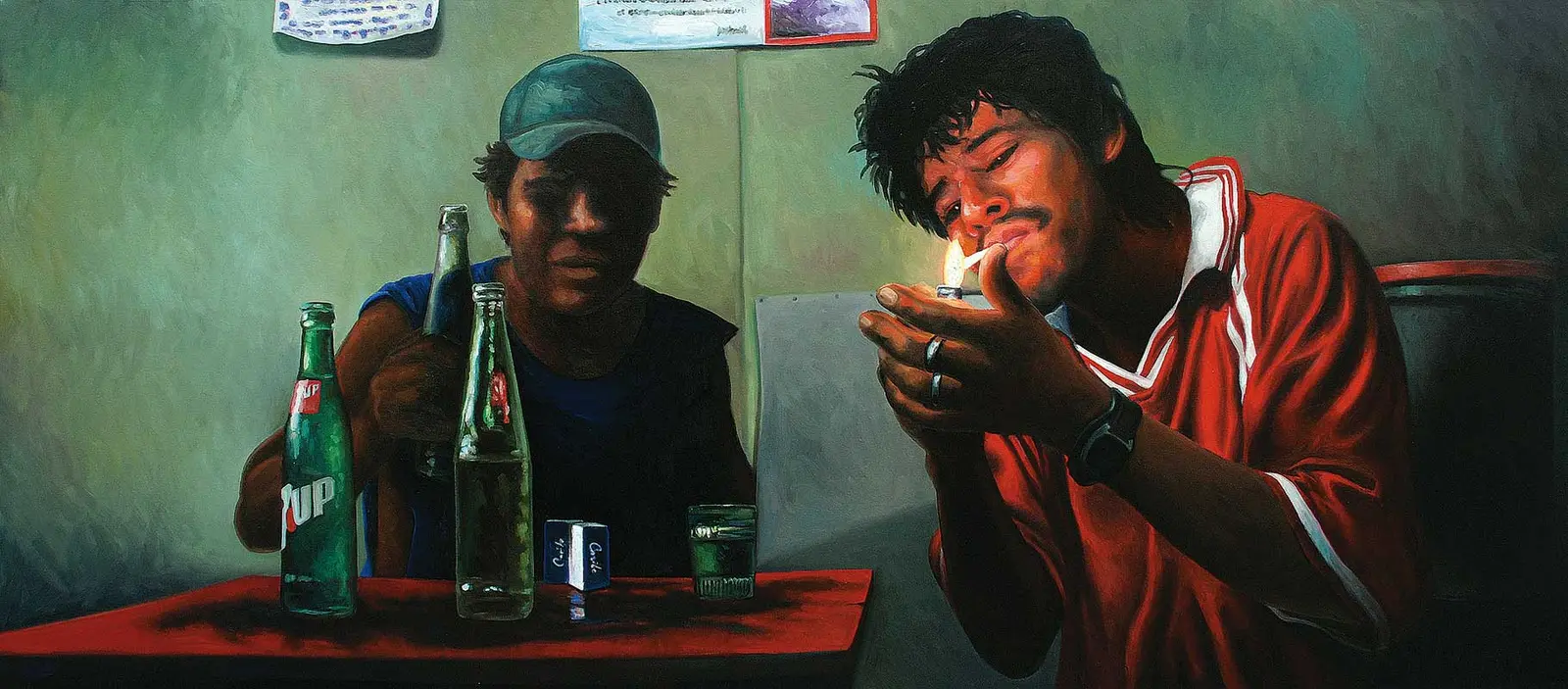
In the work Aguardiente (Distilled Spirits), there are two young men in a bar; one of these lights a cigarette, which illuminates his face in the dark surroundings. The bar is so poor that there is no ashtray on the table, and the decor on the wall comprises a piece of paper and a card that is stuck to it. One of the youths wears a sleeveless shirt, while the other is attired in a soccer-team jersey. These two boys work as stevedores in the Amazon River port, earn little, and are exploited because they carry large and heavy boxes on their backs. The picture represents the loss of many local youths who work to pay for their vices and who live poorly.
In Mediodía (Noon), it is a very sunny day, there is a big, empty park, with a boy more or less 17 years of age lying on the ground sleeping. He has no pants on, only briefs, a sweater, and is barefooted. The boy is so inebriated that he has fallen asleep; he appears to be comfortable, lying with his head and body on the ground, sleeping as if he were in his own bed. For this work, the artist took various photographs of the park and afterward found the boy sleeping in another place. He later joined the images of the photographs to make this work. The artist comments, “I painted the picture Mediodía in reference to journeys that are interrupted by misfortune, to people who become lost and who approach solitude, the vacuum, and death to such a great extent when life, represented here by the day, only has been lived halfway.”
In Anunciación (Midday), we find a woman seated on a bed and dressed as an entertainer in a topless dance bikini. The light is intimate; only the bed and the woman, who is pregnant and near to giving birth, are visible. The model for this work was Bendayán's wife in her ninth month of pregnancy. Here, the artist symbolizes the gestation of a provincial subculture, the members of which come to live in Lima and continue to live according to their customs.
The natural light of this exhibition is in the picture that measures 2 × 5 meters, titled Cielo (Sky), in which there is a sunset with dark blue and purple clouds, but where there are also light-colored clouds, yellow and orange. In the sky are hundreds of birds flying in all directions. Here, the artist makes a metaphor of life with the color of the light and the dark clouds, signifying the good and the bad. The dark clouds cover 70% of the picture. And the birds are people going in all directions, as we do in this world.
With this exhibition, Bendayán makes us think about the manner in which some people live, falling from vice and ignorance, and that all of us arrive at the same end: death. His pictures of funerals are a reminder of where, someday, we all will arrive. His pictures of drunks allow us to see that we are weak. The presentation of the works is masterful and creates an impression on the observer. The artist's themes are strong but are as in life. Bendayán represents them with no filter. His pictures, more than takes of the life surrounding us, are themes that exert an impact, and this is the best part of his work.
AUGUSTO CHIMPEN