
The first time I noticed Douglas Pérez’s visual work was at the Centro de Desarrollo de las Artes Visuales, in Old Havana. It was May of 1994, and this Cuban artist was exhibiting a few paintings in Los dados de medianoche, a group show parallel to the 5th Havana Biennial. It was a huge time and place for a 22-year-old who was still a student at the Instituto Superior de Arte (ISA), where we were later to become a professor.
I still remember the placement of those paintings. Their physical scales harmonized with allegorical, discursive grandiloquence; with the works verbal supplements, McEvilley would perhaps say. I remember the favorable impression caused in me by Pérez’s mastery of certain formal resources, even referred to in some of his titles; the historical and carnivalesque re-signification of universalized myths; the postmodern parody of rhetoric, also the visual one. But I can’t remember what I wrote on that occasion. I never published my notes on that exhibition, and I ended up misplacing them.
Fortunately, the show’s graphic archive allows me to refresh those images and to confirm that the snake, one of the most persistent symbolic figurations in Pérez’s poetics, was already present in the diptych Nacimiento en falso soporte de la República. This atavistic representation, which emerged in that painting like a long sea serpent, reminded me even of a Silvio Rodríguez song: Sueños con serpientes...con cierto mar de serpientes sueño yo…
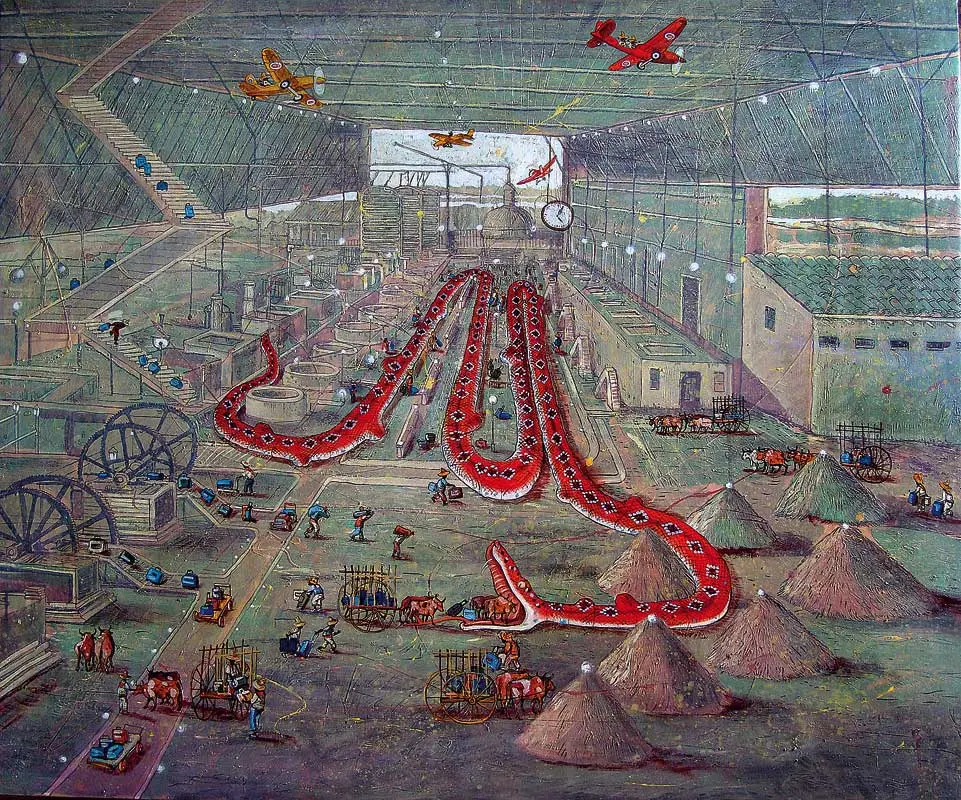
From singular presences in Pérez’s exhibitions, they became legion in his most recent show. Revered in some civilizations, feared or transformed into the source of all evil in others, they reproduced thanks to Perez’s brush and imagination. He magnified and pluralized them as expressive possibilities.
Duplicity, treachery, hostility, power, curse, venom, death; but also water, fire, hearth, cure, fecundity, and wisdom: these are some of the ideas associated with these reptiles in different mythopoetic models around the world. And although they don’t have to adjust themselves to such connotations, Pérez’s snakes do carry an immanent cultural symbolism in a dimension of maximal generality: the anthropological dimension.
As in the Book of Genesis, the artist places the serpent in an intrinsic relationship with human beings. But the symbolic implications are different. Perez represents it often in its animal morphology. And he sometimes alludes to its anthropophagical impulses. He can transform its “mouth” into an entryway to the mechanism of manufacturing (esta al fin me engulle...) or transfigure its body into highways and beltways where traffic flows at a machine-like pace (y mientras por su esófago paseo / voy pensando en qué vendrá, continues the song by the Cuban troubadour).
The snake’s characteristic sinuous movement engenders an intricate pictorial syntax: a serpentine structure, suggestive of entropy. A viewer who found me taking notes on some of the oils included in the show Por amor a las moscas commented: “This is chaos, the end-all.” We were surrounded by some twenty paintings with apocalyptic projections, paintings that were not only framed representations but also vivid spectacles, symptomatic of anomalous states.
And although Perez appealed to narrativity and subjectivism, he wasn’t doing social chronicle as such. He hybridized reality and fiction in a prospective way and with a looseness of brushstroke that kept its distance from documentary verisimilitude. Different temporal planes came together in urban-like visions, where painting and topos became integrated into a neologism, Pictopías, to name and give meaning to a series.
Utopia is not only an unrealizable chimera: it is also the non-place, a space that globalizes and loses its original identity. Nevertheless, Pérez made some landmarks, nodes, and pathways of the city where he lives and works—Havana—clearly recognizable. He arrived at a personal interpretation of the global. Physical space and historical time did not disappear: they amalgamated, perhaps, in the chronotopos.
Pictopías is not a new series. I first saw it in Cosmos, a group show held in 2007. Most widely, I later found it at the 10th Havana Biennial (2009) and, more recently, at Galiano Gallery. It is a series that renews itself, like the skin of a snake, without losing its characterization or essence. It is always revisited, like the serpent that emblematizes the cyclical nature of history.
In Pictopías, Pérez recycles, to a degree, almost twenty years of artistic production. Some of the topics and concepts revisited here are his tributes to the history of art and to the comics, human labor, the refinery as the manufacturer of sugar and of ideas, the issue of race, the city and the countryside, the element of play in art, fauna with anthropological implications… In this way, he seems to be chasing his own tail, like the famous snake. One of the eternal returns, that is.
ISRAEL CASTELLANOS LEÓN