
Initiated by Carmen González and Leslie García in Tijuana in 2003, Dream.Addictive is a collaborative artistic and technological project that approaches technology and its symbolic potential from the perspective of the interrelation of elements derived from computational physics, visual programming, and hardware development. González and García have consolidated their artistic process with interactive installations that play with the boundaries between the oneiric and the virtual.
Some weeks ago, they presented at Estación Tijuana – an expositive and dialogic initiative headed by artist Marcos Ramírez “ERRE,” a few meters from the Mexico-U.S. border – their most recent work titled, Deep Thought, The Audio Entropy Machine. The main exhibition room at Estación Tijuana had on two of its walls a three-dimensional diagram of loudspeakers connected through a pattern of geometric circuit wiring and moving sensors that became activated when visitors passed by; a third wall showed a projection with diagrams and computational process operations. The programmatic sensitive-sonorous set on the wall, designed by Dream.Addictive, is connected to a database that generates phrases, which are enounced by a single voice that mentions various personalities and thinking currents from the Twentieth Century.
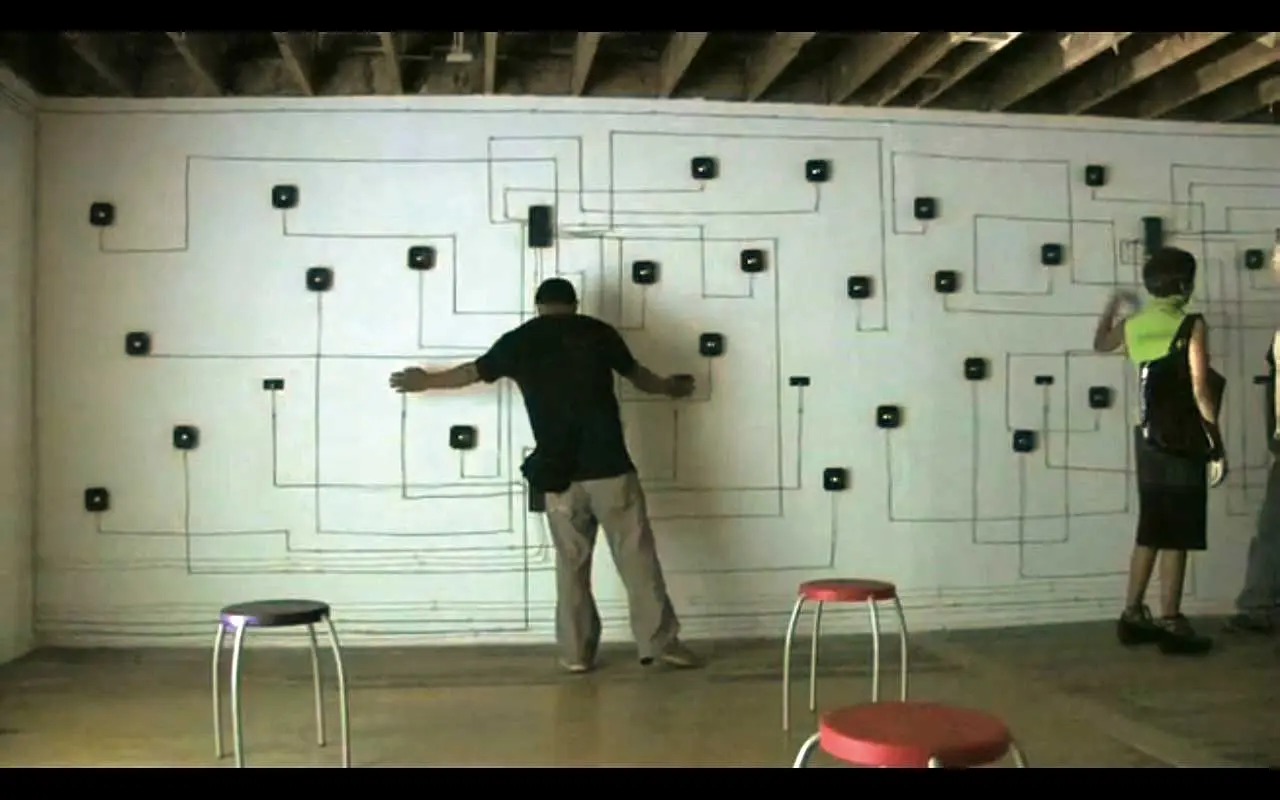
Upon perceiving body movements, each sensor activates a random audio selection in the program in such a way that as the spectator walks around the perimeter of the room, he/she receives a series of auditory shots in a sequence whose “logic” cannot be immediately understood amid all the phrases, maxims, citations, and declarations, such as the following: “No culture can live, if it attempts to be exclusive” (Mahatma Gandhi); “I shut my eyes on order to see” (Paul Gaugui); “There is only one way left to escape the alienation of present-day society:to retreat ahead of it”(Roland Barthes); “It is appallingly obvious our technology has exceeded our humanity”(Albert Einstein); and “Art is anything you can get away with” (Marshall McLuhan).
The number of declarations enunciated with the same human-technological tone of voice (which does not name the authors) generates in the spectator the imprecise but recognizable effect that inhabits mediated societies: the fragmentary, multiplicity, disparity, and the discontinuity of the unique and/or univocal sense. Inactivating these de-structural “characteristics” between the message and the referent as a device of modern-vanguardist roots (Cubism, Dadaism), the provocation to encounter this apparently meaningless discourse of postmodern resonance, is capable of inciting a sort of longing in the spectator to – still – find the remains of a logical skeleton instead of randomness, in order to trace the outline of the diffused sonorous body through which the installation permeates its own.
Entropy in computation designates the randomness used by an operative system to work with information and chance. It is generated and managed by hardware systems that work with remote data, in a way similar to the movement of the hand on the mouse, or like that of the body before a technologically sensitive surface. Nevertheless, entropy (whose Greek origin means evolution or transformation) is a thermodynamic concept, coined in the mid-Nineteenth Century, to designate the amount of energy utilized in a system. It is an essential energetic residue for performing the work that apparently will have to be scorned. It is a procedure through which the nature of bodies/systems randomly distributes the energy to maintain it in equilibrium; given that a system that finds itself under improbable conditions tends to reorganize toward a “more probable” condition, which response due to a natural tendency.
Considering both aceptions and applications – computational and physical- chemistry (thermodynamics) – the performance and the phrases of the Dream.Addictive entropic machine appears to root its meaning in a rhizomatic manner. Even when the selection of discursive fragments seeks the function of art within the capitalist machinery, its poetic and substance only reaches the maximal degree of random benefit through thermic-programatic conjunction. Because the body itself can turn out to be entropic in the mainstream of the art market, it must be used in order to function. Without the visitors' close presence (no further away than 10 cm), the exhibition would remain silent, contained in a fruitless pause – a silent technological execution that, despite its apparent self-generation/sustentation, depends upon the human body to be expressed.
Prior to the gestation of “diffuse logic” by Lofti A. Zadeth, which is contained in the entropic sonorous machine by Dream.Addictive, Theodor Adorno would affirm that the essential distinction between artistic and scientific knowledge resides in the fact that in art nothing empirical remains intact, in that in art, empirical events only acquire objective meaning when accompanied by the subjective intention. Deep Thought would appear to return to the desire for that same declared intention: that is, to turn the entropic body into a need manifested.
MARCELA QUIROZ