In the context of the celebrations of the city of Córdoba’s candidacy to European Cultural Capital, the Córdoba Ciudad de Cultura Foundation promoted 16 cultural activities or various characters, organized throughout 2009 by the four public institutions that comprise the Foundation: the Municipal Government, the Office of the Córdoba Deputy, the Andalusian Council, and the Universidad de Córdoba. This program, presented under the umbrella title of Córdova en clave 16: El futuro tiene raíces, attempted to situate Córdoba’s cultural offerings in the Spanish and international landscape, promoting those values that signal the city’s particular identity and orchestrate an outstandingly rich and solvent patrimony into a cultural and historical narrative.
The contemporary art shows El patio de mi casa, curated by the prestigious Cuban critic and curator Gerardo Mosquera from an original idea by Carlota Álvarez-Basso, director of the 2016 Córdoba Ciudad Cultural Foundation, opened within this propositive framework in cultural and artistic management. The show, without a doubt, goes beyond any classificatory scheme in use and becomes a tale of inquiry into the intimacy of the other. A promiscuous inquiry, with a certain degree of voyeurism, that supports the values of complicity when it is established on the laudable anchors of dialog and mutual understanding. More than an art exhibition in traditional terms, it is a tribute not only to contemporary art’s potential for adaptation and camouflage but to the dazzling beauty of the majestic cultural patrimony contained in Córdoba’s shaded patios, traversed by the weight of a historical memory that knows about exclusion and bondage as much as it knows about reconciliation and dialog. On the strength of so much beauty and with regards to its malleable relationship with each artist’s aesthetic proposal, each set is an exercise in exorcism, in giving, a conspiracy of the senses. The final result has been a perfect coupling, the well-orchestrated gymnastics of verb and form, the saturation of a pleasure that is sometimes denied and stolen by the cynicism of the poseur.
Very seldom have I been able to enjoy with such intensity a curatorial proposal with a narrative structure based on the intervention of contemporary artworks into traditional spaces or spaces in context selected for such purposes. In that sense, one of the show’s greatest virtues is the way it opened up the city, proposing a different kind of dialog with its most private spaces: its patios. Spaces where, on the other hand, we corroborate an extremely intense process of cultural exchange. They are the support of a cultural memory that knows of crossing voices, of anguish and redemption, of moments of expansiveness and enjoyment, of allegories of freedom. We must not lose sight of the fact that, as is stated in Los patios cordobeses (published by Obra Social y Cultural de Caja Sur, 2001) “…Romans, Muslims, and Christians identified patio culture as a particular way of thinking, seeing, and feeling life. In their way and style, each one of these cultures transformed the patio into a cardinal point towards which, like a precise compass, the entire life of the household was directed. A philosophia vital that has extended over time and reaches into the present, especially in the patios of neighboring houses, epiphenomena of an era that is reaching its end.”
Another great virtue of this project has been the way in which a close dialog of compromise and respect between artists and owners was established. The majority of the proposals externalize this and make it evident, even in a visceral way. Tradition and modernity, the private and the public, the social and the intimate, high art and popular culture: these are but some of the polarities on which the proposal operates in such a splendid way.
Another important element, mentioned as a general consideration, is the fact that despite it being a commissioned curatorship, where each artist was assigned space and asked for a proposal, every one of them, without exception, presented an intervention where the outlines of their own work and the signs of their identity are clearly recognizable. In no case do we notice an abandonment of the emphatic coordinates of their usual poetics, and there are even cases—another significant achievement—where the need to articulate and dialog with the new scenario helped emphasize even more those indications of identity and emblematic elements that make each poetics recognizable.
In this way, the show acts in a dual sphere: on the one hand, it offers a dialogic proposal with contemporary creation; on the other hand, it unveils the spectacular beauty and the generosity (a major crossing of lights and shadows if we ever saw one) of traditional Córdoba patios. This turns the exhibition into a stage, giving it the status of an aesthetic event, a “situation of the place,” given that its logic of exhibition and intervention happens in that threshold of tension between the private and the public spheres. A space, moreover, where each family remains immersed in their everyday activities. This restriction has been precisely one of the project’s premises. Something that, far from resulting in a defect, produced a high level of aesthetic seduction and profit and effectiveness in the solutions presented. This, as the curator, says, “not because of the challenge of achieving a productive balance, but because it allowed to press and investigate the relationship between public and private realms, between art and everyday life. It could also be a motivation for the work of some of the participating artists. This makes me think of a soft, subtle exhibition that would foster a hushed conversation between art and patio. A delicate, tranquil spirit will prevail, refined both in its formal and its conceptual aspects.
This assertion is corroborated as we follow the emphatic cartography in which each intervention is a delicate, opportune, and efficacious gesture of integration and dialog, of an absolutely correct synthesis of the contemporary practice of art.
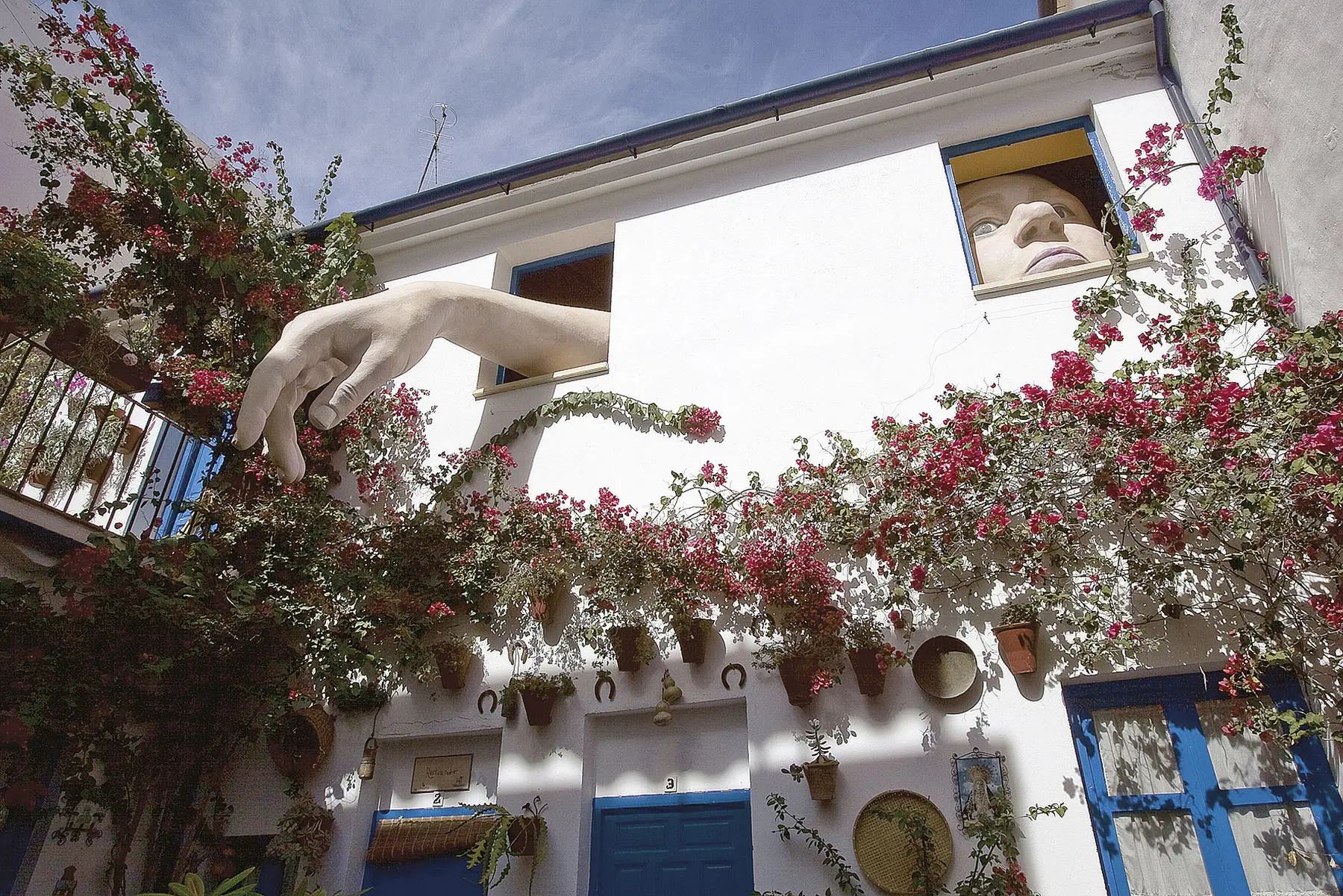
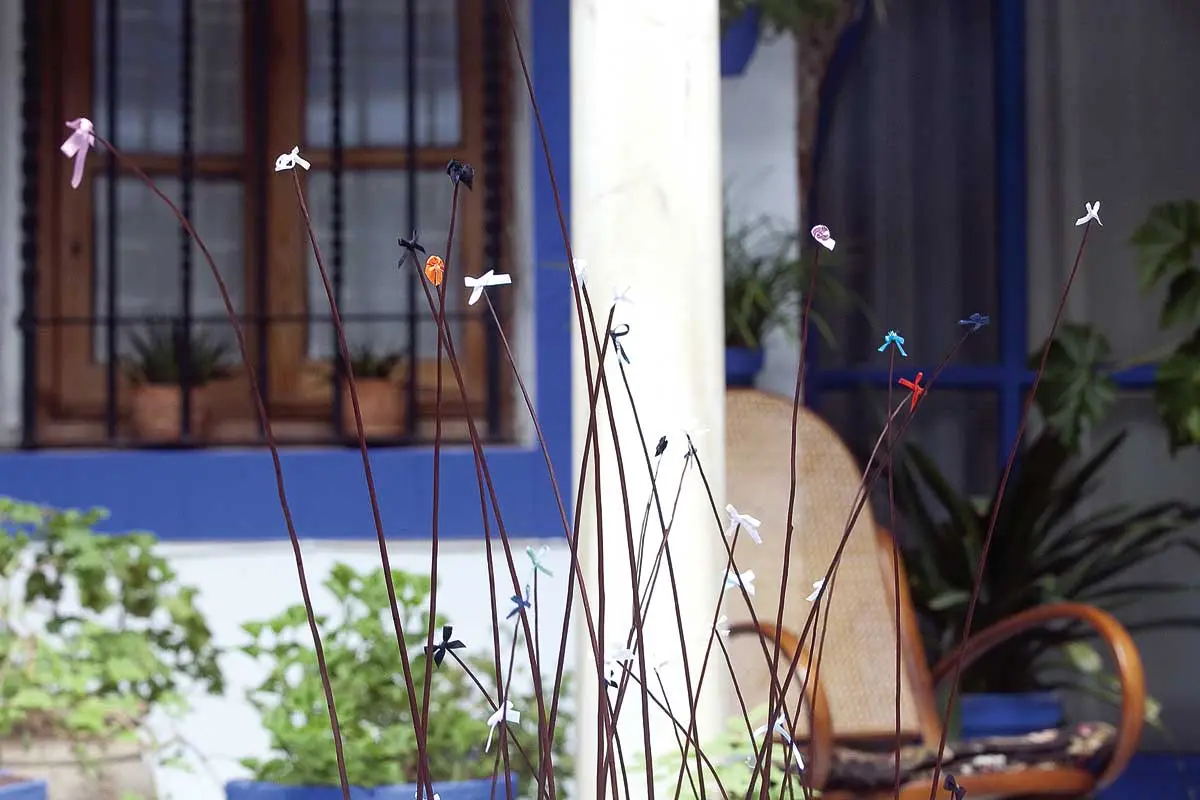
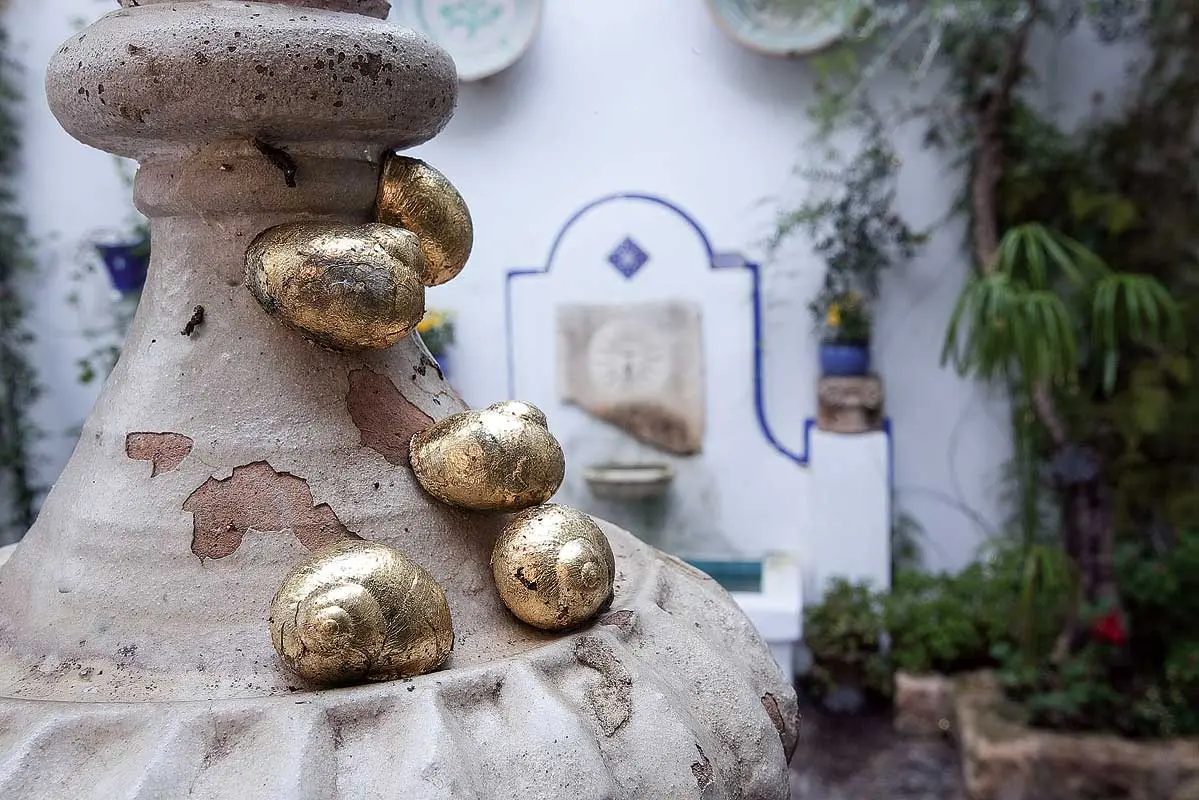
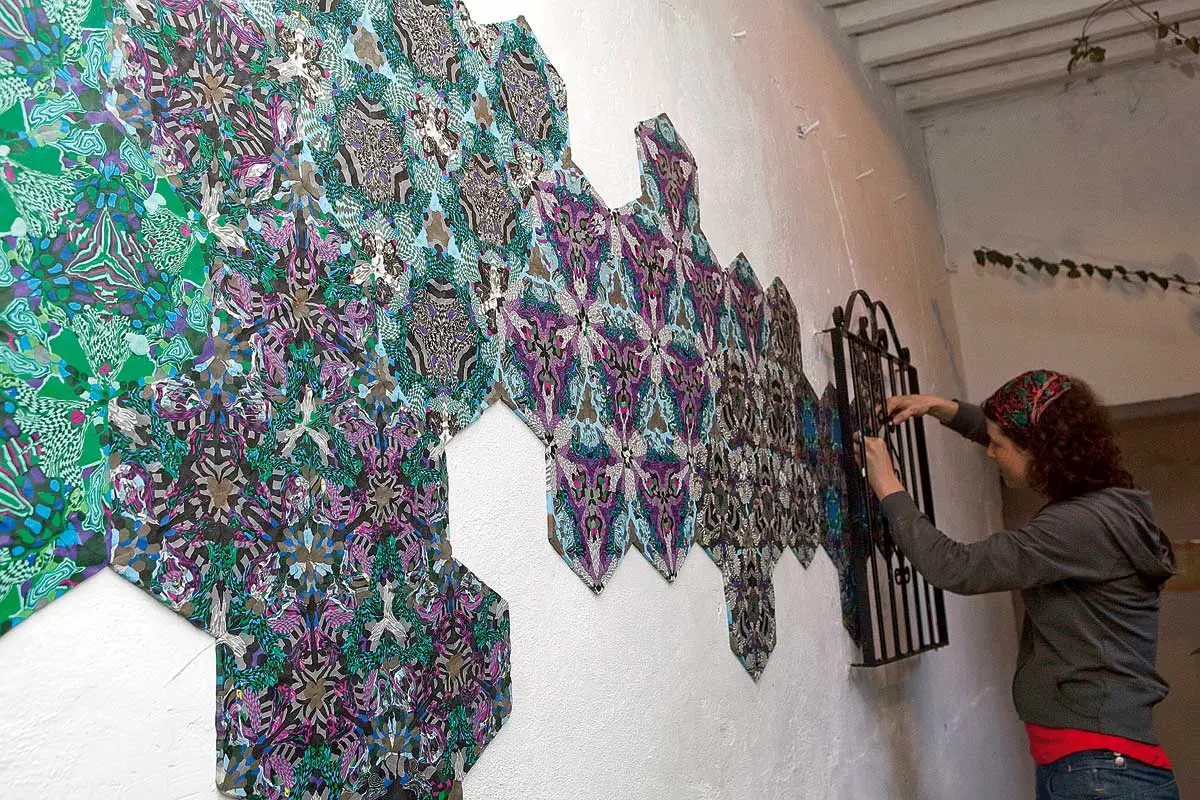
One of the most beautiful works was El espejo de tinta, by Chilean artist Magdalena Atria. It was a kind of play-doh mosaic attached to the inner walls of a patio where the artist recreates a world of fascinating chromatic effects that bring to mind the virtuosic illusionism of the Al Andalus culture; it is a dazzling mural, organic in its inspiration, that snakes around the wall’s accidents and climbs every one of its straight angles. In the same line of subtleties and delicate tones, another highlight is Jardín interior, by Cuba’s Glenda León, who creates, as a feminist kind of writing, an unexpected garden using pieces of women’s underwear. As a whole, this work is writing of a sophisticated and subtle syntax, a way of weaving reality and fiction in a single layer of narratives favorable to the sensibility that resides in the interstices of the most cultured subjectivity. The work plays with its own nominative multiplicity of meaning in order to sketch a somewhat more diffuse notion of the relationships of cultural antagonism between the public and the private. Cristina Lucas (Spain), with her excellent sculptural work, perfectly integrated to the space and titled Alicia de Córdoba, continues with her line of research into the conflictive discourses of phallocentrism that confine female identity and its rhetorics to highly specified spaces. Spaces that suffocate women and transform them into victims of unfavorable prejudices. This work differs from the others in terms of its scale and the solution it proposes and is one of the best adaptations among those contributed by this cartography of forms and concepts. Fernando Baena’s Córdoba 2016 Caracoles is one of the project’s most ingenious solutions, as the artist involves the patio’s owner (Rafael Barón), making use of his professional skills and his craft as an artisan in order to gild 2016 living snails found in the patio. The staging speaks of a work in progress, always in vertiginous and whimsical motion, that escapes any prediction and becoming, in this way, a sophisticated and subtle script on the fate of art, its sugar-coating mechanisms, and pertinacious fallacies.
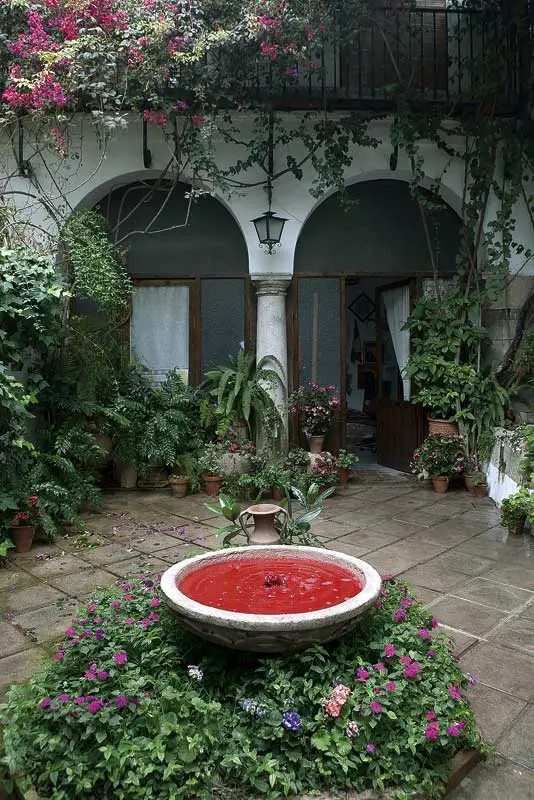
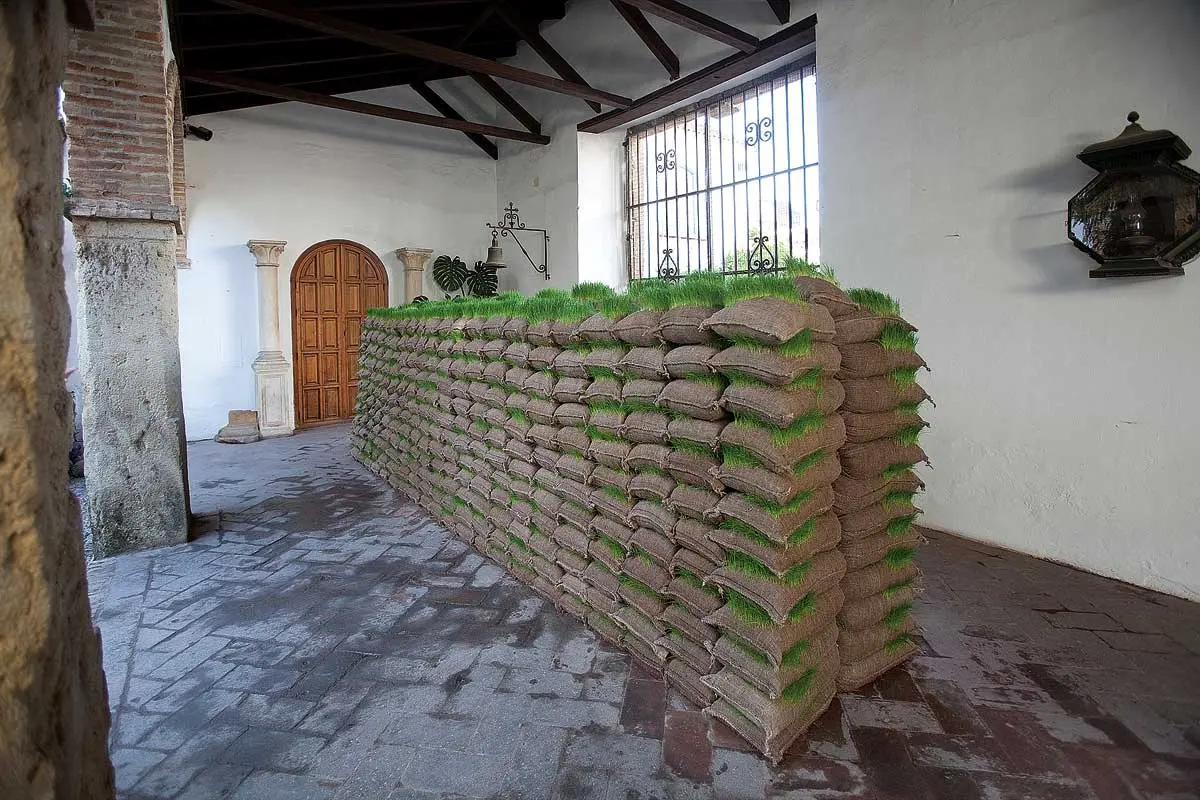
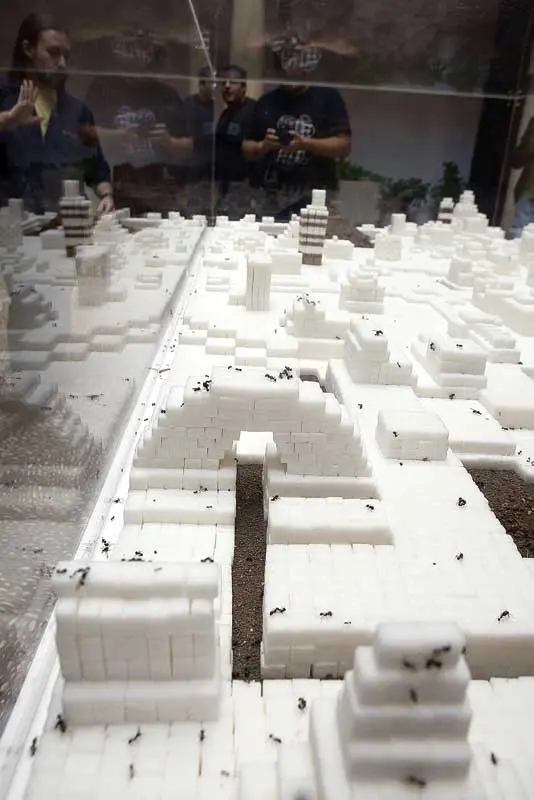
A potent, almost unsettling relationship between interior and exterior is what Brazil’s Rubens Mano achieves in his frankly marvelous work. Here he proposes a dispositive of screens and headphones in a closed circuit that problematizes the relationship between inside and outside, in a clear allusion to the vigilance and control mechanisms stimulated by contemporary culture’s paranoid systems. This work, alongside Carlos Garaicoa’s, is one of the show’s most sophisticated gestures, in conceptual terms. Garaicoa’s Principios básicos para destruir is a rigorous allegory of contemporary social behavior in a modern metropolis. A city built on sugar under the cannibalistic siege of an army of ants is the robust metaphor, with differing degrees of linguistic and cultural complexity, for the schizoid state of the culture of spectacle and consumption, the vices of seductions, and the hyperbolic yearnings for the transformation into a demented-instrumental gesture that invalidate the subject from any analytic and reflective option. It is not by chance that the work is found in the patio of the Facultad de Filosofía y Letras, which amplifies even more its meaning and inaugurates multiple chains of conceptual derivations that go beyond the works’ propositive threshold. Moving in a similar direction are the proposals by Spain’s Federico Guzmán, Mona Hatoum from England, the young Chinese artist Kan Xuan, and Priscilla Monge, from Costa Rica. Monge’s work is a minimal but beautiful intervention on the fountain in a patio, covering it in red paint. A way of warning about the conflicting states of life and death flows as ways of conservation and destruction, the reactive principles of Eros and Tanathos. In its totality, this work signals those moments of cruelty that at times cross into and flirt with the realms of pleasure, love, and tenderness.
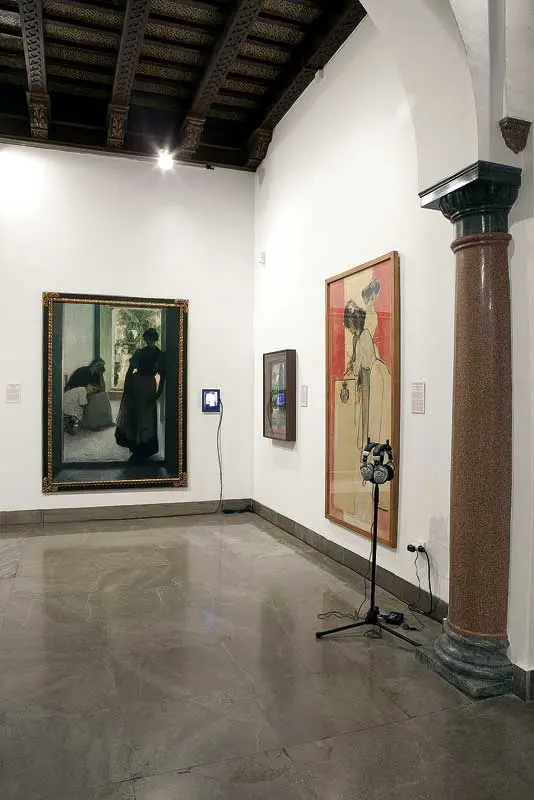
The proposals presented by Mariana Castillo (Mexico), Monira Al Solh (Lebanon), and Nedko Solakov (Bulgaria) generate different interpretative schemes. Solakov’s Una visita focuses its attention on the conversation that takes place around the patio, establishing a particular synergy between the work of art and the curatorial demand. Only that on this occasion the artist presents an exercise in the satisfaction of the other’s desire, fulfilling the expectations of the person that allowed the use of her space by bringing along her favorite actor, of whom she declares herself an unconditional fan. The result of this encounter that bridges the gap between art and life is a video that narrates the dialog between the owner, the actor, and the patio as the stage and witness to the encounter.
That, I believe, has been the project’s greatest achievement: To turn the patios and the art into an architecture of strong meanings, an articulate discourse of allegories and journeys, a song to beauty there where the contemporary beast slays what has yet to be born.
ANDRÉS ISAAC SANTANA