
It is evident that a great part of Eugenio Espinoza’s work is based on the conceptual precepts that began to influence every artistic manifestation since around the 1970s. This can be clearly observed in his work Impenetrable, exhibited at the Ateneo de Caracas in 1972. It consists of a natural canvas painted with a black grid – his trademark element – and extended 30 to 40 cm high across the entire width of a room, in order to prevent the public's access. It provoked great astonishment when it became known very late (in 2003) in the U.S. It is a critical work that above all pretended to be an analysis of the public reaction prior to the Penetrables by Jesús Soto. A similar approach could also be observed in the exhibition held at the Conkright Gallery in 1973, where the same canvas, industrially printed and bought by the meter – and wrinkly – was used in a thousand different ways, as it was also drawn in postcards that showed different landmark places or landscapes of Carácas, or in the experiences Espinoza carried out together with Claudio Perna in 1972, when the gridded canvas was thrown into the air on any region of Venezuela (in the Médanos de Coro, for instance); this approach can actually be observed throughout his entire artistic career, just as it occurred in this recent exhibition at the Sala Mendoza.
Another characteristic – in addition to his critical and questioning attitude – that stand out in his work is the constant resorting to his previous pieces to continue to renovate his ideas and to reaffirm himself. In his exhibition at the Sala Mendoza titled x, aluminados x, sostenidos we encounter these two phrases of his thinking. The aluminados are the product of the review and self-criticism of his previous work. The work they result from (presented at the Museum of Fine Arts, Carácas in 1972) showed painted grids on natural canvas that had been previously wrinkled, folded, or torn. The work not only questioned the idea of the frame as support, but also that of the grid as a rational form. When the work is observed or imagined unfolded or smoothed out, it would appear deformed; thus, the rationality of the grid would be questioned. When executed on a much more durable material than canvas (aluminum painted white), the grid continues to appear deformed and eroded, as in the other version, and on occasion would appear as it if were shredded. Espinoza also resorted to the grid in a work he presented in Miami titled Negativa moderna (Modern Negative). In this work, the gridded canvas, correctly extended onto the floor but cut in stripes, is the object of deconstruction by a public invited to walk on it, which demonstrated Espinoza's new interest in the ephemeral or disposable.
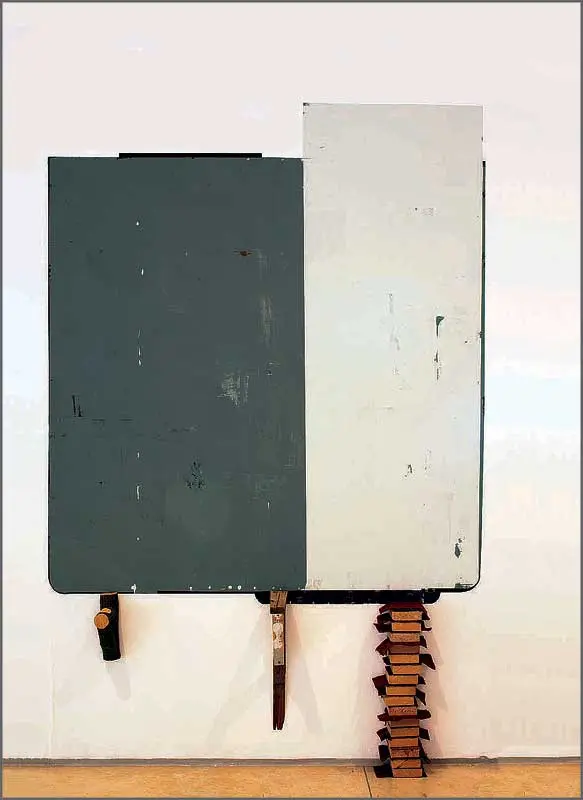
On the other hand, the artist's restless critical attitude makes it appear that other works, presented in the exhibition under the title Los sostenidos, are simply painted on the wall. They do not have or need an easel; they are ephemeral works that will disappear when the exhibition ends. Although it is not the first time that works directly painted on the wall have been presented in Carácas, these are different from previous ones (by Gerd Leufert: Visibilia, 1966, and Nuevas Nenias, 1985), which could be uniformly repeated. Espinoza's are neither repeatable nor permanent; thus, they are disposable and cannot be collected.
Although the works are of an overtly conceptual nature, they owe their beauty, their clear capacity to move, to pictorial art – similarly to the manner in which it was manifested after the advent of modernity. The works amaze us because of their splendid colors that, while influenced by those used in the graphic arts – always so luxurious and attractive – convey here a great depth of feeling, an abundance of wisdom and discretion. Magnificent impasto and textures add to their beauty, while also underscoring their ephemeral nature. It would be very difficult, if not impossible, for them to be repeated, as they would continue to be dependent upon the inspiration brought by a particular moment.
Given the particular brand of humor that is so characteristic of Espinoza, and without doubt to make more evident the lack of weight in these paintings, namely, their ephemeral condition, he has placed several kinds of supports under them: brackets; old hand ladders, or wedges. These are works that also have the quality of creating the illusion of deep space, or rather, of a space that moves forward to meet the environment in which it is placed. While such an effect underscores the conceptual nature of the works, it does not detract from their pictorial qualities, from the illusionism that painting usually conveys.
IRIS PERUGA