
Coinciding with the 50-year birthday celebration of the ineffable gallery owner Jacob Karpio, London-based artist Francisco Valdés (Chile, 1968) inaugurated his first-ever exhibition in Costa Rica. At first glance – and taking into account that up to 18 years separate some of the works – one can give in to the temptation of regarding the exhibition as a retrospective. Not so. It is actually a confrontation among works created during different periods of Valdés’s artistic production.
Like the vast majority of contemporary artists, Valdés does not limit his artistic endeavor to a sole technique: unclassifiable as a painter, he also resorts to installation, drawing, and video. Among his earlier influences include painter Sigmar Polke, as well as the utilization of Benday dots. The latter technique, invented by illustrator Benjamin Day – and popularized by Roy Lichtenstein – is different from the traditional grid of halftones to the extent that here, the size of the point can vary, while the Benday dots are always the same size. Thus, in Lo-Fi, Valdés “imitates” this technique from the advertising industry – the points and their superimposition are created by hand – and allow us to distinguish the image as we move away from it while making it indistinguishable as we come nearer.
This work and Valdés’s approach somehow constitute a good clue to appreciating the general proposal by the Chilean artist. His inquiry is geared toward the processes of reproduction, which involve original prototypes and mass-produced goods that leave off being these. By the way, Lo-Fi utilizes fellatio as an “image,” which represents a subtle comment by the artist about the pornographic industry and its obsession with close-ups. Paradoxically – and therein lies the mocking wink by Valdés – the closer we get to Lo-Fi, the more we are unable to discern the image that captivates us.
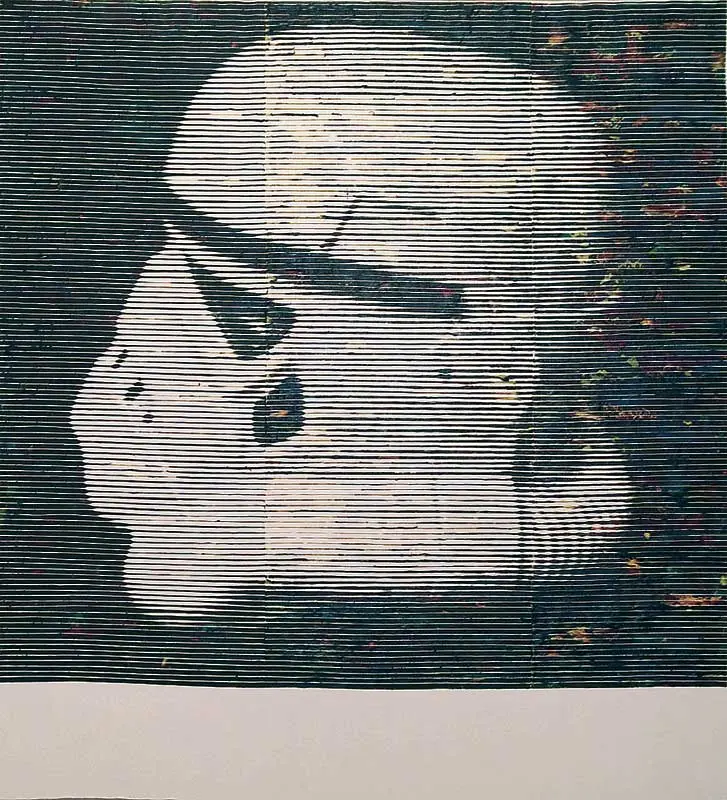
In another painting titled Prototype II, the helmet of a Star Wars character can be easily distinguished. Technically, the work is resolved in stripes of paint that alternate with the white canvas. The helmet is actually an original prototype created at some workshop entrusted with producing it. Noteworthy is that, if we follow the plot of the Star Wars movie, we realize that the soldiers using these helmets are actually clones. In other words, the dialectic between that which is original and that which is copied – and how to distinguish both – is clearly one of the central themes of this proposal by Valdés.
All of these represent a tangential comment on the originality of the “work of art,” its promotion, and the fetishist emphasis that is imposed on the art object itself. Valdés resorts to highly hermetic codes for his works, and that which at first glance may appear to be one thing after careful analysis becomes another.
Such is the case of his video installation titled Reagan 1973. It consists of a video loop that contains a series of pencil drawings based on one of the sequences from the 1973 film The Exorcist. At first glance, we appear to be before a “handcrafted” pastiche: a remake of sorts of the sequence of Regan McNeill's – the girl possessed by the devil – exorcism. On September 11, 1973, Chilean president Salvador Allende was assassinated during a military coup promoted by the U.S. government.
At first sight, the two events appear to be disconnected and the connection is not easy to discern. Valdés does not provide big clues. We only know that both things occurred in 1973: Reagan's exorcism and the violent “exorcism” by the Chilean military (to eliminate the devil of communism that had entered Chile), which also took place in 1973. By extension, we could also read this work as the current demonization of the Muslim countries, which has been carried out for more than a decade by the U.S. government (from Bush, Sr., or his son, George W. Bush) and the resulting exorcism-invasion to finish off the “demon.”
A three-dimensional piece, the work Carpets & Rugs utilizes opaque acetates printed with advertisements for expensive floor coverings piled on support hidden from view. It is a black-and-white impression. The superimposition of the acetates reminds us of the way in which carpets are displayed in stores. A simplistic reading would allude to the Middle Eastern culture – known for its carpets – and the piling up could be interpreted as the crumbling of that culture. Nevertheless, Valdés has mixed Persian rugs with medieval European ones, thus completely invalidating the most obvious reading. Resorting to the metaphorical use of opacity (lack of transparency), juxtaposition, and repetition, Valdés, in reality, alludes to the immemorial politics and practices that the Western world have been carrying out against the Eastern world: from the medieval crusades in search of the Holy Grail, to the invasion of Iraq in search of sacred oil.
JOAQUÍN RODRÍGUEZ DEL PASO