In October, the Galería El Museo presented a solo exhibition by José Horacio Martínez (1961, Buga, Valle, Colombia) titled Desde este inmenso autobús (From This Immense Bus) that included more than 10 works and workbooks illustrated by the artist, rendered in Indian ink on canvas.
A painter with a long artistic career, Martínez is most interested in inquiring about the process and the nature of painting. His unique style renders an amalgam of strokes, marks, layers, textures, and translucencies that decisively, dynamically, yet subtly, make their way onto the canvas. The richness of colors that appeared in previous works such as Desde este jardín (From the Garden) is replaced by a more mature painting expression. The palette in this work is minimal and consists only of black paint and white, and the majority of his works were created in Indian ink. Washes, the contrasts between the shades, and the fluid contours are the basic visual tools that afford this artist a sober rendering of the image.
The faces in the Cabezas (Heads) series emerge from the canvas like fuzzy patches that eventually acquire nearly photographic definition as a result of the skillful handling of the watery material. This recent production by Martínez partly centers on the individual faces of persons of African descent, which rendered on medium-format canvases. I perceive that Martínez revels in the plastic possibilities allowed by dark skin, because his works appear to analyze the properties of ink to convey gestures, volumes, highlights, and contrasts in a skillful light-rendering demonstration. To that end, his figurative interest breaks down the characteristics of photography as he appropriates these to create pictorially.
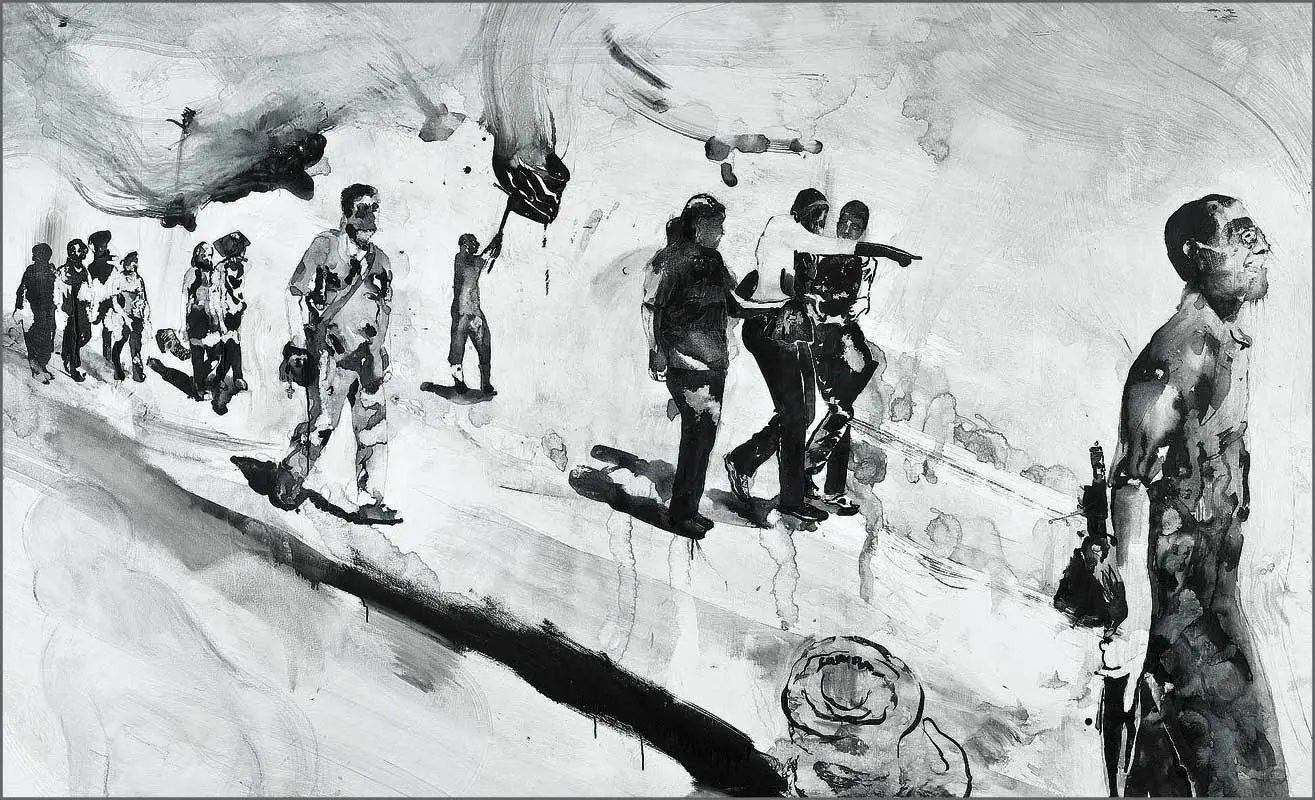
On the other hand, the artist communicates, in works such as Fila bautismal I and II (Baptism Line I and II), recurrent themes of everyday life and anonymous characters experiencing mundane events. Referring to the exhibition’s title as someone looking out a window from inside a bus, Martínez portrays passers-by ritualistically wandering in the same direction as if in a ritualistic parade toward no specific destination. As a sort of impressionist painting, the patches outline faces and bodies and insinuate undefined characters within ethereal atmospheres achieved through translucencies, because these underscore the ephemeral nature of the now, of the passing of time, of the constant shift to the future.
Habano (Havana Cigar) of 2009 is a large-format horizontal piece that depicts some characters behind the smokescreen of a cigar. A sketchily rendered character is lying down smoking a cigar as the smoke fills the rest of the image. With the volatility of the watery ink, José Horacio Martínez masterfully renders the smoke, or vapor, as he reiterates this atmosphere that barely reveals the people “floating” on the canvas.
The traces of ink are more calligraphic and the stains and outlines are flatter. Nevertheless, the expressiveness on the faces and the body postures are more overt as the images become playful and vivid.
The works in this series are dense. They live at the discrepant border between the sensory and the conscious worlds. They exhibit clarity of draftsmanship but within vague spatial limits. Everything in this work represents confrontation (non-aggressive) between opposing elements or, better stated, a juxtaposition of ambiguities through the handling of materials and themes, in which it is of the utmost importance to present the work clearly as an event, and to that end, to evaluate the development of the processes that reflect the coming-into-being of the image in the artist's mind.
There are no narrations per se, but rather episodes rendered and moments elicited by memories. Although the images in José Horacio Martínez's work consist of these moments, the viewer may observe them as simple episodes whose origins are not really relevant. They reach beyond simple representation. To understand them, one must prioritize the dynamic evolution of this artist. Earlier exhibitions would serve to complete in the viewer’s mind the examples of an artistic endeavor that develops to encompass more dimensions of meaning and space in a progressive fashion.
The absence of color allows Martínez to create works that are very academic –technically speaking – and that results in a sort of overview of the elements that constitute pictorialness as a whole. Martínez structures his images by providing a chance with a personal order through such elements, as he is consequently able to shape the subjects and situations on the canvas surface.
The ink permits reflection between each layer as it dries: Thus, the layered-over image is reconstructed in a controlled and meticulous manner.
Despite this, the brush strokes and the traces are instantaneous and instinctive in contrast to this control, for they are solicitous, and this turns them into spontaneous acts, operating in identical fashion to thought.
MARIA JOSÉ RAMÍREZ