Notice was barely taken in 1969 of the exhibition Cuerpos blandos by Juan Pablo Langlois (1936) at the Museo Nacional de Bellas Artes in Santiago. Forty years later, between October and December, the proposal is reissued for that space within the program Ejercicios de Colección (Collection Exercises). Despite the simplicity of the work and that just a few spectators saw it during the 20 days, it was on display – and because only about 8 black-and-white photographs have appeared through the years in catalogs, art books, and press releases – these works by Langlois have become a referent of Chilean contemporary art, unanimously valued and admired particularly by young artists tired of academic bravado and conceptual density.
What it the key to its worth? What makes it remain relevant within the context of an artistic production defined by frailty and references to the disappeared?
During those years of social, political, and cultural unrest –when the visual was just beginning to be transgressed by some who worked the everyday object through painting and beyond the frame– Cuerpos blandos was, first and foremost, a gesture specially charged with the marginal simplicity and ephemeral poetic with which Langlois would bestow his future works. The work consisted of 200 meters of polyethylene tubing filled with wrinkled newspaper pages. It comprised an enormous worm disposed of across space so as to disrupt visitor access through the exhibition areas and wide staircases as it perforated the venue to the point of perforating windows and extending outside into the street, where it was tied to a tree near the main entrance. A photograph of a young Langlois – who at the time responded to Vicuña, his mother’s surname – that shows him posing for the camera by the tree to which his work was tied, became one of the most recurrent images in the history of Chilean art.
As strange as it may appear, Cuerpos blandos was the byproduct of boredom. Then, Vicuña was a well-known architect and a quiet painter who favored geometric abstraction, but one who would eventually lose interest in the canvas. He was about to come to terms with his fascination for everyday objects and the work of Marcel Duchamp. Then one day, he began to stuff dozens of garbage bags, as the idea of transgressing the museum’s conservative purpose began to take shape. The work's subsequent notoriety is due, in part, to chance: a week after it was installed, it had to be momentarily dismantled to allow for an important exhibition of Chilean paintings from the 1900s, which was to be held in the same site. For three days, Langlois’ work was left entangled like a worm among other artworks stored in a warehouse. Another recurrent image of local art is a photograph taken therein.
Nevertheless, Vicuña never repeated this type of work. His subsequent works resorted to everyday objects such as mattresses, pieces of bread, or packs of cigarettes. In urban interventions or in emergent galleries during the years of the Chilean dictatorship, the artist intelligently combined autobiographical elements with plays on words, photocopies, and scaled figures modeled with paper from periodicals and glue. These works only survive through handcraft books, notes, and personal photographs. Always utilizing undesirable materials that appeal to our own frailty, Langlois during the 1990s amassed a group of works that dealt with the residual memory, an objectualist architecture that recuperated images from the press and from the collective history. During the 2000s, he continued to develop a repertoire of decadent and erotized three-dimensional objects fashioned of paper immersed in Dantesque orgiastic scenes. The foundational act thus continued to be invested with an aura of legend.
Within the context of a Chilean act marked by analytic excesses and obsessions concerning exposure and internationalization, Langlois has remained an artist with a low profile. His artistic production is plagued with both sterile and intensely fertile creative periods during which he has avoided the temptation of falling for a conceptualist language, and has instead favored a simple, lucid, and finely humorous poetry that could be associated with a Duchampian spirit or with the poetry of Nicanor Parra.
Cuerpos blandos was not truly appreciated until the 1980s during a period of political repression when art was strengthened by an avant-garde current that burst onto the scene charged with great aesthetical drive and critical acclaim. It is perhaps only through the lens of time or context that this work could finally be truly appreciated for all its effectiveness and value.
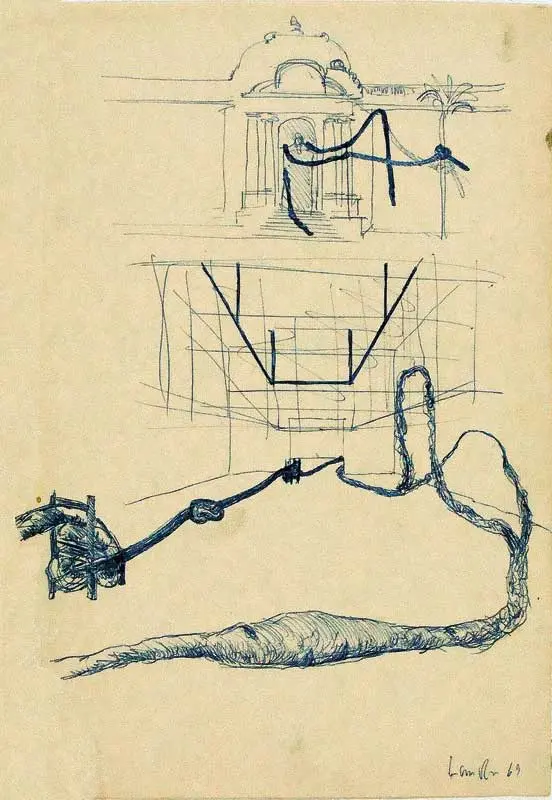
Currently, the work is once again exhibited, accompanied by the famous photographs and a series of sketches recently acquired by the National Museum of Fine Arts in Santiago. It is clear that Langlois did not intend for this work to transcend its time. His notes – probably created during a monotonous afternoon – are now a vivid part of the history of the artistic interventions and the evolution of Chilean art from the later part of the 1960s. The work has been recuperated through the compilation of documents and memories that make the transgressive nature of the piece relevant again. It is curious that – during this reposition – the piece once again must converse with a large XIX Century Chilean art exhibit titled Territorios de Estado (State Territories) in a manner similar to what occurred in 1969, as the work again takes over a museum that is in a constant state of transformation and before a local public who remain skeptical of critical experimentation and of denominating a piece such as this a “work of art.”
CAROLINA LARA