
Under the suggestive title Fusion: Leandro Soto’s Journeys, the Farside Gallery accompanies us on a magnificent trip in which conciliation with the spirit regarding entelechy reaches beyond puerile differences and transgresses periods and cultures in search of the definitive and accurate encounter with human nature.
The exhibition is by Leandro Soto (Cienfuegos, Cuba, 1956), to whom art is, above all, a system of relationships in which equilibrium among each of the participating elements in the universe is essential for the harmony of the whole. This principle, shared by many cultures, is the core of a work that always centers its discourse on the poetic nature of the mythic and the sacred as spiritual mechanisms that disdain the self, society, and nature.
Art is, then, approached as the favorable result of an errant experience where the transformational journey gradually establishes norms that underscore a multiplicity of things, paths, and possibilities, a plurality that is the expression of that subjacent unity that overcomes any differences. It is precisely in this interstice – where multiculturalism is an expression of synthesis and integration of values – at which the work by Leandro Soto is assembled.
His proposals – paintings, sculptures, writings, and set designs, among others – can be figurative or abstract, anecdotal or metaphorical, but they are unfailingly marked by displacement of the self, in which individuality ceases to exist in favor of the ideal channel that can embody and convey experiences, deities, and personal or collective stories. To Leandro, the artistic endeavor is assumed as a shamanic experience in which the self becomes a trans-personal being.
Leandro Soto formed part of the Volume I movement that, from the beginning of the ‘80s in Cuba, rebelled against the social realism rhetoric that had dominated the so-called la década gris (the gray decade) of the ’70s. Two of this movement's central characteristics comprised its compatibility with leading international artistic proposals, and its innovative inquiry into Cuban culture and history. Leandro was one of his generation's artists interested in exploring the Afro-Cuban roots and, specifically, the deities of the Yoruba pantheon, which possess a deep-rooted presence in Cuba's popular religion.
His performance-video-installation titled Olorum: Durga, Isis, Yemayá (2008-2009) is one example of this interest. The work represents an inquiry into the notion of the “Mother” in the sense of being a sacred archetype associated with preservation, fertility, and creation. This creative energy connected to femininity is an unavoidable constant in cultures as different as the Yoruba, the Egyptian, and the Hindu. Engaging water as the connecting element, each of the deities makes an appearance and then leaves behind a continuous flow that is nothing more than the expression of the ever-changing flow that we call culture.
When he was 11 years of age, Leandro left his hometown to pursue his artistic education in Havana. This marked the beginning of the nomadic ways that have shaped his artistic proposals, in which the idea of the traveler or chronicler serves as an essential device for meditation, teaching, and remembrance.
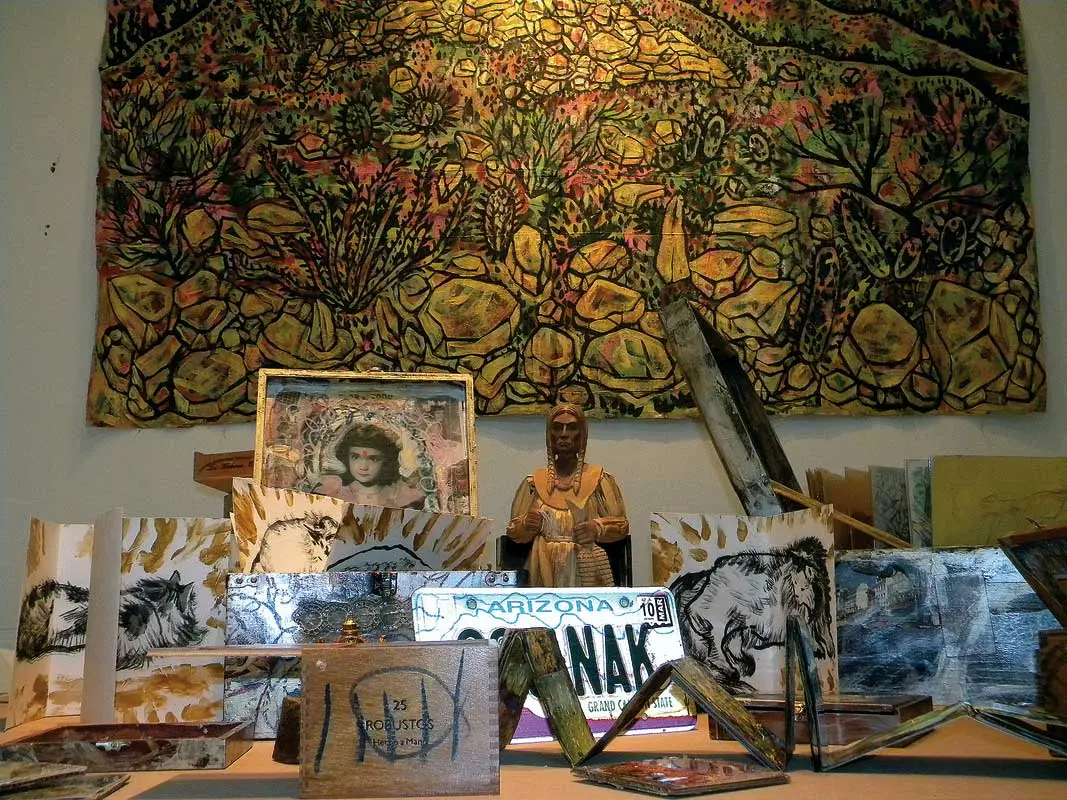
Traveler’s Box (from the series Mapping Arizona) created in 2004-2005 is a clear result of Leandro’s aforementioned approach. The box contains a 97-foot roll of rice paper that describes the artist's Arizona trip from Phoenix to the Grand Canyon. The spectator must unfold the roll in order to discover incrementally, in each section of the paper, a portion of the trip, thus to begin a journey of his/her own. The sketchy and spontaneous- appearing drawings describe an ever-changing landscape that, at times, is dominated by the intense light and the aridity of the desert, which leads to abstraction, lucubration, and dreaminess. On other occasions, exuberant cactus clusters appear to sprout from nowhere as they energize the journey.
The work is an inquiry into the displaced individual facing new surroundings dominated by a candid and unprejudiced dialogue between the subject and this new habitat. It is also a wink of the eye, as well as a homage to a similar displacement experienced by some artists from the Surrealist movement who, after fleeing from World War II, spent years studying Arizona's desert landscape.
At the end of the gallery in the last room, Leandro presents us with La Historia del Tabaco (The History of Tobacco), an installation consisting of tobacco boxes of various sizes, each containing delicate treasures. Preserving and reusing the cigar boxes as whimsical coffers is a Cuban tradition. Each time these are opened, they release the aroma of cedar and tobacco in capricious evocations. Each box is a universe revealed from which past stories emerge; they are detonators of personal stories that we will never know but accounts that nevertheless elicit our own memories, as they invite us to the ever-indispensable inner trip.
One could spend hours unearthing this or that, searching for connections, shared nexus, attempting to recognize ourselves in others through the tireless process of remembering (as it pertains to its Latin etymology re-cordis: to revisit the heart). In the end, we are all part of a journey through this wandering and collective experience that is our contemporary society.
JANET BATET