It has been 2 years since a series of retrospectives by Brazilian artists, whose artistic activities initiated during the 1980s, began to be presented as part of the exhibition program at the Station Pinacoteca – a part of the Pinacoteca do Estado Museum and Gallery in São Paulo. The goal of this series is to present panoramic visions of current productions, both to survey individual trajectories from their origins until today – the majority of these never before exhibited – and to gauge the problems that have frustrated the development of contemporary art in Brazil for at least the last thirty years. This program has already showcased monographic exhibitions by Paulo Pasta, Iran do Espírito Santo, Beatriz Milhazes, Paulo Monteiro, and Daniel Senise, among others.
During August and October, the institution presented Leda Catunda 1983–2008. It included around 70 works by Catunda and included paintings, collages, reliefs, and watercolors. During that same period, another exhibition presented three works by the artist created in 2009, at the Fortes Vilaça Gallery. The sum of both exhibitions revealed a process of artistic formation and consolidation of a singular poetic that Catunda has been able to achieve through trial and error in an artistic quest focused on surpassing the limitations of painting. Paradoxically, she succeeds in doing this by simultaneously establishing affective and analytical relationships with the medium, as if she wished to investigate the real contemporary possibilities of activity so frequently qualified as obsolete, as she pushes the medium against a real-world of common images and objects that are available and vulgar.
Leda Catunda’s education aids in part to explain her ambiguous commitment to painting. As a student of the Fine Arts at the Armando Álvarez Penteado Foundation in São Paulo, Leda attended several courses taught by historians and artists – Walter Zanini, Nelson Leirner, Regina Silveira, Julio Plaza – who, in their own works, demonstrated (or continue to demonstrate) an interest in addressing, always from a critical standpoint, the nature of the art institution, from the role it has played throughout history to its insertion into the market. This took place during a time, in the early Eighties, when the international art world had called for a “return to painting,” as exemplified in canvases by the Neo-expressionists in the U.S., the “New Savages” in Germany, and the Italian Transavantgarde, who were given the responsibility of “bringing back the enjoyment and pleasure of painting.” Brazil had its own movement, assembled behind a similar motto, and called the “Eighties Generation.” It was made up of young painters ready to “renovate” aspects of the painting medium – although a decade earlier, during the Seventies, there were other artists such as Iberê Camargo and Eduardo Sued who were working more assiduously than ever before in the history of Brazil toward that same goal.
Within this context, but hardly sharing the hedonism or “drama” of the energetic European and U.S. painters, from early in her career, Leda Catunda had a more distant relationship with painting, as she actually relegated the medium to a second plane, nearly as “background,” whether utilizing pigments to cover figures partially industrially reproduced on the blankets, towels, and textiles she used as support, or to take advantage of the patterns and textures found in these surfaces by creating archetypical forms such as jackets, purses, and animals, which she rendered with a brush. Her earlier works presented at the Pinacoteca exhibition include Vedação em quadrinho (Smudge on Comic Strip) of 1983, and A vitrine (The Showcase), Onça pintada I and Onça pintada II (Painted Jaguar I and II) of 1984. These latter three works initiate the curatorship by Ivo Mesquita, who, with the spatial arrangement of the exhibition, sought to underscore in Catunda’s work a sort of nostalgia for the “traditional pictorial genres:” the first exhibition room is dedicated to pieces associated with portraiture; a second module contains small reliefs and large collages, and finally, a third exhibition space gathers the remaining works with representations and suggestions of landscapes.
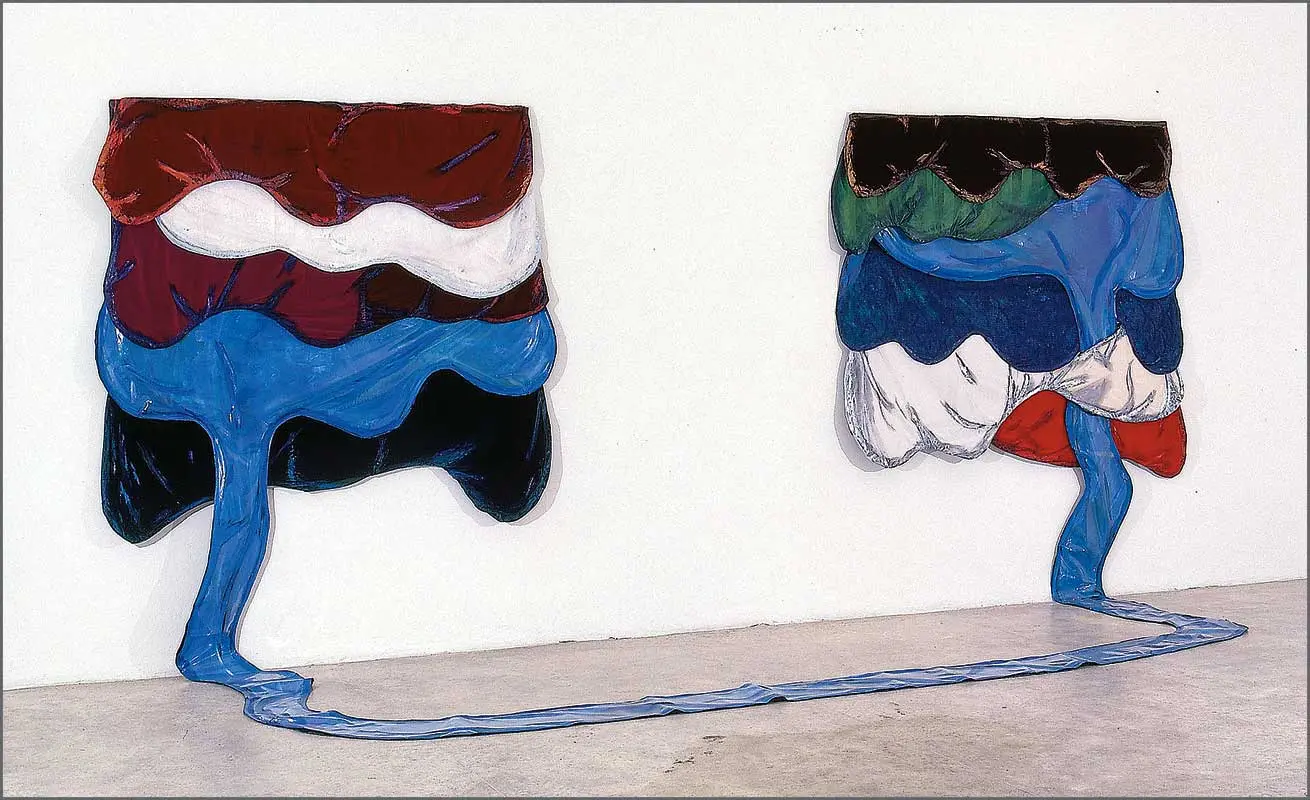
Indeed, Leda Catunda’s production rejoices in figurative allusions that are even humorously reiterated in the title of the works. Likewise, it is no coincidence that the recent pieces exhibited at her solo show at the Fortes Vilaça Gallery make strong references to nature: Paisagem com onça (“Landscape with Jaguar); Duas árvores (Two Trees), and Rio comprido (Long River). Incidentally, it is possible that preconceived “themes” and “motifs” may constitute one of the conditions of the artist's work, less to illustrate ideas and commentaries on painting than simply to implement it. Her endeavor avoids easy approaches and any inkling of purity in the solutions.
The approach adopted by Catunda during her evolution in the 1990s included the utilization of embroidery, collage, and other types of patches among the heterogeneous parts of the painting. Management is unpolished, messy: sometimes soaked and overwhelmed by soft fabrics, and at others, is bare, diluted, and quickly rendered with plastics and patterned textiles. Despite the artifice that comprises an intrinsic part of these, the forms inspire something organic, remind us of drops, cells, tongues, innards, and stomachs. The structures stand out, soft and smooth, with volumes projected toward the three-dimensional field, searching for a tactile gaze; they intertwine with each another amid full and empty surfaces, as they reveal the gracefulness of their connections and their somehow unstable but nonetheless compiling unity.
In the face of so many suggestions of comfort – reinforced by the awareness of everyday materials on the surfaces, or by of the figurative tendencies of some pieces – Catunda appears to juxtapose an exhortation for tireless, dislocated, and dissonant cognitive actions that are equivalent to the organization of her works. To these sensations of well-being would correspond a certain degree of agitation, a uniform vitality, which in the end correspond to a painting that does not fit in the plane, one that is open to the shared space in life, to become, not a window, but a conscience immersed in its overcharged surroundings.
JOSÉ AUGUSTO RIBEIRO