
The art of drawing today is as variegated as those who engage in it. Its practitioners generally work on a two-dimensional format of paper on which can be applied a variety of materials to its surface including ink, paint, pencil, pen, crayon, and all sorts of matter executed via mark-making and affixation. There are also those who undertake a reductive or subtractive approach akin to de-collage consisting of an array of techniques such as tearing, ripping, shredding, slicing, and so forth. Then there are relatively fewer artists who eschew these practices altogether and explore drawing’s ontology and in the process, expand its formal parameters and conceptual possibilities.
Early instances of drawing’s structural reconfiguration are evinced in Robert Rauschenberg’s Erased de Kooning (1953) and Piero Manzoni’s Line 1000 Meters Long (1961). The former consists of a drawing by the iconic, figurative-based New York Abstract Expressionist which was defaced by Rauschenberg via erasure. Conjecture about this aggressive gesture situates it as symbolic of a historical break with the past, though Rauschenberg has stated that he was not attacking his predecessor as much as he was paying homage to him and his artistic milieu. Erased de Kooning is, however, formally and conceptually innovative in that it proposes more than half a century ago the need for drawing to overcome the limitations of its historicity. This, in one sense, is also the importance of Manzoni’s contribution to drawing as well; in which a work-on-paper the length referred to in his work’s title was placed inside a chrome-plated drum. As a precursor to Conceptual Art, Manzoni’s piece raises interesting questions: is it drawing or sculpture; and if both, is either medium subservient to the other? Although this either/or conundrum is integral to the work, it also reflexively interrogates assumptions about genres as anachronistic rubrics. That is to say, it questions homogenous classifications of art which adhere to formalist rhetoric of medium specificity. Line 1000 Meters Long continues to engender debate concerning these issues as well as others some 48 years after its inception. What can be argued about Manzoni’s artistic entombment as well as Rauschenberg’s erasure is that they were art historically necessary; for the two works ontologically offered other possibilities of working on paper such as those found in Marco Maggi’s diverse artistic practice.
Marco Maggi’s expansive approach to drawing encompasses many of the aforementioned formal registers including mark-making as addition, cutting and incision as subtraction, as well as a general modus operandi located at the overlapping interstices of drawing, sculpture, installation, and architectural studies and models. Does Maggi’s art cease to be drawing when a work atrophies from planarity to a quasi three-dimensional form that feigns sculpture; does an installation made of paper sheets laid on the floor replete with marks on their surfaces, inherently not drawing because it teeters at the formal precipice between the architectonic and the two-dimensional? Even less than a sustained observation of Maggi’s oeuvre reveals a poetic response to these questions; for what drives his artistic imagination is a poly-formal vocabulary that is conceptual in orientation articulated by a sophisticated métier. Take a look, for example, at PreColumbian & PostClintonian (2008).
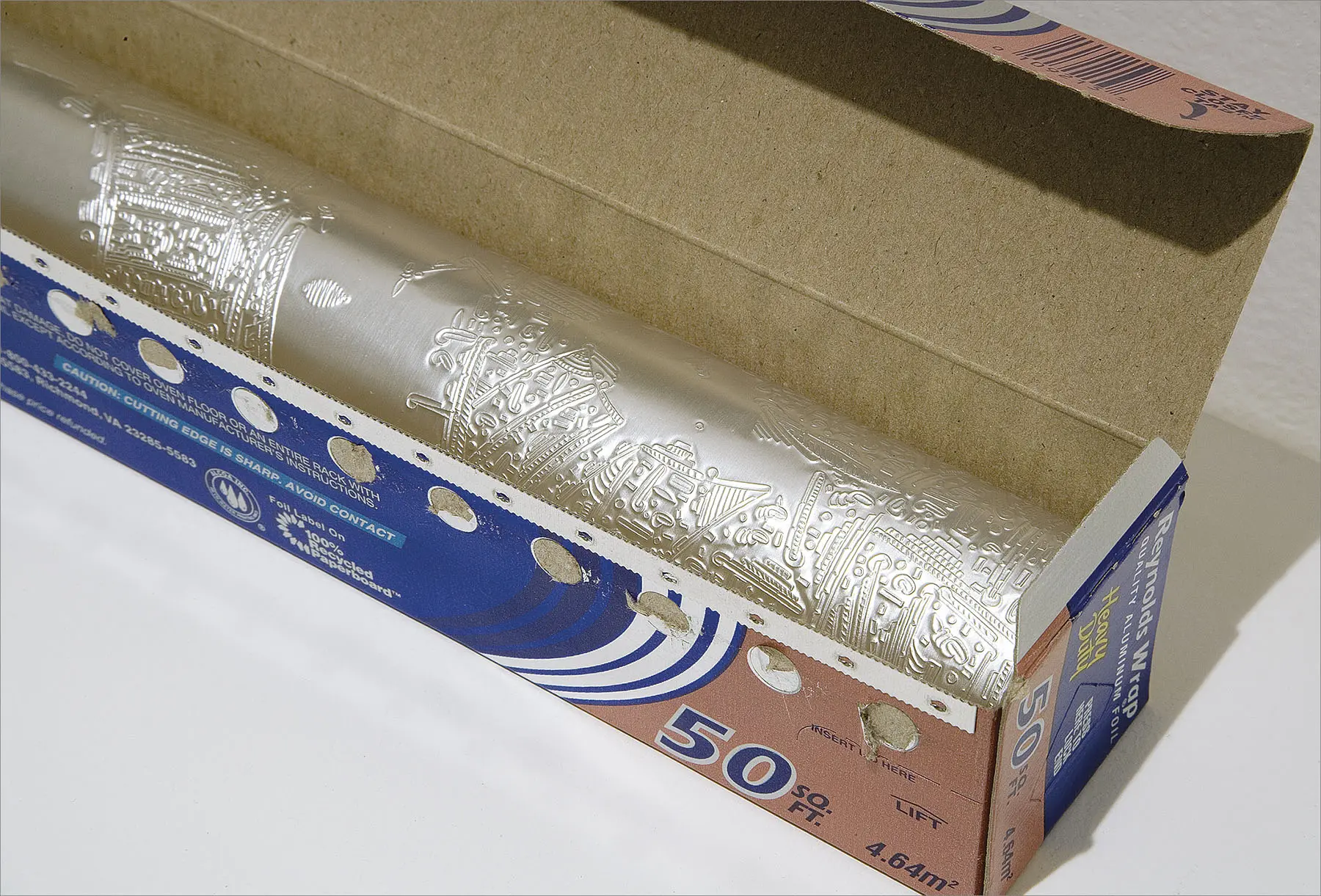
This work consists of a prefabricated roll of foil whose surface is finely penciled subsequently creating impressions akin to incisions on an engraver’s plate. The delicate lines that undulate across the sheet of foil are enigmatically rolled up rather than laid out flat. This ostensibly simple, albeit multivalent conceptual gesture negates conventional exhibition display, which conceivably would unroll it and present it like a scroll. Maggi opts for the trope of placing the roll back into the opened box of its commercial manufacture simultaneously concealing and revealing its contents. There is an obvious connection here to Line 1000 Meters Long in the affinity between a cardboard box and chrome drum as repositories. But Maggi’s drawing as sculpture and sculpture as drawing veers from Manzoni’s iconoclastic work by way of other formal and conceptual devices, particularly in the use of matter as both signifier and signified. Surely the work could be construed as a kind of assisted readymade; although the sheet of foil is intervened, it is returned to its original, readymade receptacle. But to simply imply that Maggi is only concerned with art history or in an artistic dialogue with his peers undermines the complexity of his practice. There is a subtlety to Maggi’s work that raises it to a level all its own, and in the process underscores the artistic intelligence of its maker.
PreColumbian & PostClintonian alludes to, among other things, a template used for printing; a matrix from which a potentially endless number of prints can be made. At the same time, it negates reproducibility. It’s the antithesis to Walter Benjamin’s “mechanical reproduction” thesis by presenting a template incapable of mechanically reproducing the corollary prints. There is also something to be said of Maggi’s semiotics of materiality that reveals his work’s inherent polysemy. Foil, as a noun, not only refers to what partially constitutes PreColumbian & PostClintonian, but as verb, it also means to “enhance,” “contrast’ as well as to “deter” or “impede.” And this, moreover, is integral to its ontology: the foil “enhances” and “contrasts” both container and content, but it also “deters” and “impedes” reading them as either formal aggregates or sculptural gestalt. In doing so, the work is a conflation of the literal and the metaphorical: on the one hand, there is a deferral of meaning between the literal i.e. foil as a noun, and the figurative i.e. foil as a verb. It is also made more complicated by the temporal bracketing of its title: New World/Third World on one end and Old World/First World on the other. Nothing less than art as poetics, then, is how one can characterize Maggi’s work underscored in the wordplay of his titles, the use of matter as both signifier and signified his expanded formal language, and the collapsing of genres at the ground zero of drawing. But what also differentiates Maggi’s art from others who work in a similar medium is its precision. There is paradoxically an overwhelming yet understated exactitude in his attention to detail which, in lesser hands, may succumb to formulaic conceptualism. This is especially so when Conceptual Art is articulated in systems, schemas, diagrams or is monochromatically reduced, regardless of whether the aesthetic vocabulary leans towards the mathematical, linguistic, or the formally hermetic. Without a visually strong yet critically poetic praxis, Conceptual Art can succumb to what Benjamin Buchloh coined the “aesthetics of administration.”
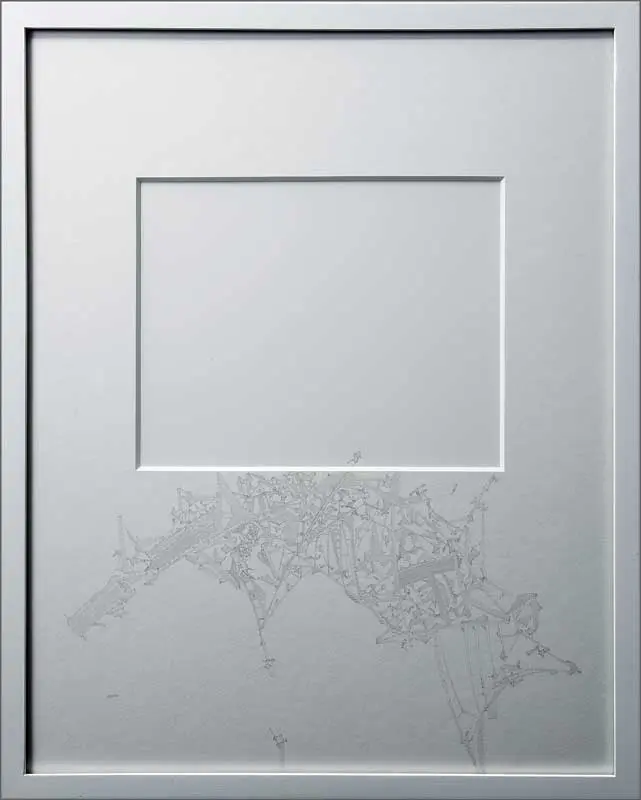
In San Andreas Fault (2008), for example, the artist explores an area not usually the province of artistic practice: ostensibly frenetic, yet elegant and fragile lines and marks in hairline detail are inscribed outside of the picture plane and onto the work’s matting. There are a few artists today or historically who have formally engaged the frame, let alone a picture’s matting. To be sure, Grupo Madi and Lucio Fontana grappled with the frame’s ontological limitations. Fontana went much farther by exploring the space behind a painting and its support wall as well as the textured surfaces of a canvas created from its puncturing and slashing. The superseding of the frame or at least its use as a pictorial trope is not of twentieth-century origin, however, but goes as far back as Georges Seurat’s Gray Weather, Grande Jatte (1886-88). With all respects to this innovative work of early Modernist painting, Seurat’s pointillist landscape and trompe l’oeil frame inadvertently underscore that the delineator is ultimately more interesting than what is being delineated. Other artists such as Howard Hodgkin emphasized the frame as no less worthy to be painted, and therefore it was subsumed into the canvas. But his pigments that spill from canvas to frame as inextricable pictorial totality is more formal nuance than conceptual strategy. Maggi’s mark-making that meanders across the picture’s matting may, instead, be closer to Robert Ryman’s use of the sides of canvases as an integral component to his painterly compositions.
Paradoxically, the presence of Maggi’s sinuous lines deployed on the matting inevitably draws attention to absence; they direct the eye both to the marks and to the surrounding void evoking a slight pictorial unease. Maggi also exponentially complicates the work by way of its title. The San Andreas Fault is the geological register that precariously runs up California and is responsible for tectonic tremors and earthquakes. If, then, one continues Maggi’s compositional logic to its conclusion where the lines of San Andreas Fault are a metaphor for the potential subterranean trigger, what is one to make of the matting as surface and the depression that it frames; is what is being depicted in this instance a form of drawing as topography? And in doing so, is this not a more conceptual approach to embodying marks somatically without resorting to surface tactility? The formal and conceptual tropes inherent in San Andreas Fault are the sine qua non of Maggi’s aesthetic, and germane to other works including the installation Hiporeal (2008), Micro & Soft on Macintosh Apple (2009), Kodak Circle (2009), and Graphite Clock (2008).
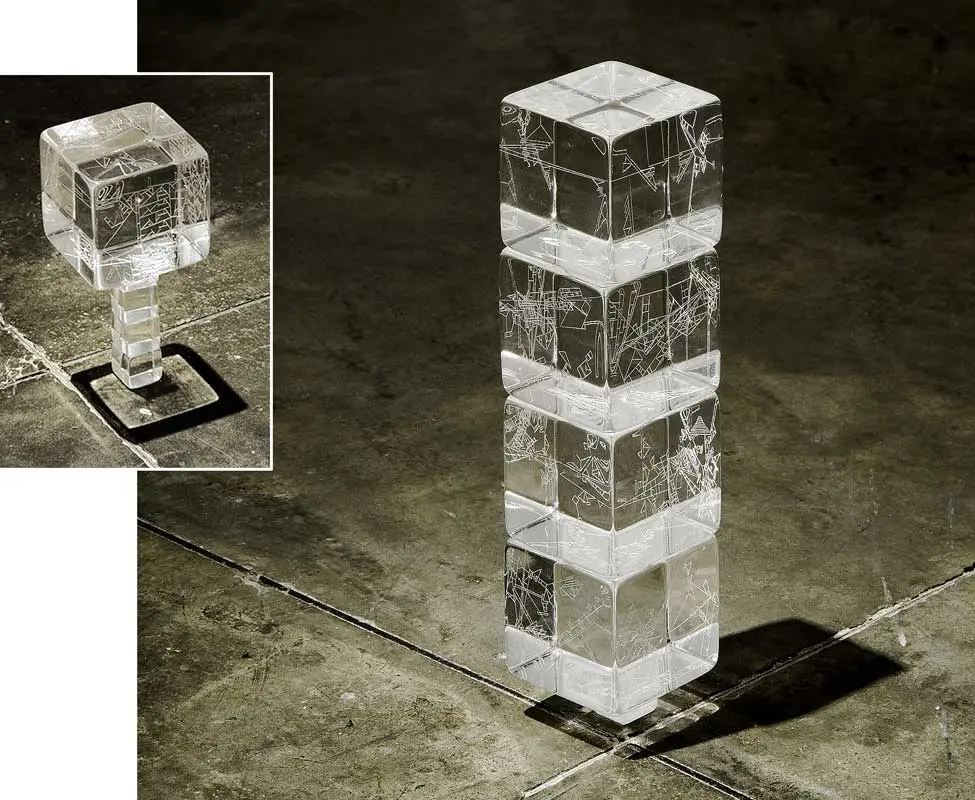
Hiporeal is a floor piece made up of small, acrylic geometric cubes that are both opaque and transparent and whose surfaces are inscribed with marks. But like other works that play with scale and the interdependency between positive and negative space such as Cildo Meireles’ Southern Cross (1969-70), for example, Maggi’s installation also dialectically manipulates light and shadow to destabilize the so-called “white cube” and the spectator’s role. The installation is a constellation of independent forms placed on the floor in which the presence of the individual pieces are simultaneously magnified and atomized by the exhibition lighting and cavernous gallery space. As the light beams focus downward on each element, the spectator becomes exceedingly cognizant of a triangulating asymmetry between the artwork’s minutiae, the enveloping exhibition environment, and the spectator’s overpowering presence. Hiporeal has, however, an affinity with PreColumbian & PostClintonian by being housed in the gallery-like a cardboard box to foil roll; and parallels San Andreas Fault in using negative exhibition space as the latter emphasized the mat over the area where the work would be inscribed. The dichotomy of light/dark and positive/negative space that permeates within and around Hiporeal evokes religiosity all the while subverting its own artistic aura. The formal and conceptual dialogism intrinsic to the work has also been expanded into other registers including Micro & Soft on Macintosh Apples (2008), Kodak Circle (2009), and Graphite Clock (2008).
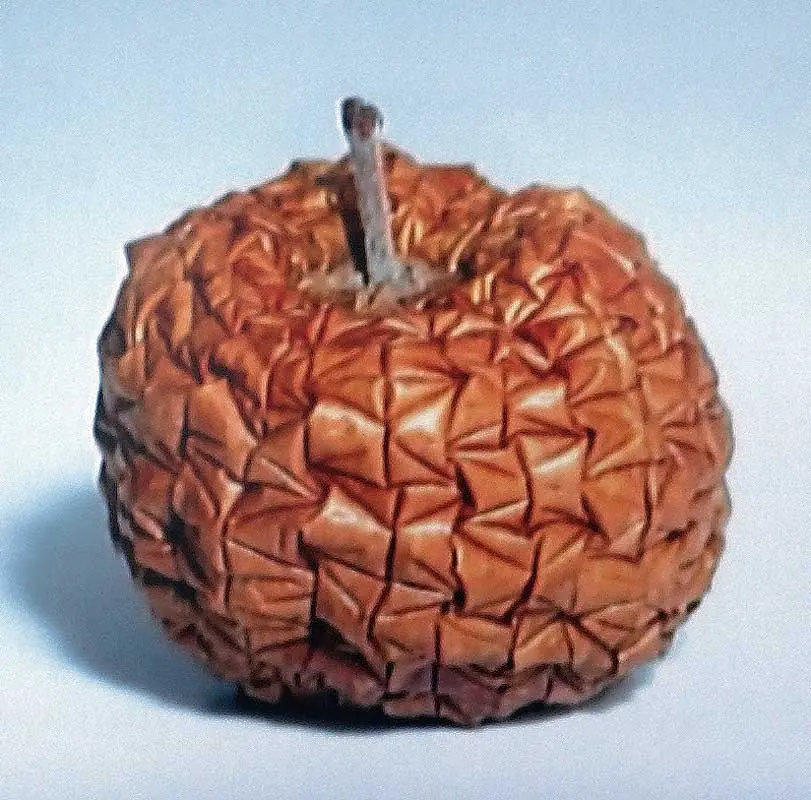
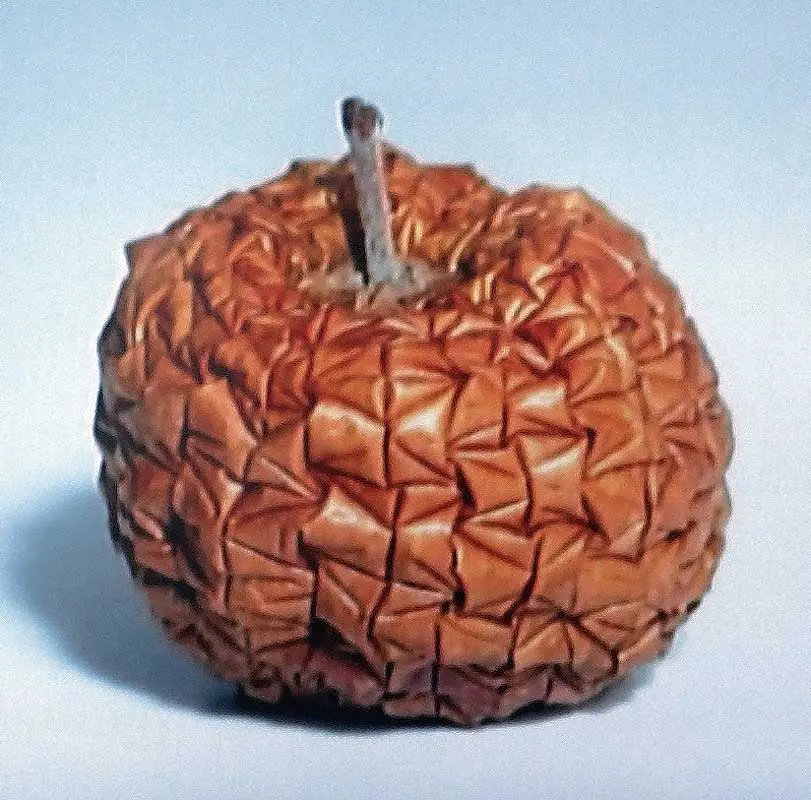
Micro & Soft on Macintosh Apple is, as its title implies, a play on the literal and the figurative; for it coyly alludes to both fruit and the Macintosh Apple or Apple Mac as it is ubiquitously known. Micro & soft is an ironic reference to Bill Gates’ computer corporation and rival to Apple computers. Maggi’s series of apples that constitute his work, which is incised with cuts, feign dehydration, and mimetically convey its title, are more than commentary on computer monopolies, the moribund of technology, nor are they only a poetic exegesis on nature/culture dichotomy. But there is something to be said of the work’s ostensibly simple, yet complex form that folds back into its narrative. The apples described in the work’s blurb are New Paltz Macintosh apples. New Paltz is the university town in New York where Maggi received his degree and where he has taught. There is never a detail, however minute or peripheral, in Maggi’s art is that is innocuous; everything in his art has meaning, but the meaning is never singular but multivalent. What is one to make, then, of the New Paltz Macintosh Apple and its phonetic link to the Apple computer as well as Microsoft, if not the notion of the New Paltz apple as an epistemic symbol? And, of course, what is the matrix of the apple as epistemology in the West if not that original forbidden fruit plucked from the tree of the knowledge of good and evil? Of course, one may construe this rather wild explication or possibly far-reaching interpretation as a case of over-reading a work; but it does nonetheless underscore how Maggi’s art can reel the imagination. There are few artists today whose works can have such an affect; for Maggi’s poetic yet intellectually rigorous art can trigger a plethora of narrative possibilities when experiencing and pondering it. This, of course, is no small feat as attested by Micro & Soft on Macintosh Apple as well as the equally idiosyncratic Kodak Circle and Graphite Clock.
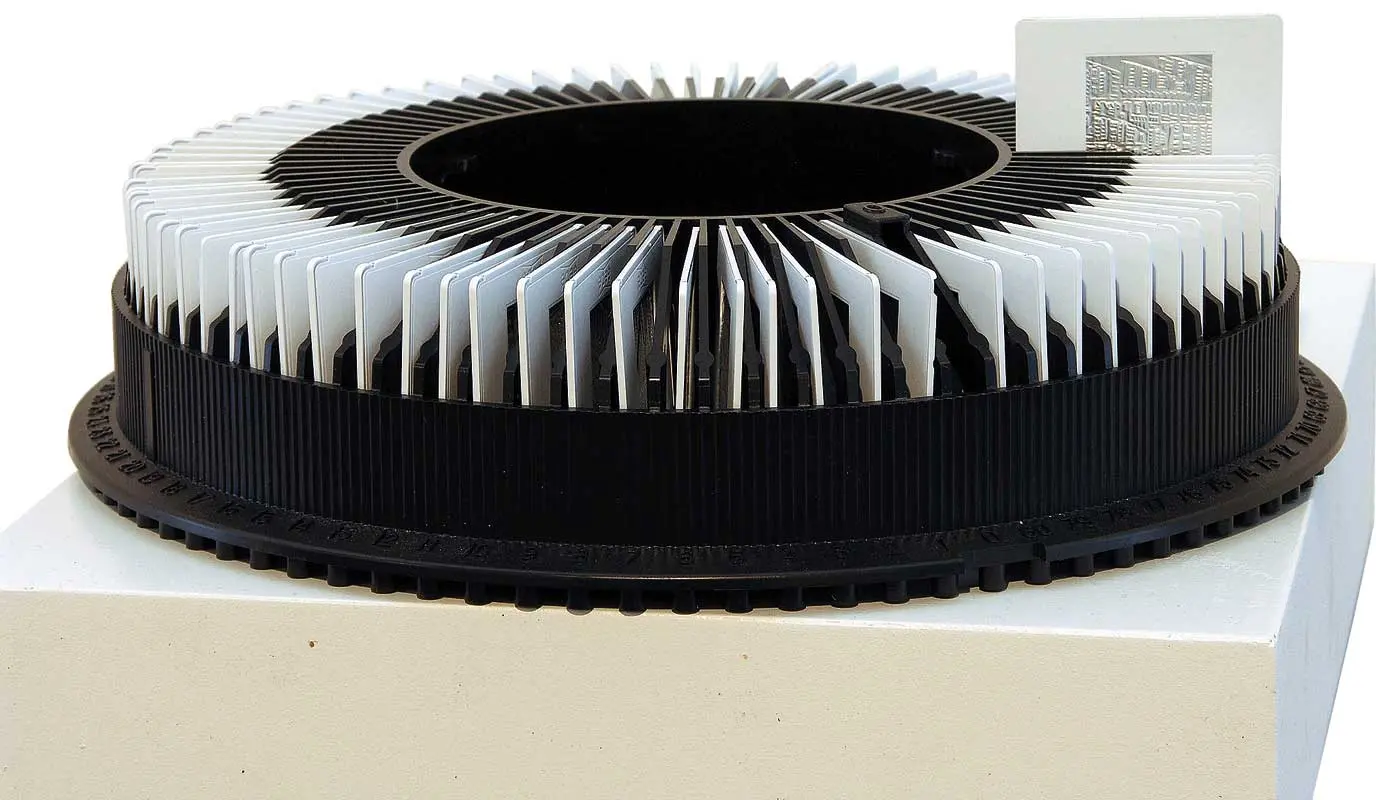
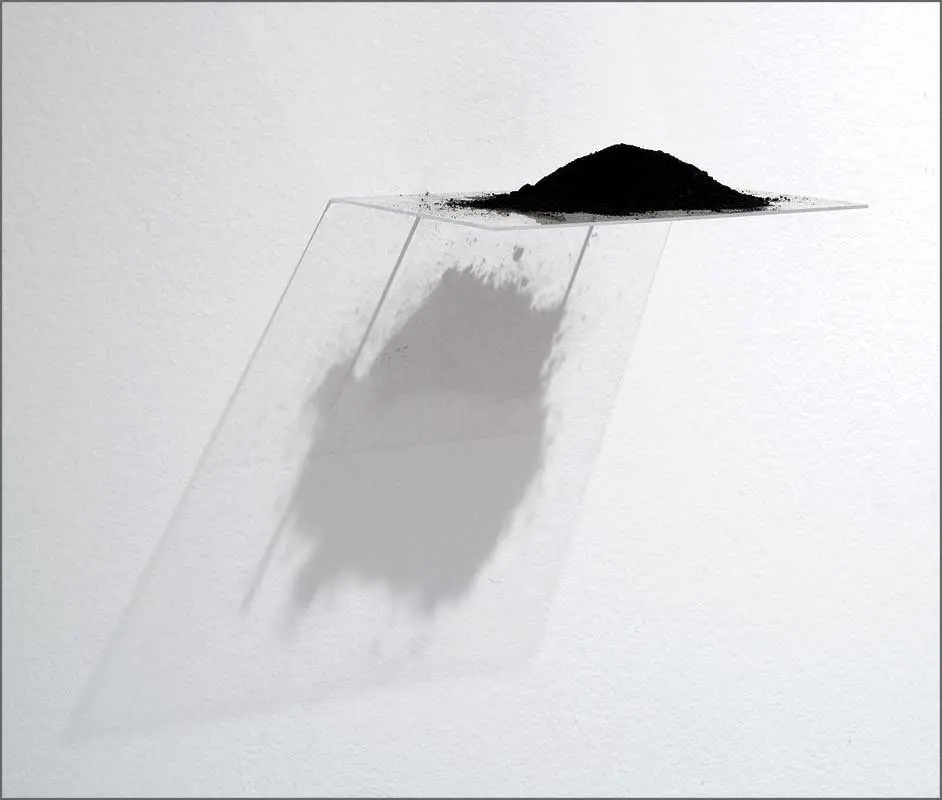
Kodak Circle is also a complex work executed with an economy of means. Playing on both stasis and dynamism, Kodak Circle implies temporality and drawing’s ontological malleability all the while subverting the medium of the moving image. The death of painting rhetoric formulated in the 1980s vis à vis video and film is undermined in Kodak Circle via the slide projector’s subservience to drawing. Each slide in the 48 slide carousel consists of a drawing in pencil on the aluminum surface. Yet each drawing is different and this allows the viewer to take on the role of artistic collaborator as well as curator since he/she has the liberty to exhibit a number of slides partially exposed from the carousel in myriad configurations. Furthermore, not only is there no front or backside to the work because of the carousel’s circular format, but both sides of the slide reveal its marked alteration as a kind of mirror image. Graphite Clock similarly dovetails on the oscillation between imagined time and actual space, and from object to language and back again by way of its humble, yet polyvalent use of materials: it consists of a sculpture made from grounded graphite piled on top of a small glass plate that protrudes from the wall. The work can be characterized as an atrophic drawing made palpable via the corporeality of the graphite. It is actualized, however, not in the gesture that one conventionally finds in mark-making but through sculptural form and more importantly, through language. The linguistic dimension intrinsic to Graphite Clock, which is a quintessential Maggi artistic strategy, resides in the title’s etymology. Graphite was the term given by Adolf Abraham Werner in 1789 for the material used in pencils, but the word’s origin and meaning is Greek and signifies to “draw” and “write.” What is being “drawn” or “written” on the work is neither a picture nor text, rather it is the sculptural object whose constitution “draws” and, “writes” itself by virtue of its etymology and material makeup.
What is apparent in the works discussed above is that Marco Maggi’s art is a confluence of visual poetics and conceptual verve where aesthetics and ideas seamlessly mesh. Whether his work manifests as installation or on a smaller, intimate scale, or on paper or in disparate media, Maggi questions the ontology of art in general but specifically that of drawing. It is not only structural issues that he elaborates as philosophical disquisition or as a kind of visual haiku that seizes our attention; but also his virtuoso techniques that include variegated inscription practices, modes of subtraction and reduction, and a plethora of formal and conceptual tropes executed with the greatest aplomb. Through his unique and complex modus operandi, Marco Maggi remains at the forefront of his chosen medium. This is poignantly evinced in how he continues to reconfigure drawing’s contours in seemingly endless permutations; one result of Marco Maggi’s protean artistic endeavor is that he perpetually forces us to rethink over and over again, how imperative and necessary the art of drawing is today.
RAÚL ZAMUDIO
New York-based independent curator and art critic. Most recently co-curator, Beijing Biennale, 2009; co-curator, Seoul International Media Art Biennale, 2008.