From September 17 through October 22, 2009, Mauricio Cervantes (Mexico City, 1965) presented his solo show titled Memoria de un hermenauta (Memory of a Hermeneutic), which included 24 medium- and large-format works created during 2008 and 2009. Walking through the exhibition rooms at the Centro de las Artes II in the city of Monterrey, Nuevo León, the overwhelming reaction by the public was one of curiosity. Such a reaction occurred because this artist, who did not pretend to use trompe-l'œil, nevertheless exhibited canvases mounted on wood treated with paint and certain oxidation and erosion processes, as well as other works created by means of similar processes, but that utilized pigmented concrete tiles. In both cases, the expressive, thematic, iconographic, compositional, and chromatic solutions were identical because, more than a perceptual sleight-of-hand, Cervantes chose to attain similar results through the use of different supports.
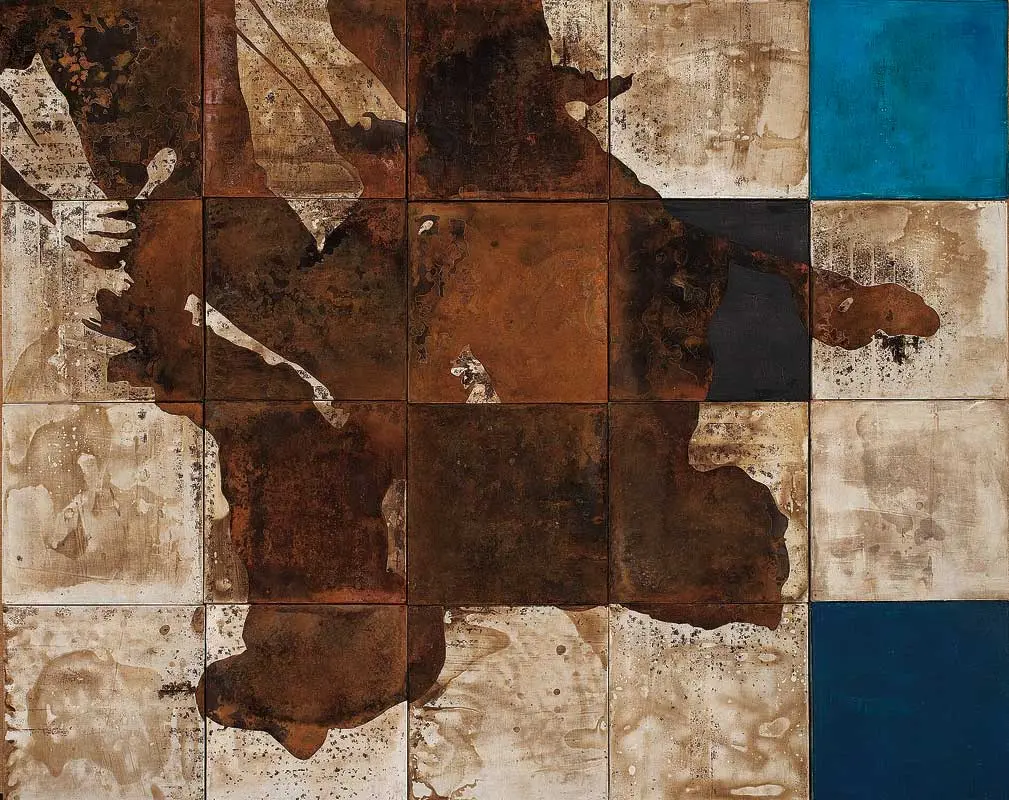
In addition to the effect of curiosity already mentioned, the public was also able to experience others, such as the feeling of finding themselves in the presence of a merging of rigor and freedom, or of feeling that they are invited to discover similarities and differences among the works, given that contained in the precise grids – created with adjacent modules, measuring 20 to30 centimeters on each side – there are marks, traces, and multiple other effects achieved that stand out, while the representation of shadows of women, or of couples with children – or even certain ornamental motifs – are recurrent parts of the exhibited group of works. A prominent aspect of Memoria de un hermenauta is exploring the contributions made by women to humanity. It is a theme that Cervantes has included in this exhibition, as well as in the 2008 exhibition titled Trama expansiva (Expansive Weft). He uses shadows to allude to that which is fleeting because it is always changing. At the same time, through these shadows of female characters or of adults with children, Cervantes creates a necessary song to life within the context of rather pessimistic times.
Another element that is noteworthy is the references in these works by Cervantes to mythical-magical thought, which goes against rationalism and the postmodern emphasis on the intellective that have dominated a great part of the artistic production in the West during the Twentieth Century. It is important to point out that the references to the past by Mauricio Cervantes do not contradict the artist's optimism, in that these are far from nostalgic. They are references to a period during the second half of the 1940s when the hydraulic tiles he used to stop being mass-produced. On the other hand, these references are also an invitation to change the predominant direction in which we have embarked (economically or even politically). It is a change that is reflected in his work, and therefore in his art, as Cervantes resorts to materials that, although no longer produced, can be revived from the past, recuperated, and brought up to date through the elements, memories, and documentation that remain from that time.
This exhibition is very meaningful because of Mauricio Cervantes’ relationship with Monterrey – going back to 1994 when his first gallerist and promoter was Guillermo Sepúlveda. Cervantes lived in Mexico City until 2004, when he decided to relocate to San Agustín Etla, on the outskirts of the city of Oaxaca. To this day, his interaction with the Oaxacan cultural world is as rich as it is intense, to such a degree that Cervantes decided to begin working with pigmented concrete tiles after a trip he made in 2007 to Juchitán, also in Oaxaca. Today, the news has spread about his use of materials from the past, which had ceased to be manufactured and that were ultimately destined to cover floors. And now, even the renowned Oaxacan artist Francisco Toledo has shown interest in using this type of tile as supports for his works.
Memoria de un hermenauta represents a milestone in Mauricio Cervantes’ artistic trajectory. While it is true that he had already explored the possibilities found in carrying out serial work and variations within groups of works, on this occasion, digital pre-production, as well as production systems that he established in his workshop, are absolutely different from those to which he had previously resorted. A carefully crafted catalog of the same title was created to accompany this exhibition. It includes texts by Indira Sánchez and an introduction by Olga Margarita Dávila. The edition was produced in the city of Oaxaca by El Castor Publishers, headed by art promoter and gallerist Manuel García.
CARLOS BLAS GALINDO