
Miguel Ángel Ríos (Argentina, 1943) presents three powerful video installations that deal with identity and territorial issues, power, and violence, along with four large-format photographs and 15 drawings that reveal the process involved in producing his videos. His works Neither Color, Nor Height (2001), On the Edge (2005), and White Suit (2008) are presented within the framework of the Contemporary Program – dedicated to contemporary local and regional art – in Gallery 1 (ground floor) of the Malba – Costantini Foundation.
With the instauration of the last military dictatorship in March 1976, Ríos went into exile after having been detained at the sinister political repression center known as Coordinación Federal (located at Moreno Street, in Buenos Aires). An internationally known artist, Ríos currently resides in Mexico and New York. His curiosity and his nomadic ways throughout the continent have sharpened his interest in the games and traditions of Latin America, which are reflected in his work, such as is the energy of Catamarca, his natal province located in the Argentine Northeast.
On two screens that face each other, the work titled Neither Color, Nor Height (2001) depicts two soccer matches that Ríos has altered digitally. He exchanged the colors of the jerseys worn by Maradona and Pelé – the greatest soccer icons in their respective countries of Argentina and Brazil – and the audio on each of the televised matches. Viewers are surprised to find the Argentinean player wearing the Brazilian colors in the recording of the 1986 Argentina vs. Belgium semifinal match narrated in Portuguese. Likewise, it is very strange to see Pelé wearing the Argentine white-and-blue jersey during the 1970 championship match between Brazil and Italy, narrated in the unmistakable accent of a sportscaster from Buenos Aires. The title suggests that playing skill is more important than physical height or the color of the player’s jersey. The images with the masterful plays projected simultaneously could also be interpreted as questioning the sterile nationalisms, the political borders at times when millions of people are displaced from their homes, and when there are incalculable obstacles for entering the more developed countries.
Once again color plays a central role in On the Edge (2005), a diptych that unfolds through the confrontation between groups of black and white spinning tops. This work draws inspiration from another work, Till Death, a video presented at the Ruth Benzacar Gallery in 2005. A universal human activity as well as ancient sacred space, the game becomes serious in the piece titled On the Edge, where the combat that ensues between the spinning tops clearly shows them fighting for territory. Exhibited next to one another, the installation’s two synchronized monitors appear to be pulling the spectator into the center of the projections, where the tops violently compete for space. They attack each other, crash, fall, and are eliminated. This action unfolds persistently and hurriedly, in the midst of the marvelous concert produced by the infernal dancing sound of the tops spun off-camera by more than fifty skilled youngsters from the town of Tepoztlán, Mexico. In the end, one can observe the supremacy of the white tops over the black.
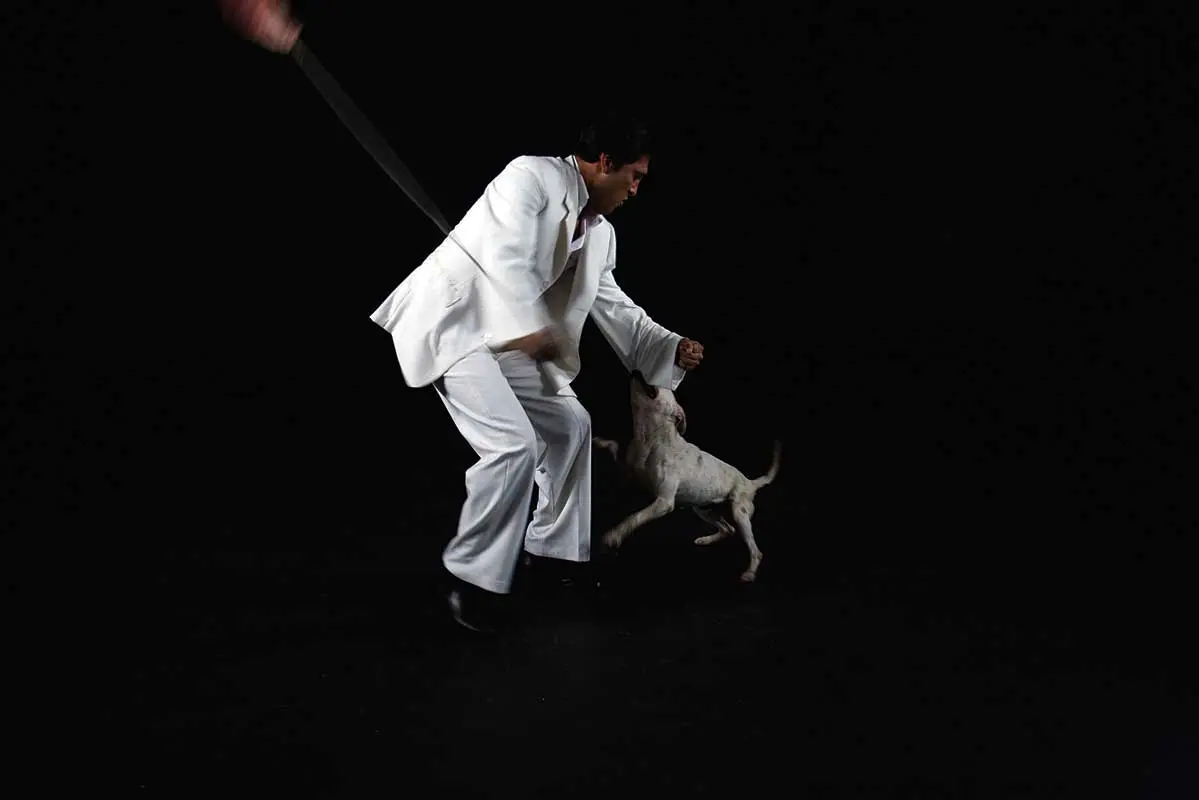
The central character in White Suit (2008) is shown swinging cords with pieces of raw meat fasten at their ends, as if they were boleadoras (throwing weapons), to the beat of a flamenco and malambo mix. The sounds and the violence also play a central role in this video-installation, in which the man dances as he is besieged by a pack of fierce-looking, and clearly ravenous, dogs. The man in the white suit dances nonstop as the dogs lie in wait for the attack, but find themselves in a frozen state because of the man’s confident dance moves. The dark-haired figure dressed in white marks the space with his cadence and keeps the animals at bay. That is, until one of the dogs jumps, bites, and grabs onto one of the sleeves of the dancer – not hurt because the fabric contains a protective material – who without losing the rhythm of his footwork, shakes the dog around. At one point, the still-dancing man arbitrarily decides to throw the meat and observes the dogs fighting against each other for the pieces. For the recording of the video – which took place in Mexico, and for which several cameras were used at once and in real-time – Ríos had to rely on the expertise of trainers to ensure that no one would be seriously hurt by the dogs, one of whom played a central role in the movie Amores Perros.
Metaphors for what there is too much of and for what is lacking, these attention-grabbing videos rely upon political themes with very human consequences, such as territoriality and the supposed integration among Latin-American countries issues that for some years now have been a constant preoccupation of Ríos, as he has expressed through several series and mediums.
Accompanying the exhibition is a bilingual Spanish-English catalog with critical essays by Guillermo Gasió, Paulo Herkenhoff, and María Belén Sáez de Ibarra.
VICTORIA VERLICHAK