
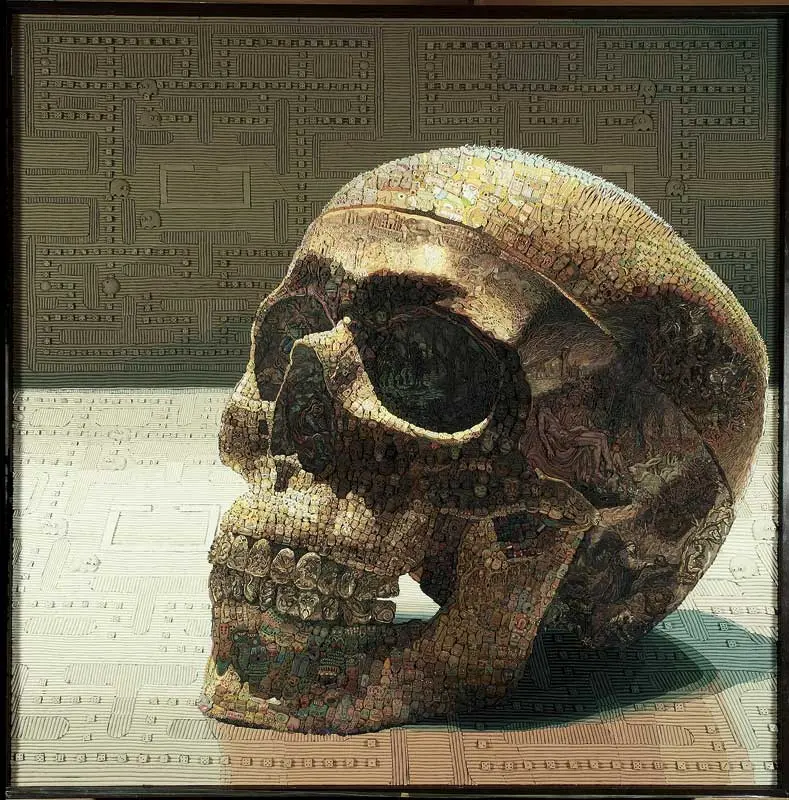
The exhibit Silencio (Silence) by the collective Mondongo at the Ruth Benzacar Gallery presents possible universes and lost worlds where dozens of people visit day after day, attracted by the glowing commentaries from Calavera, the subject of all the attention. Its presence alone justifies the entire exhibition. Nevertheless, there is much more to see in this exhibition that confirms the evolution of the joint work by Agustina Picasso (Buenos Aires, 1977), Juliana Laffitte (Buenos Aires, 1974), and Manuel Mendanha (Buenos Aires, 1976), all of whom were trained as painters and have collaborated since 1999.
The first exhibit by the group was at the Recoleta Cultural Center in 2000. Since that time, they have exhibited in numerous places, including in China, where they were sponsored by Comme des Garçons the fashion house founded by Japanese designer Rei Kawakubo. From its conception, Mondongo has generated a great deal of media attention because of the social connections the group has, and also due to the celebrities they portray and the rare materials they choose to work with, which are often associated with the themes approached. With notable virtuosity, they have created images of the Spanish royalty and Pop idols, as well as of Pope John Paul II, local art-scene personalities, and movie stars, among others. The images of King Juan Carlos, Queen Sofía, and Prince Felipe – commissioned by a secretary from the Spanish government following a visit to Buenos Aires – were fashioned of more than 22,000 pieces of glass in colors that reflect, according to the artists, the several crystals through which the Spanish society sees them. Nevertheless, one inescapably observes the connection possessed by these pieces of color glass with the way that the Spanish conquistadores attempted to buy their way across the Americas. In a similar fashion, the collective also created David Bowie’s face form mountains of glitter, while that of the Pope was designed in hosts on wood. The image of beloved gallery owner Ruth Benzacar (Buenos Aires, 1933-2000) was conjured up with hundreds of wooden stick matches, while Walt Disney’s face is done in plasticine.
After years of flirting with effectism, with a certain frivolity, and with creating thematic series in Silencio (Silence), Mondongo succeeds with autonomous works that address several themes. This time, they once again paint with plasticine, thread, and plastic. Thankfully, they decided to leave behind the annoying use of food in their works, as when in 2004, they manipulated hundreds of kilos of cold cuts, cheeses, and crackers in a country where 40 to 50% of the population lives below the poverty line.
Calavera is an impressive work of plasticine on wood (200 × 200 × 7 cm). It appears as a skull, which contains and describes much of the history of the world. It combines fiction and reality and includes minuscule animal and artwork reproductions of well-known artworks such as The Scream by Munch, the Pietà by Michelangelo, and The Hare – somehow modified – by Dürer. There are also everyday life scenes, mythological figures, architectures, and battles face unequivocally rendered after specific people as well as after imaginary ones, iconic figures from the Western and Christian traditions such as the Statue of Liberty and Christ Crucified. An endless depiction of scenes, the work was constructed over a background that appears to be aboard with electronic circuitry that had been drawn with dice. A contemporary memento mori (remember death), invites to be seen time after time. The Ruth Benzacar Gallery has announced that another version of this work will be exhibited at Art Basel Miami Beach.
There are many autobiographical elements in the pieces that portray a Juliana Laffitte ready to give birth to her daughter Francisca, while surrounded by a bucolic landscape. Panóptico III (Panopticon III) is a moving diptych (each measuring 300 × 125 × 7 cm.) created with plasticine and cotton threads on wood. Surrounded by more than twenty young girls –older versions of the aforementioned Francisca– the mother figure and the entire scene appear to be a meditation on a desired and placid maternity, but one that is also excessive within the context of these turbulent times. Agustina Picasso’s self-portraits of when she was a young girl are also ambivalent. From a distance, these appear to be angelical faces, but a closer look reveals that they are constructed with images of penises, sperm, and miniature breasts.
Another two works allude to a river, which could very well be the Río de la Plata that surrounds Buenos Aires and represents a geographical and cultural space shared with the neighboring city of Montevideo. One of the works, fashioned from plasticine, alludes to what could possibly flow in its currents: corpses (are these the remains of the victims of political prosecutions, aka the disappeared?); bottles; industrial manufacturing waste; some plants; plastic, and more plastic. It was precise with plastic (bags) that the group ¨painted¨ the second piece, a monumental view of the same river that this time appears choppier.
Moving away from the opportunism and the immediate response to the popular reaction that characterized their previous works, such as those with images of Evita (fashioned with bread), Maradona (created with gold chains), and Che Guevara (made with bullets), with Silencio, the Mondongo collective, now, proposes instead the ¨silence¨ of these ten reflexive and subtle pieces.
VICTORIA VERLICHAK