
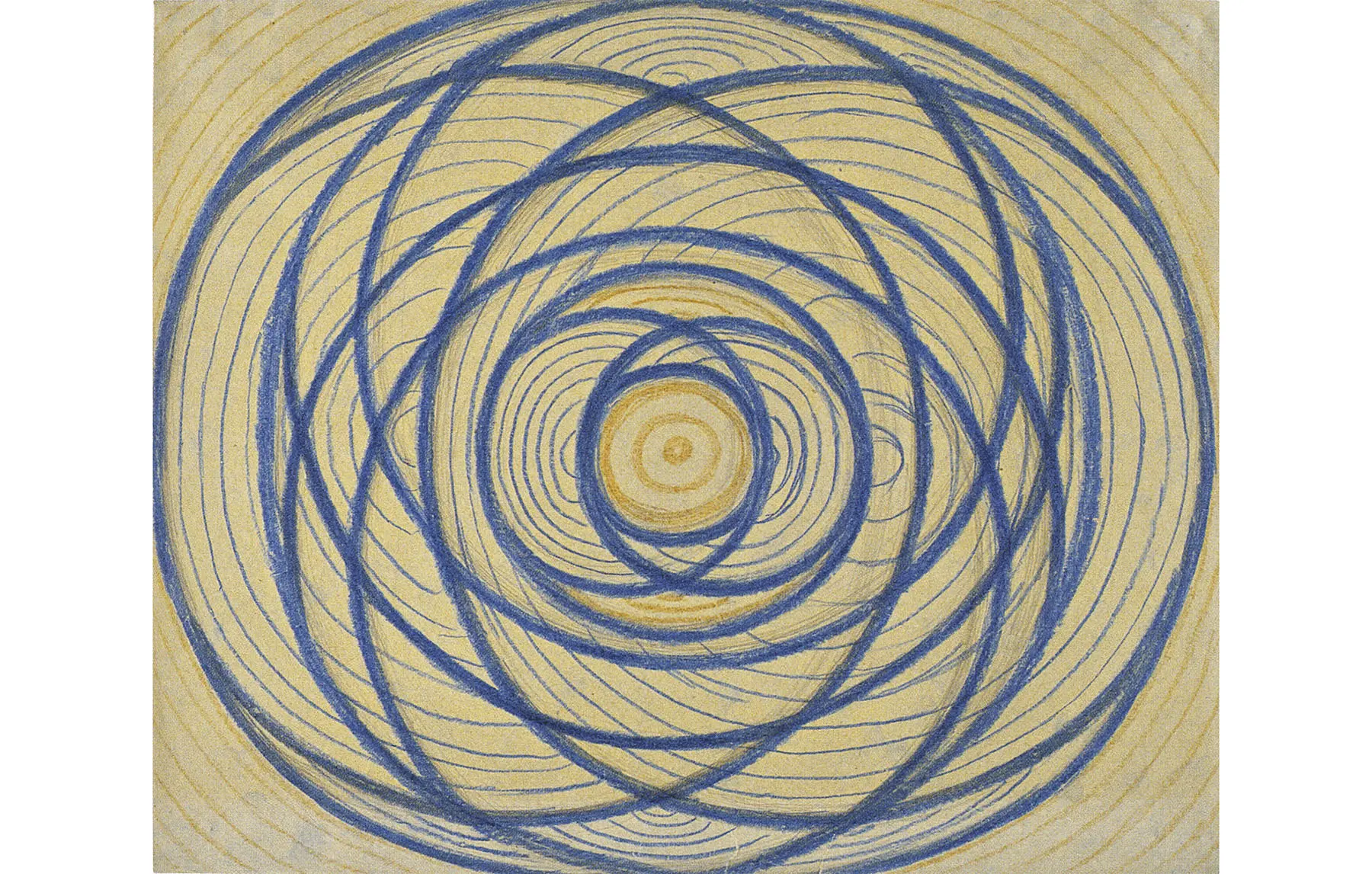
With the rather misleading, corny, and obvious title of Dance of Colors, Nijinsky’s Eye, and Abstraction, the Kunsthalle in Hamburg tries to drum up big capital with a flimsy investment.1 At the core of the exhibition are approximately one hundred small drawings Nijinsky completed during a manic year in 1918-1919 shortly before withdrawing completely from dance as a result of intensified schizophrenia.2 In addition to Nijinsky’s drawings, the exhibit, self-defined as “ambitious,” includes memorabilia, sketches of Nijinsky by other artists, and more substantial showings by other Eastern European abstractionists who coincided in Paris at the time, some of them connected with the Ballets Russes, the dance company where Nijinsky established himself as the greatest male dancer and choreographer of the twentieth century. The show’s advertisement explains this curatorial decision:
“Like Nijinsky at times, these painters lived in Paris between 1910 and 1925 and worked on the themes of dance, rhythm, and motion in a highly abstracted manner. Strong colors, arches, concentric circles, ellipses, and sweeping curves dominate their compositions. The paintings are marked by a strong, rhythmic accent and call to mind a dance motion or the musical progression of a film sequence. In their dynamism, the physical presence of the human figure on the canvas links up with the light, the shapes, and the vibrations of the cosmos to build up to a stirring dance of colors.”
The attraction of Dance of Colors was the title’s promised crossover of media. As someone with no real interest in ballet, nor particularly well informed about Nijinsky, beyond his name and fame, I was drawn by the suggestion that this exhibit beyond a formalist interest was also tackling the complexity of hybrid forms of expression. The idea of interdisciplinary art is quite old, and here I thought I would find more clues to its possibilities. In 1850, Richard Wagner had articulated the concept of the Gesamtkunstwerk, or “total work of art” and applied it to all his operas afterward. I was intrigued by the possibility that Dance of Colors might provide a key to the work of later artists who, with different degrees of success, tried to merge media and blur borderlines – artists such as John Cage, Nam June Paik, Robert Wilson, and Heiner Goebbels. Disappointingly, speculation of this nature turned out to be absent from the curatorial intentions of this project.
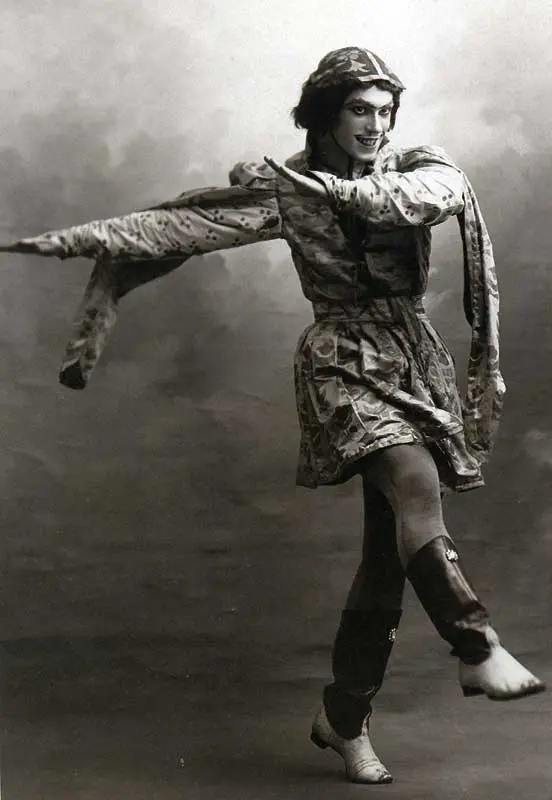
A key figure in this exhibition is Sergej Diaghilev (1872-1929), who founded the Ballet Russes, where Nijinsky achieved his glory. Dance of Colors is in one respect, and explicitly, an homage to the Ballet Russes on the 100th anniversary of its founding. While it’s not possible to know whether Diaghilev really had in mind or thought that he had achieved the ideal of the Gesamtkunstwerk, it is certainly the case that he opened the stage to the cutting edge and semi-cutting edge talents of his time in dance, music and art and put them to work as a team in service to the creation of a major spectacle. Diaghilev had started his project with the intention of enriching European culture with the introduction of his notion of Russian creative power. He was particularly intent on infusing new energy into ballet, then strong in Russia but in decadence in the rest of Europe. He emphasized Russian talent, but the project soon took its own direction and included pretty much any modernist creator who was close to Paris. Between 1909 and 1929 Ballets Russes engaged among others: Ana Pavlova, Vaslav Nijinsky, and George Balanchine (originally Georgi Balanchivadze) in dance; Stravinsky, Debyssi Milhaud, Poulenc, Prokofiev, Ravel, Satie, Respighi, and Richard Strauss in music; and Picasso, Matisse, Derain, Miró, de Chirico, Dalí, Balla, Utrillo, and Rouault in art. In light of the multidisciplinary collaboration orchestrated by Diaghilev, the show at the Kunsthalle seemed especially promising.
Diaghilev was searching for all-encompassing rhythmic structures that connected movement to other forms of expression. In 1911, with Nijinsky, he visited the Swiss music teacher Emile Jacques-Dalcroze, who was very skeptical of traditional ballet and in that same year had proclaimed its death. He also dismissed opera – though he acknowledged some refreshments introduced by Wagner – claiming that the majority of singers and composers don’t know the laws of the body. Dalcroze developed a technique of rhythmic gymnastics where music was to be experienced through body movements, which in turn would help keep the timing in the aural part of music.3 He called his system “eurythmics.”
Around the same time that Diaghilev and Nijinsky were looking into the work of Dalcroze, Rudolf Steiner was introducing into anthroposophy a concept he labeled eurythmy. While Dalcroze’s concept of eurythmics conceived of movement as subsidiary to music, Steiner’s eurythmy intended a synthesis of expressions. Many, if not most, of the participants and collaborators of the Ballet Russes were connected with theosophy and in particular with the dissident branch represented by Steiner.
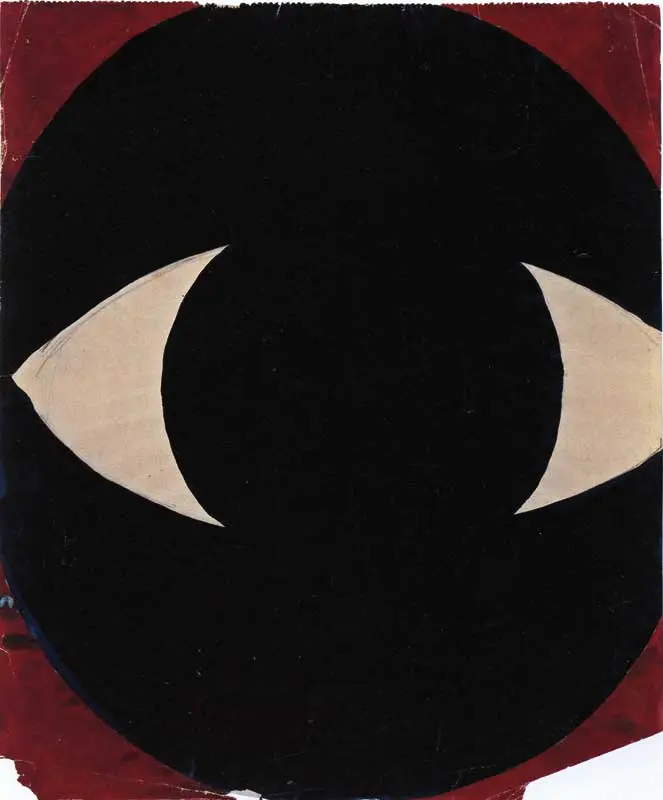
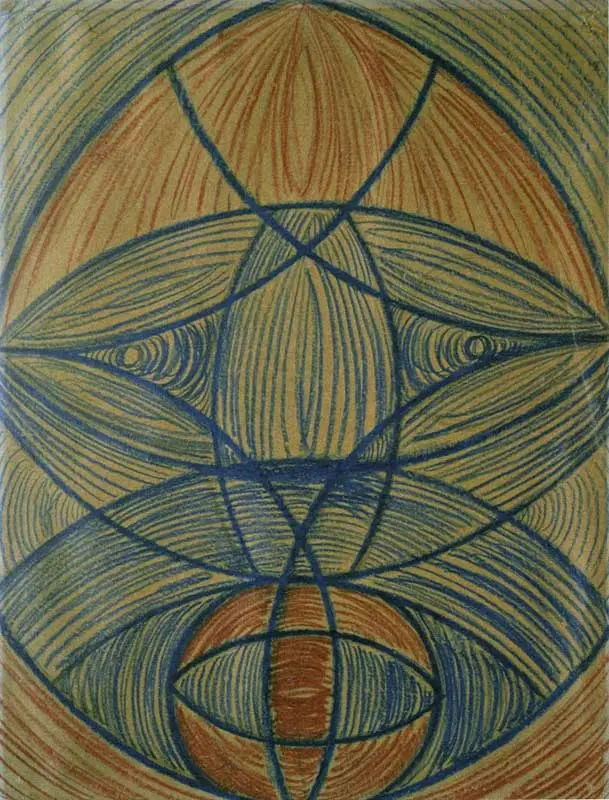
While endorsing Dalcroze’s ideas and methods, Nijinsky went on to focus on circular shapes in ways very close to anthroposophy: “The circle is the complete, perfect movement. Everything is based on it—life, art, and surely our art. It is the complete line.”4 The statement sounds very much like Steiner, who, in his esoteric writing about art stated: “If the true, living, sentient human being confronting a circle, senses the feeling of egohood, selfhood, arising in his soul, or when he sees a fragment of a circle he feels that it typifies the independent self, he is learning to live in forms.”5 As it turned out Nijinsky ultimately found himself more drawn to Tolstoy’s rational Christianity in which one reaches God through reason rather than faith. Yet he also came to think he had a special, not entirely rational relation with God: ''I shall feel and You shall write. I am writing because You are writing. I shall stop when You stop;'' and ''I am a man in a trance . . . I can write in a trance . . . I am in a trance of God.''6 Sifting through hairsbreadth distinctions between different spiritual beliefs is not the important point, however. Mystical beliefs seemed to have influenced most of the artists involved in this cross-disciplinary search.
It was only after his psychotic breakdown that Nijinsky wrote down his ideas about the mystical importance of the circle. Yet these ideas retroactively help to explain his drawings, which were completed before his breakdown. Almost all of them explore the circular curve as an organizing principle. The text in the catalog notes that Nijinsky’s drawings were often dismissed as signs of his mental illness,7 but disputes this characterization. It’s pointed out that when Nijinsky started to show symptoms of disturbance, his wife went to see Eugen Bleuler, the Swiss psychiatrist who had coined the term “schizophrenia.” She described Nijinsky’s symptoms, but Bleuler’s first response was funnily dismissive: "The symptoms you describe in the case of an artist and a Russian do not in themselves prove any mental disturbances."8 It should be noted, however, that Bleuler subsequently revised his diagnosis after meeting Nijinsky in person.
In 2006, Nijinsky’s drawings were exhibited at the Ricco/Maresca Gallery in New York. This is a gallery specializing in outsider art, but the title was chosen for that show - A Dance With Madness – was perceptively ambiguous with respect to the role of mental illness in Nijinsky’s work. And seeing the Hamburg show, one can understand why. Certainly, when viewed in that context, Nijinsky’s drawings do not seem the product of a deranged mind reaching for a mad synthesis of the universe. They are amazingly simple and appear to be in a disciplined search of ascetic elegance. In the end, though, it really doesn’t matter very much how one chooses to classify Nijinsky’s drawings, for they are not particularly impressive and, had the author been different, would probably not merit exhibition.
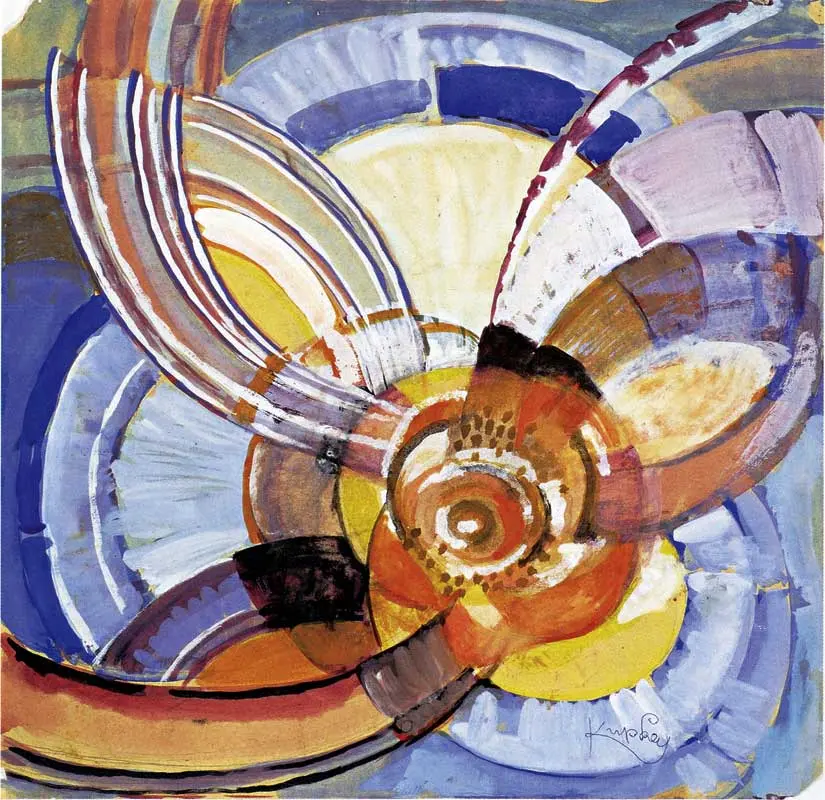
This brings us back to the larger scope of the exhibition. The art component is spruced up by a limited choice of artists whose connection with or mutual exchange of influence with Nijinsky is rather flimsy. (The notes by the essayists in the catalog abound in the use of words like “probably,” “may,” or “it is likely.”) Leopold Survage, Sonya Delaunay-Terk, Alexandra Exter, František Kupka, and Vladimir Baranov-Rossiné are represented by works typical of their production and taken mostly from the period from 1910 to the early 1920s. A few of the pieces are strong, but overall the exhibition is not exactly stunning. And it seems to be more informed by kitsch than by art; the only thing holding the show together being Nijinsky’s myth. For instance, Kupka’s main possible link to the exhibition’s theme is that in 1911 he worked on a series of paintings (Amorpha: Fugue in Two Colors) that were inspired by the movements of his daughter while playing ball. Léopold Survage has somewhat more of a connection in that he did work with Diaghilev, but that collaboration began only in 1922, long after Nijinsky’s departure. While his work has interesting implications for intermedia studies, it never came to fruition. He aimed to organize his abstract paintings sequentially so as to make an animated movie with the title Colored Rhythms, but the project failed for lack of funds.
Sonya Delaunay began working with Diaghilev in 1917. Her initial interest was in dance, which seems to have been prompted by the recent arrival in Paris of the tango and the foxtrot. Even so, her artworks here (from the period 1913-1928) are probably the most interesting in the show. And yes, she used many circles and curves.
There is nothing intrinsically wrong with circles. Tibetan mandalas are among the most interesting works produced in the history of art. If one chooses to go beyond a purely technical fusion to seek a total work of art, mandalas may actually qualify as the most accomplished form of Gesamtkunstwerk. They try, in one single map, to encompass both the Universe and the people attempting to decode it.
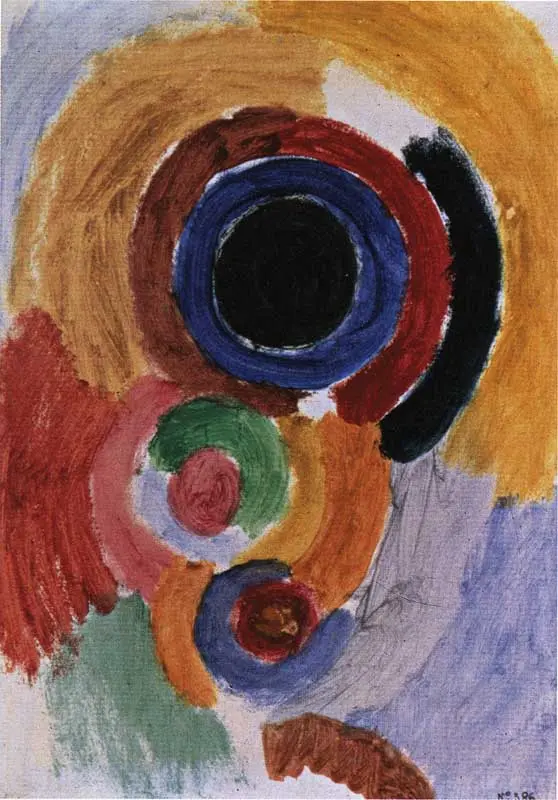
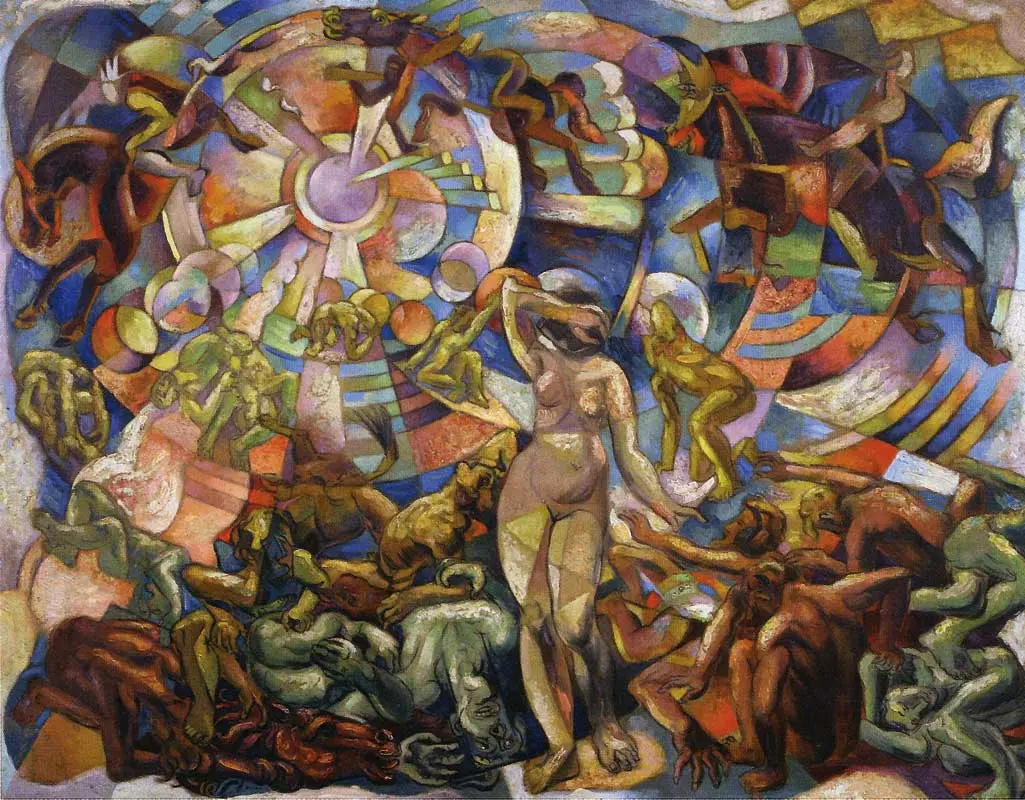
The modernist approach to circles was not related to mandalas, however, and the manner in which the circle and curved lines were used is problematic. On the one hand, artists relied on the possible symbolic value of the circle, using it as a narrative device. Nijinsky and others invested some meaning into the symbol, a meaning that had to be made explicit by sharing the significance of the symbolism. In the case of the paintings of Baranov-Rosiné in the exhibit, the most extreme examples of this tendency, the result is bad illustrative imagery. On the other hand, solving an image by using curves as formal building blocks became a formulaic and simplistic method for rendition and expression. Including some of Picasso’s work of the early 1930s, André Masson’s calligraphic disguises a decade later, combined with biomorphic approaches, formalism here offered a basic recipe offering “fun for ages 3 to 80,” the consequences of which we are still suffering today.
Synesthesia, the translation between senses (typically sounds into colors), was the rage at the beginning of the twentieth century, and especially so among theosophists and anthroposophists. Nijinsky’s vision of combining all his concerns in drawings was related to synesthesia, which operates on the most basic levels of sound, color, and movement and helps to explain the exhibition’s focus on abstraction. But it is a very basic translation, more akin to transferring alphabets than complex statements. A sound recalls an associated color or a color recalls a sound. A melody or a composition happens after this first association of the visual and sound units.9 It’s a pity the show neglects to seriously credit Wassily Kandinsky and Alexander Scriabin. In 1909 Kandinsky, intrigued by the compositions of Arnold Schoenberg, worked on his Yellow Sound piece, a spectacle that combined color, music, and dance. Composer Scriabin, a friend, and collaborator of Kandinsky who also worked with Diaghilev had started on his Mysterium already in 1903. Never finished, it was to be performed at the foot of the Himalayas, combining music, dance, color, and smells. After the performance, the world was supposed to end. He created a “color piano” (clavier a lumieres) in 1915, shortly before his death. Both Kandinsky and Scriabin were Russians, worked with sound and color, and did work much more interesting than what the Kunsthalle had to show. One also misses any reference to Loie Fuller, a U.S. dancer and choreographer active in Paris who at the end of the nineteenth century was experimenting with the combination of dance with colors. In 1896, her Serpentine Dance used layers of silk to create abstract moving sculptures in space that kept changing colors thanks to the recent invention of electric lamps. Fuller also used her technique in a performance of Stravinsky’s Fireworks in 1915, a year before Diaghilev’s presentation of the same piece, and she strongly influenced Giacomo Balla, who designed the corresponding sets for him.10 In an odd way, two apparently contradictory dynamics seemed to coincide in the modernist search for the total artwork at the beginning of the twentieth century. One dynamic was rooted in a mystical search for the all-containing icon, a symbol that could represent the unity of all things. The other dynamic was grounded in a rational search for a unitary framework for action sufficiently complex to accommodate every single mode of human expression – a total or universal construction.
The first, reductive approach was problematic since it produced symbols that could not capture the essence they purported to stand for. The goal of expression was an iconic form in which was embedded the truth of all things. But all that could be achieved was a visual prompt, in the nature of a cartoon, capable only of prompting preexisting memory of meaning, not new learning or new knowing. In this sense, modernist symbols were like the cross that signifies Christianity but do not constitute the essence of Christianity and cannot bring the viewer closer to knowing it. Nijinsky’s drawings, wavering between circles and eyes, may thus represent his beliefs in a simplified manner. But, in spite of what he wanted to happen, the drawings did not contain the essence of his beliefs. Nor, unlike the case of mandalas, can they take us onto the path that led to his beliefs.
The second dynamic seeks to express essence not with symbols but by total immersion in a unifying activity. This, too, was problematic, but for another reason. In time, “total art” became dangerously connected to totalitarian art. In one of his several landmark exhibitions (Der Hang zum Gesamtkunstwerk, Kunsthaus Zurich, 1983), curator Harald Szeemann explored this kind of work and its possible connection to differing worldviews. In one of the essays for the catalog of this exhibition, Bazon Brock warns about the danger of forgetting that art mediates between a speculative image of the world and actual life, that art does not design life.11 In 1918, German architect Bruno Taut designed a utopian crystal palace to top the Matterhorn, the Swiss mountain nearly 15,000 feet high. Taut, a pacifist, had conceived the project as a protest against the madness of the First World War. He prefaced his project (in Latin) with the declaration: “To build is necessary; to live is not necessary.”12 A project prompted by pacifist beliefs ended up explained by a life-denying ideology.
We take many of the myths of those early decades of the twentieth century for granted and much of the art produced is still paradigmatical for us. As a consequence we don’t see clearly that a half-baked mixture of obscurantism and politics informed the times, and that often the difference between symbols and art got lost. The function of symbols is to stand for something. The function of art is to be something. It is true that those decades liberated the making of art and honed our analytical skills. We can therefore better focus on what we have to do as artists. But, by overlooking the difference between symbol and art, we fail to confront and evaluate what that something we have to do actually is.
Thoughts and speculations of this kind are utterly absent in Dance of Colors, Nijinsky’s Eye and Abstraction, and I missed them. But perhaps it would be unfair to use this as a criticism. This exhibition was probably intended as an older-crowd pleaser – a nostalgic crowd more interested in ballet than in a search for the meaning of art. In that case one should be grateful that it actually still manages to make us think about that meaning.
(Edited by Selby Hickey)
NOTES
1. Hamburger Kunsthalle, May 20-August 16, 2009.
2. Nijinsky’s last performance, which happened to be with the pianist Arthur Rubinstein, took place in Montevideo in 1917.
3. Hubertus Gassner, “Der Tanz der Farben und Formen,” in Tanz der Farben, Nijinskys Auge und die Abstraktion, catalog to the exhibition, Hamburger Kunsthalle, Hamburg, 2009, p. 42
4. Gassner, p.48
5. Rudolf Steiner, Anne Stockton, Art: an Introductory Reader, Rudolf Steiner Press, 2003, p. 131
6. Danil Gesmer, “DANCE; Nijinsky’s Inner Choreography,” The New York Times, 03/07/1999. According to Gesmer, Nijinsky also considered patenting a pen named “God,” for God to write through other people as well.
7. Thomas Röske, “Im Schnittfeld der Farben,” Tanz der Farben.
8. Joan Acocella, “Secrets of Nijinsky,” The New York Review of Books, V.46 #1, 01/14/1999
9. In his Seven Types of Ambiguity (1930) William Empson refers the rhythm of poetry to the pulse: “[…] a rhythmic beat taken faster than the pulse seems controllable, exhilarating, and not to demand instant sympathy; a rhythmic beat almost synchronous with the pulse seems sincere and to demand intimate sympathy; while a rhythmic beat slower than the pulse, like a funeral bell, seems portentous and uncontrollable.” New Directions, New York, 1966, p. 30
10. Rhonda K. Garelick, Electric Salome, Princeton University Press, Princeton, NJ, 2007, p. 202
11. Bazon Brock, “Der Hang zum Gesamtkunstwerk,” in Der Hang zum Gesamtkunstwerk, Verlag Sauerlaender, Aarau, 1983, p. 24
12. Der Hang..., p. 363
LUIS CAMNITZER
Uruguayan artist. Emeritus Professor at the SUNY College, Old Westbury.