
In Creative Credo, a text that begins with the well-known dictum “Art does not reproduce what we see; rather, it makes us see,” Paul Klee writes that “the specific elements of the graphic arts are points and linear energies, planes, and space.” That “linear energy” is precisely what courses through the drawings exhibited by Pablo Solano at the Jorge Tadeo Lozano University’s Museo de Artes Visuales. The show, comprised of 140 drawings from the 1950s to today, brought to light the work of an artist who is relatively unknown to the contemporary audience, even despite several solo shows in Bogotá. In 1965 Solano exhibited at the Museo de Arte Moderno, in 1980 and 1981 at the Témpora gallery, and his most recent show was at Luis Pérez Galería in 1994. With Hechuras de línea, the title of this most recent exhibition, Pablo Solano reveals himself as one of Colombia’s most interesting modern artists, an exceptional draftsman who exhaustively explores the potential of the line using graphite and ink.
Solano’s career as an artist was launched in Paris, where he traveled with Rogelio Salmona and Germán Samper when he was an Architecture student at Universidad Nacional. In this first European sojourn, he worked in le Corbusier’s studio and met artists like Julio LeParc and Miró; he became friends with Willy Grohmann, Klee’s biographer, and Michel Tapié, the critic of informalism. Years later he was to return to Paris and share his studio with Isamu Noguchi. His work was presented in solo shows and featured in group exhibitions in Paris and other European cities, alongside artists like Soto, Fontana, Rothko, Tobey, Moore, Arp, Chillida, Miró, and Saura, among others. Between 1971 and 1976, having returned to Colombia, Solano participated in projects with Carlos Rojas for Artesanías de Colombia.
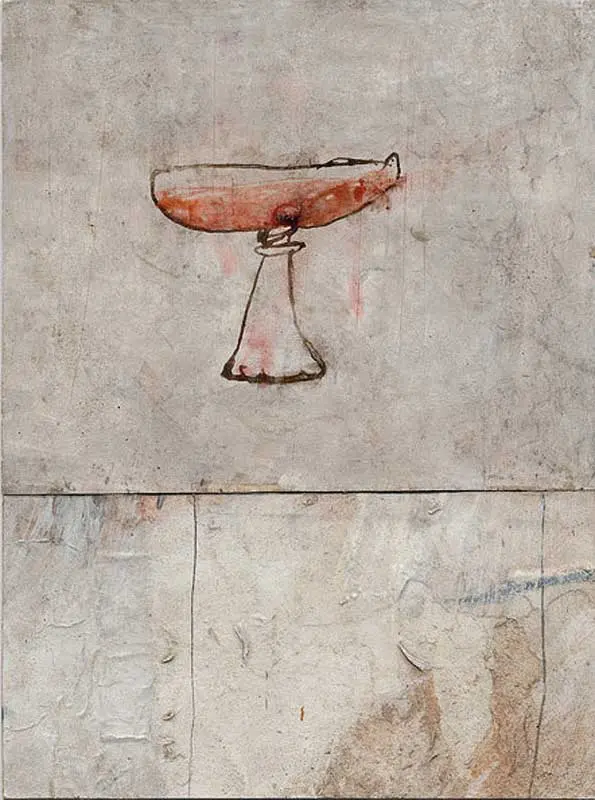
This exhibition brought to my mind some drawings by Julius Bissier presented by Bogotá’s Museo de Art Moderno many years ago. I had never before seen such delicate and poetic works as those small watercolors; now, in this Solano show, I have encountered a similar poetics. Solano’s drawings share with Bissier’s a sensibility, and approach to art and to the world that is akin to Klee’s, Wols’, and Michaux’s, artists who explored graphic media and made visible the greatness of the trace and the value of surfaces. Like them, Pablo Solano works in small formats, so one needs to come close to his drawings to perceive the subtle way in which a line contours objects, how it insinuates the presence of an apple, delineates glasses, or traces the outline of a landscape. In other drawings the line becomes entangled and, by accumulation, forms dark blotches in contrast with the white background. Other lines unfold and create a sort of weaving or architecture, marking spaces and suggesting staircases, as is the case with Babel, Pueblo artesanal, and other drawings from 1998. In yet others we find sfumato tones, light grays that confer a particular value to the thick, dark traces that impose themselves on them.
Exhibited in a different, contiguous room were video works by a number of young artists who participated in the preparation of the show alongside Marta Combariza. A few of these works used paper and graphite, while most were in media different from drawing. A few years back, at the 40th National Artists Salon, we saw the pedagogical exercises of Juan Mejía, who takes drawing to places beyond marks on paper, an artist who has also shown us how drawing is present in writing, as Johana Calle has done as well. These young artists worked along similar lines. One of their works, titled Coincidencias, used video as a medium to show how lines, as connectors of points in space, can also act in the temporal plane, and how its “energy” is present in everyday life. In their various actions, such as exhibiting a page from a personal diary or displaying the movements of a ball, deeply captured the meaning of a show that through the investigation of the line revealed a startling world.
Although many of Solano’s works are not dated, the show was organized chronologically, in groups of established affinities. It brought to the fore that energy alluded to by Klee, which helps us understand that the line, beyond recording and evoking the visible, has a value as human action, as gesture and manifestation of sensibility. And, as the young artists perceived, this linear energy extends also to contemporary expressions.
MARTA RODRÍGUEZ