Ronald Moran is perhaps the Salvadorian contemporary artist who has had the most exposure in recent years. He has represented his country in international biennials such as Venice and Havana; and recently one of his paintings was sold at Sotheby’s. Despite the success, Moran felt the need to change his work and go in a different direction. His last solo exhibition, Brevedad Inmaterial, at the Ex Teresa Arte Actual in Mexico City is a good starting point. The show was carefully curated and consisted of five new works, all installations, and videos. Although he is working within the same theme of violence, we can see new elements. Before he showed the effects of it, now in his most recent pieces he investigates the causes. Moran also brings to the table the identity card through the problems that affect a significant part of the world. His work is local in that sense, but at the same time, it is international; local due to the specific situation that he is addressing an international because it is done within the contemporary art language.
One installation from his series Home sweet home functions as the link to the kind of work he was doing previously. In this piece, Moran covered a served empty dining room with his trademark white cotton blanket. The table is set, giving the impression that somebody was having dinner and had to flee from the place. Moran is implying what could happen any given day in a normal Salvadorian home; people have to abandon their daily activities and run for their lives.
Polaroid 060 continues his work with the Salvadorian gangs, especially the one known as Mara Salvatrucha (MS), recognized as one of the most brutal of all. The piece consists of 35 Polaroid photos, a life-size photo of a member of the MS, and a video that illustrates how a group of young men fulfilled their dream of becoming members of this gang. The idea for this piece came to Moran when he visited Chiapas, a small town in the middle of the jungle, and in speaking with the young men there he realized that their dream was to become a member of this deadly group. These people’s aspirations were reduced to becoming a gang member, which is a shocking social reality, a slap in the face.
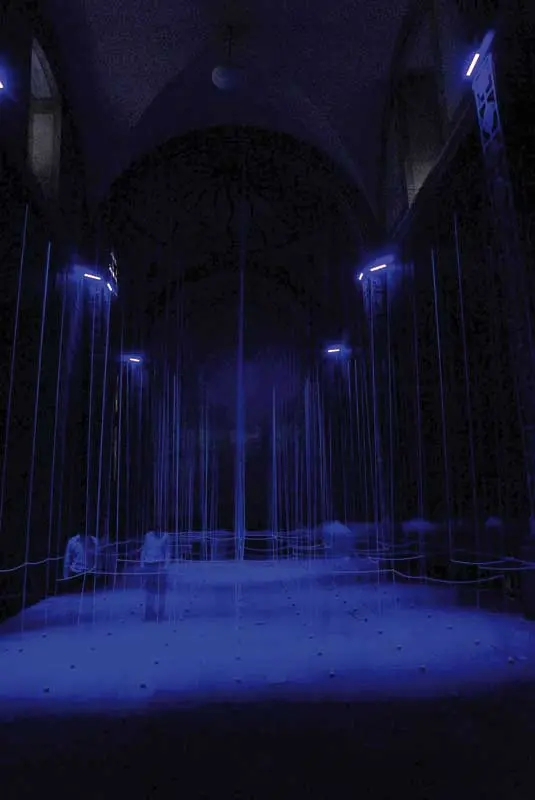
Perhaps the most impressive of the five works is the installation Laberinto. Made of threads hanging from the roof, and reinforced by blue light, the work is literally a labyrinth. The mythical implications of labyrinths tell us about facing the unknown; it is the metaphor par excellence of a leap of faith, a journey through the indefinite. What lies ahead is totally unpredictable, taking into consideration that we can make it through. Moran is using this simile to talk about migration. How the emigrant has to sort through all kinds of obstacles to get to the end, almost like a labyrinth, where you can see the entrance but don’t know if you will make it to the end.
Tiro al blanco is another piece that plays with the idea of uncertainty and luck. It is just a glass target of a very minimalistic appearance. It implies the presence of a shooter, who would have only one chance for his shoot, which will break the target. This is a unique opportunity, which knocks at our door only once. The piece follows a trend that he started with his work with toys. Before he was wrapping the toys in his characteristic white cotton, now he is experimenting with other materials and making the work appear simpler. The frailty of this piece can be interpreted as the fragility of life itself, how a wrong decision can shatter it forever.
The video Breve cuestionamiento que traspasa el estado material is another piece inspired by the idea of migrating. Showing several aerial views of land and sea his intentions are to show the three possible physical ways to migrate: sky, sea, and land. Supported by heartrending music, the images of these empty and limitless spaces suggest the many lives lost en route to reaching the Promised Land: the United States.
Moran brings to our attention the nonexistence of a future for young people in Central America. Through his works, we can see how their lack of perspective makes them wish to become outlaws. Their prospect is reduced to two alternatives: either become gang members or migrate. Being a gang member could kill them very young. Migrating implies a physical trip that can also kill them quickly. If they succeed on the trip, then comes the process of adjustment and navigation through the legal system, a procedure that could potentially continue forever. Potentially both possibilities are as bad as their current status: to vegetate endlessly through life in their towns.
Analyzing Moran’s work, we could interpret it as an expression of his obsession with violence, since it is reflected in his work in one way or another. However, considering the environment of his country, perhaps the most violent in the region, it is an understandable fixation. With this exhibition, he demonstrates the indisputable reality of this region: how the permanent violence forces people to migrate.
IRINA LEYVA