
The October 9 workday was colored by the staggered opening of various individual exhibitions in Havana. The movement began with the inauguration of a retrospective show, named for its exhibiting artist: Sandú Darié. Some had been awaiting it since last year when this emblematic visual artist (1908-1991) would have been 100 years old. But the Museum of Fine Arts (MNBA, its acronym in Spanish) allowed this commemorative fact to slip by and instead framed the exhibition in the Kinetic Year that, from last January, has been celebrated at the Casa de las Américas during the 50th year of its founding.
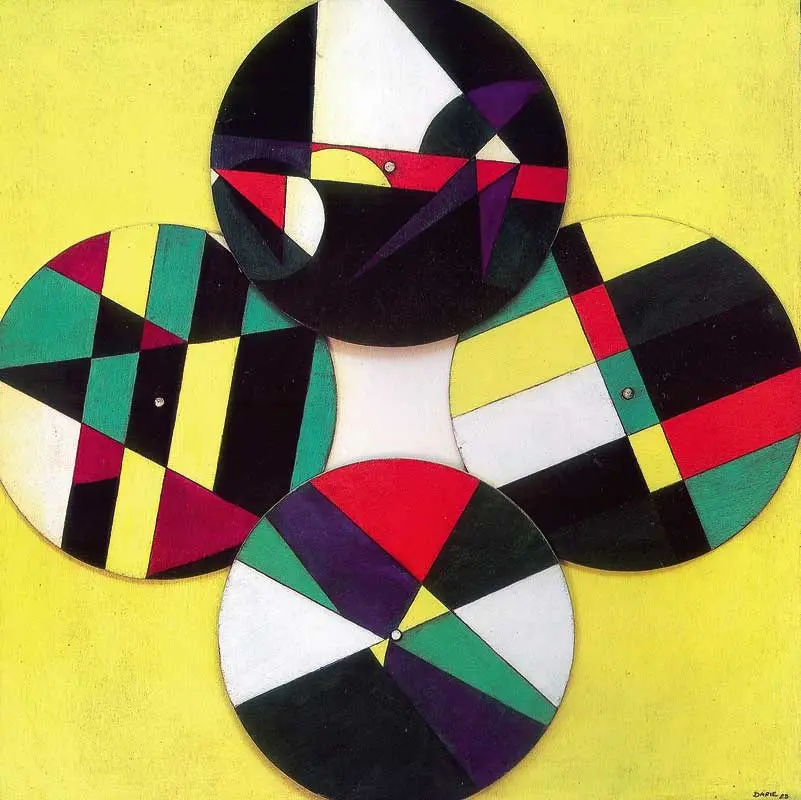
Previously, the MNBA had lent one of the works that represented Darié in the international anthology titled Lo(s) cinético(s) (The Kineticist[s]), inaugurated in the latter third of 2007 at the Museo Reina Sofía in Barcelona. All of this permitted extending homage to an artist who has a space in MNBA's permanent salons. In these spaces, I had become familiar with some creations that I later distinguished in the temporary Sandú exhibit, displayed in the largest area of the museum itself. I then discovered other artistic proposals that, in their majority, were kept in the MNBA depository.
Because this was a retrospective exposition, one could have expected a synoptic course through different landmarks of the artistic trajectory. And, in part, it was that. The curating was centered on the organic transition of the abstraction of kinetic art. This melded with the tone of the general announcement of the collective exhibition inaugurated previously at the Casa de las Américas, and in which Darié participated with a work of sculpture. But above all, it was inherent in the inclusion of the best known and relevant of Sandú's works.
Born in Rumania and residing in Cuba since the 1940s, this artist was one of the pioneers of the geometric abstractionism of this country, where Daríé became a naturalized citizen and came to form part of the group of Ten Concrete Cuban Painters. He was influenced by the Neoplasticism of Mondrian. He participated in the expositions and publications of the Argentine International Madi Movement. And he became a significant exponent of Optic-Kinetic Art, and not only in Latin America. “A picture is an entirely free creation, conceived in the purest intuitive enjoyment of space, suggesting ecstatic emotions”, he noted in the catalog issued for his exhibition at the Lyceum of Havana (1949).
Fifty years after this assertion, I appreciated lesser known edges of the abstraction of Sandú. I refer to a first-born, of poetic glimmers. And to another, done nearly at the end of his life, in which there peeped a geometric figure. As they did in his renderings of stools, typical seats for the Cuban rural dweller, which he endowed with anthropomorphic features and first exhibited at the Second Biennial of Havana (1986). These implied a return to the significant work, proscribed by an orthodox Abstractionism. And they included, also, a certain confluence of abstraction with a foregoing, and nearly edged out, role.
Prior to arriving in Cuba, as an emigrating Jew, Sandú had published antifascist cartoons. And in Havana, he showed personal cartoons in an exhibition in favor of the struggle of the Spanish people. The synthesis of ideas and traits that exacted the humoristic drawing from him might very well have been the anteroom for the essentiality of his later Abstractionism. In the 1949 catalog, he affirmed the following: “During its constant evolution, painting has gone from being representative to being purely creator”, that is, disengaged from narrative commitments, bereft of extra-esthetic contents.
In this manner, the artist procured visual enjoyment, achieved in his paintings of geometric permutations and fixed compositions. He also reached that which is denominated “transformable structures,” which required the participation of the public. Thus, this left the condition of the public as a mere spectator to one side. He/she abandoned the contemplative attitude to put other senses into action, such as that of touch.
These were works represented at the MNBA anthological exhibition, in which an experimental short was included, titled Cosmorama (1964), promoted as an “art film” and today considered the precursor of video art in Cuba. Under the direction of film producer Enrique Pineda, Darié here manifested his concept of the spectacle, with its dynamic integration of music, image, sound, and color.
Sandú was also interested in popular Cuban toys. He entertained a ludic vision of art. He did not divorce art from life. He conferred great value on the social, participative impact of his work. This interactive character often engaged in gestating a piece together with other artists. He possessed the aptitude and attitude for integrating and working in teams, sometimes multidisciplinary. Together with architects and other specialists, he intervened in numerous environmental-design projects, visible in distinct enclaves of the insular geography of Cuba. Similarly, some of his sculptural models could be seen at the MNBA retrospective.
Darié was a multifaceted being, an entrepreneur: lawyer; businessman; painter; sculptor; audiovisual artist; set designer; ceramist; editor of visual arts publications; speaker, and Kinetic and Abstract Art theorist. However, this restless personality was scarcely intuited behind his circumspect demeanor.
ISRAEL CASTELLANOS LEÓN