
Sebastián Spreng: Handmade Horizons and Songs was the title of the exhibition presented during the months of May and June at the Kelley Roy Gallery, located in Miami's Wynwood District. In this exhibit, Miami-based artist Sebastián Spreng (born Santa Fe, Argentina, 1956) offers the public his latest series, in which the horizon becomes the common thread.
Spreng’s proposal is charged with a high degree of synesthetic sense. His work is always both a visual and an acoustic experience: in both instances, our eyes and ears play tricks on us. We allow ourselves to be seduced by the illusion displayed that we are faced with, as this unfailingly makes its way toward even more distant destinations that, paradoxically, lead us back to the soul. This perennial pun appears to shake its Handmade Horizon and Songs, in which contrast and the endless play with contradicting feelings and bipolar sensations are a constant.
One of the essential components of art – whether visual or acoustic – is space: the distribution of the elements in the composition, and the air between them. This is something that in music is known as a segment and can be correlated with the distance between the elements in a visual composition.
In music, acoustic power underscores the feeling of depth, while in painting the same result is obtained through the vibrancy of colors and the use of sfumato. Small and blurred forms in the background are set against vivid and clear forms in the middle and foregrounds. The measured – and contrasting – play between these elements dominates Spreng’s work: vivid colors, vibrant oranges, or somber blues are combined to create a peculiar universe. Layers, superimposed translucencies, are interjected one after the other to suggest distant backgrounds.
Liederkeis Opus II (2008-2009) is a neuralgic installation in the exhibition. It consists of 45 images that insist upon the polyphonic idea that characterizes the pictorial production of Sebastián Spreng. The work takes its name from the title of a series of musical pieces by Robert Schumann. Liederkeis Opus II plays with vibrant colors and monochrome, with representation and abstraction, with oneness and multiplicity, as well as with micro- and macroscales.
It is in the middle of this bipolar symphony that the horizon appears as an essential equidistant line, which is at once the nexus and the demarcation element. It is a clear barrier separating reality from unreality, light from the darkness. The horizon guides the spectator throughout the exhibition. It efficiently structures our visit from beginning to end, serving as a versatile, melodic line. While guiding us, it becomes a grave and inquisitive element: a sort of tightrope on which our past and present are at play, as well as our fears and desires, our hopes and fantasies.
The horizon appears as a type of sheet music used by the artist – here, a sort of demiurge or capricious Parcae – to compose each note in abrupt ups-and-downs, good and bad choices, disquieting pauses, and ever-increasing suspense.
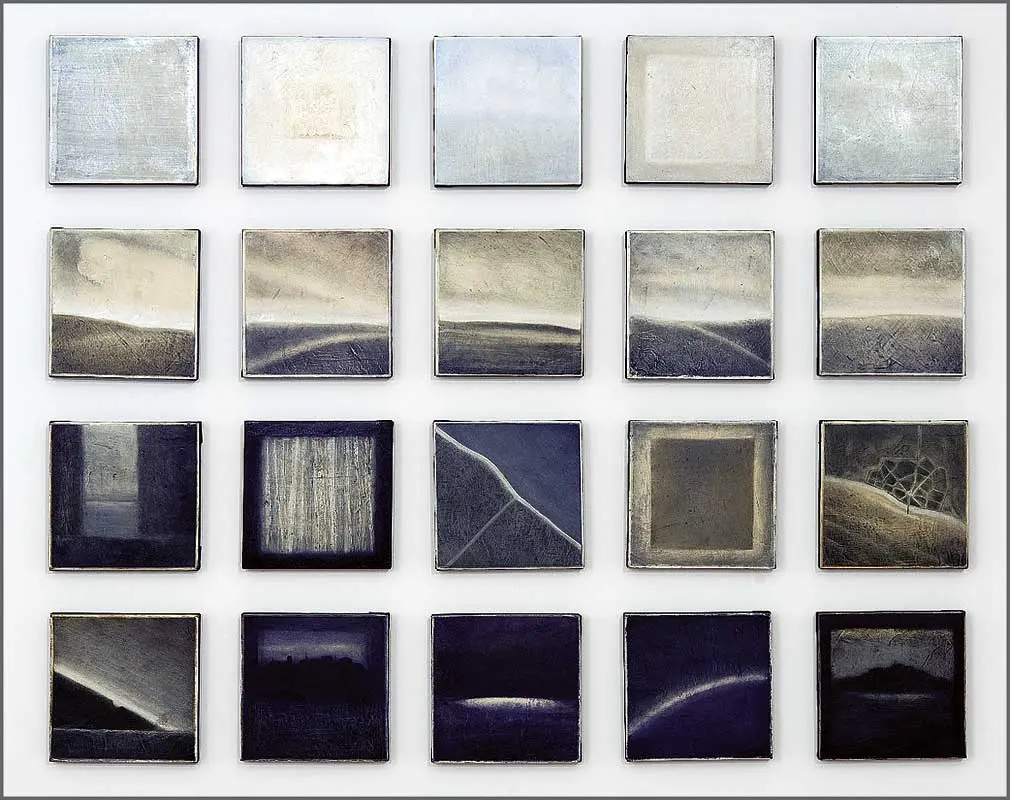
Delicate Balance (2008-2009) is the other installation included in the exhibit. Consisting of twenty paintings, the work is initially noteworthy for its monochromatic nature and a tendency to favor repetition and otherness. The installation is closely connected with another two works also included in the exhibition: Los Adioses (The Goodbyes, 2008), a titled taking its name from Beethoven’s piano sonata No. 26, Les Adieux, and Rorschach (2008), which adopts the name from the famous test, once again referring us back to the predominance of repetition throughout the exhibition.
Serving as a counterpart of these canvases, the viewer will find at the opposite side of the gallery the piece titled Océano (Ocean, 2008), in which the generous utilization of deep blue conveys a spiritual calm.
As if the differences between one proposal and the other were not sufficient, Spreng delves into another element that is not found in painting: time. While music occurs throughout time, painting is subjected to a set time, one that is static and frozen on the canvas. It is not for nothing that painting is associated with timelessness and transcendence. Nevertheless, Spreng subverts this limitation by creating in the pictorial space a feeling of cycle or evolution, achieved thanks to the influence of the ever-changing horizon.
The exhibition is impregnated by a clear romantic spirit that is dominated by musical borrowings, a predilection for open scenes, and the subjective nature of the images. It consists of 88 works – many of these 10 × 10¨ small-format images – that are regrouped to form larger works, dominated by a sense of their puzzle-like quality and their changeable and recompositional nature, bestowed upon them by the base element and a polysemic sense that enables multiple readings.
Sebastián Spreng: Handmade Horizons and Songs is a highly suggestive exhibition. It compels the viewer to search for elements unnoticed during its first reading; elements lost or distant, or barely suggested by a horizon always acting with unifying purpose, as it represents both the cohesive element and the driver of change.
JANET BATET