
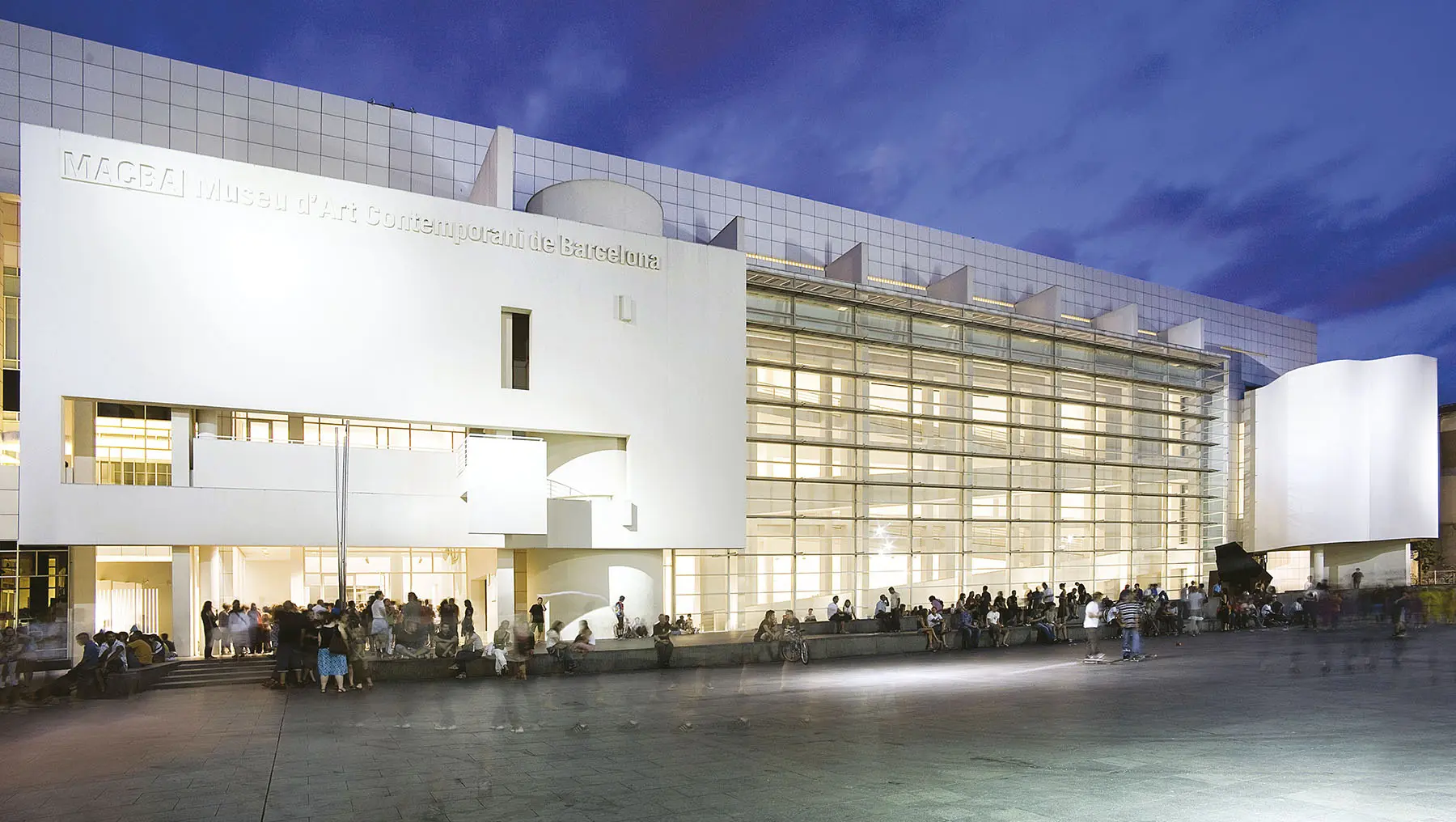
Bartomeu Marí (Ibiza, 1966) has been named director of the Museu d’Art Contemporani of Barcelona (MACBA) chosen unanimously by a jury in an international competition. His designation was formalized last April 14th, following his ratification by the Consell General of the MACBA consortium.
The jury for the competition comprised a commission of experts, with representatives of the institutions that are part of the MACBA consortium and of civil society: Lynne Cooke (a member of MACBA’s advisory committee and director of the DIA Center for the Arts in New York City,) Chris Dercon (a member of MACBA’s advisory committee and director of Munich’s Haus der Kunst,) Vicente Todoli (a member of MACBA’s advisory committee and director of the Tate Modern in London,) Carles Duran (gallery operator,) Pere Portabella (artist,) Xavier Anrich (philosophy professor,) Vicenç Altaió (representing the Department of Cultural Affairs of the Generalitat de Catalunya,) Ainhoa Grandes (representing the MACBA foundation) and Mata Clari (representing the Department of Cultural Affairs of the Barcelona municipal authority.)
According to the jury’s judgment, from among the 16 candidacies in the running Bartomeu Marí’s was the one that brought to the table the most experience and ambition, presenting the most complete and rigorous project and offering the most solvency for projecting the future of MACBA in the conditions of this new period.
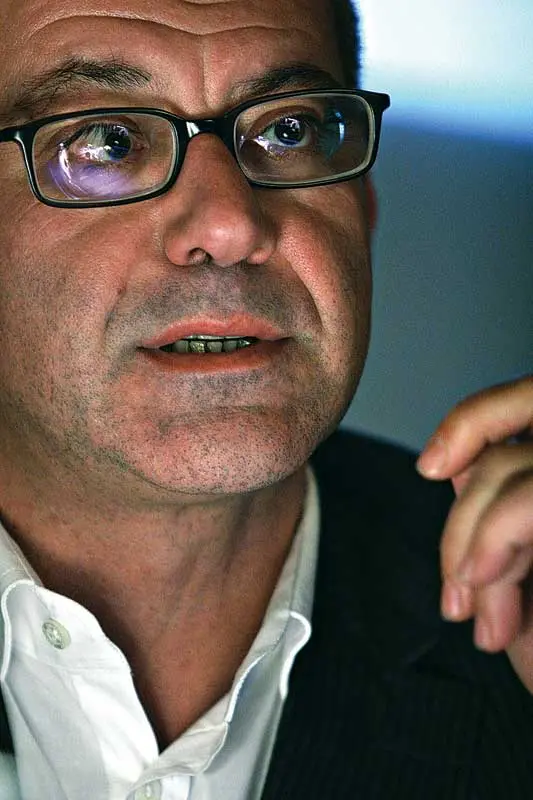
Cristian Segura: Upon assuming the office of director at MACBA last April, you said that no “Copernican turns” were necessary.
Bartomeu Marí: MACBA doesn’t need a “Copernican turn” because the museum works pretty well. This is a young museum, with a prepared and motivated team, with positive annual results in terms of attendance and management. Evidently, the generational shift regarding my predecessor will be gradually more noticeable in the exhibition program, in the collection. I have introduced the position of a chief of temporary exhibits, who will join the chief conservator (Chus Martínez) to reinforce the aspect most weakened by these changes: paradoxically, the exhibits department. The public will see the changes before we do: I don’t plan projects by gauging whether they are different, but in terms of their quality and uniqueness.
C.S.: A clear difference between you and your predecessor, Manuel Borja-Villel, has to do with your education. He had a doctorate in Art History, while you studied philosophy and shaped your career in the arts almost as an autodidact, working directly with artists. How do you think this will be reflected in the museum?
B.M: The museum must also work with artists, not only with works of art. And this is not just rhetoric. The museum’s commitment to history shouldn’t make it lose sight of the present, of the spirit of risk and inventiveness. Macba is better situated than any other museum to read the meanings of the passage from the Twentieth Century to the Twenty First. The exhibitions and the collection will reflect this gamble. The results will perhaps be visible in twenty years…
C.S.: As the person responsible for exhibitions at MACBA for the past four years, you have a special understanding of the Museum’s spaces, in particular of their exhibition potential. What do you think of the building projected by Richard Meier in relation to the Museum’s functional needs?
B.M: The exhibition galleries in the Meier building are highly “made over.” Their structure and appearance have been heavily intervened to trim the original hard edges. There are no difficult spaces for art if one has good ideas. It is likely we will invest more in specific projects that have to do with the collection and the museum’s discourses. This is to say: we will not decorate the building, but will turn it into rubber, will make it malleable, flexible… The museum grew in 2006 with the addition of the Capella MACBA as an exhibition space. It also grew in 2007 with the Archives and Documentation Center, a gambit for knowledge and public service. It is my turn to say that MACBA has become small, and that we need to seek new spaces, possibly outside Barcelona’s center.
C.S.: What challenges are posed by the Capella dels Angels, with its clearly Gothic tradition, different from those posed by a white cube?
B.M: It is a desacralized space that still smells of religion, belief, and ritual. It is much more difficult than the Meier building. I remember with a bit of a headache the experiences of “contemporary art in historic spaces” that were insistently practiced in France in the 1980s and 1990s… Successfully intervening the capella is like formulating the theory of gravity. And attempting to transform it into a white cube is a big mistake. So, I see it as a singular space of risk.
C.S.: What would be your intent in terms of knowledge and pedagogy regarding the Pantalla space, where the library, classrooms, and archives are located?
B.M: The Independent Study Program wants to situate MACBA in the line of specialized education and can also work as an R&D lab in the realm of art. It is a para-academic gambit, which means that it situates itself where university studies don’t reach. It is not an art school, nor is it a center for the formation of curators and critics; it’s all of that at once. The program doesn’t “work” for the museum. It acts with great independence, but it is an essential part of the institution. Macba is not only an exhibition machine but a center for the generation of thought and opinion.
C.S.: A contemporary art museum must take into account what is occurring right now. It must constantly revise the concept of art, the concept of the exhibition, the concept of the museum. This involves less critical distance when it comes to making decisions and acquiring works of art. What are MACBA’s criteria for the formation of its collection, when you are working more with hypotheses than with certainties? How does this affect a collection that is conceived as permanent?
B.M: Indeed, one of the challenges in feeding the collection is the challenge of facing the present. I see the Macba collection’s mission as that of an entity that “stitches” the present to certain traditions within art. There is not a single history of art, but constant rewritings of complementary histories. Thus, a collection is not a stable entity but one that must allow for the future to tell very diverse stories. In art, as you say, there are no certainties, but there are convictions. And it is on the basis of these convictions that the museum acts. And it is necessary to accompany those convictions with good arguments, which is what you can debate and create dissension about. As I said before, Macba is well equipped to read the passage from the Twentieth Century to the Twenty-First: the collection has a hard nucleus in the 1960s and 1970s, which is when the ruptures that define the contemporary were produced (even if we can trace them back to the early decades of the last century.) My purpose is to bring that hard nucleus closer to the present.
C.S.: The MACBA Consortium is a mixed model of the public and private sectors; according to the statutes, the administrations (the Generalitat de Catalunya and the Ajuntament de Barcelona) are responsible for contributing the necessary resources for the construction of the space and its ordinary functioning, and the Fundació Museu d’Art Contemporani must provide the means to configure MACBA’s art fund. Based on your professional experience in public and private institutions, what advantages and disadvantages do you find in this model?
B.M: For now, all I can talk about are advantages: the consortium is a unique construct in the terrain of Spanish museums. It works: it follows clearly articulated criteria and doesn’t interfere with the team’s scientific decisions. They let us work, demanding results but not interfering with our curatorial decisions. Spain’s Ministry of Culture has recently joined the consortium, which implies a recognition of the museum’s importance at the state level and allows us to carry forward new projects such as the Documentation and Archive Center and to widen the Independent Study Program, as well as to devote a portion of our resources to the collection.
CRISTIÁN SEGURA
Artist, curator, and exhibition designer. He was Director of the Museo de Bellas Artes de Tandil and won the Museum of the Year Award in 2001 from the Association of Argentinean Art Critics. He is currently Director of Trip, Center for Art Experimentation, and Exhibition.