There are at least three major problems in viewing Damian Ortega’s works, several (but not all) of which most artists would love to have. First, he has already created several works so visually explosive, such as the exploded Volkswagen (Cosmic Thing) or the large circle of weapons hanging in the air (Controller of the Universe), that you tend to measure all his work against them, forgetting that far more of his work is very quiet and all of it theoretical. The second problem is common to socially committed artists: to achieve some balance between theory and practice or form, especially in an exhibit with a title like this one, Capital-Less. The third follows from his success and reinforces the first: Ortega has already established his general ideas, practice, and materials. When we walk in, we nod, as if to a neighbor, and ask “what’s new” but not expecting too much.
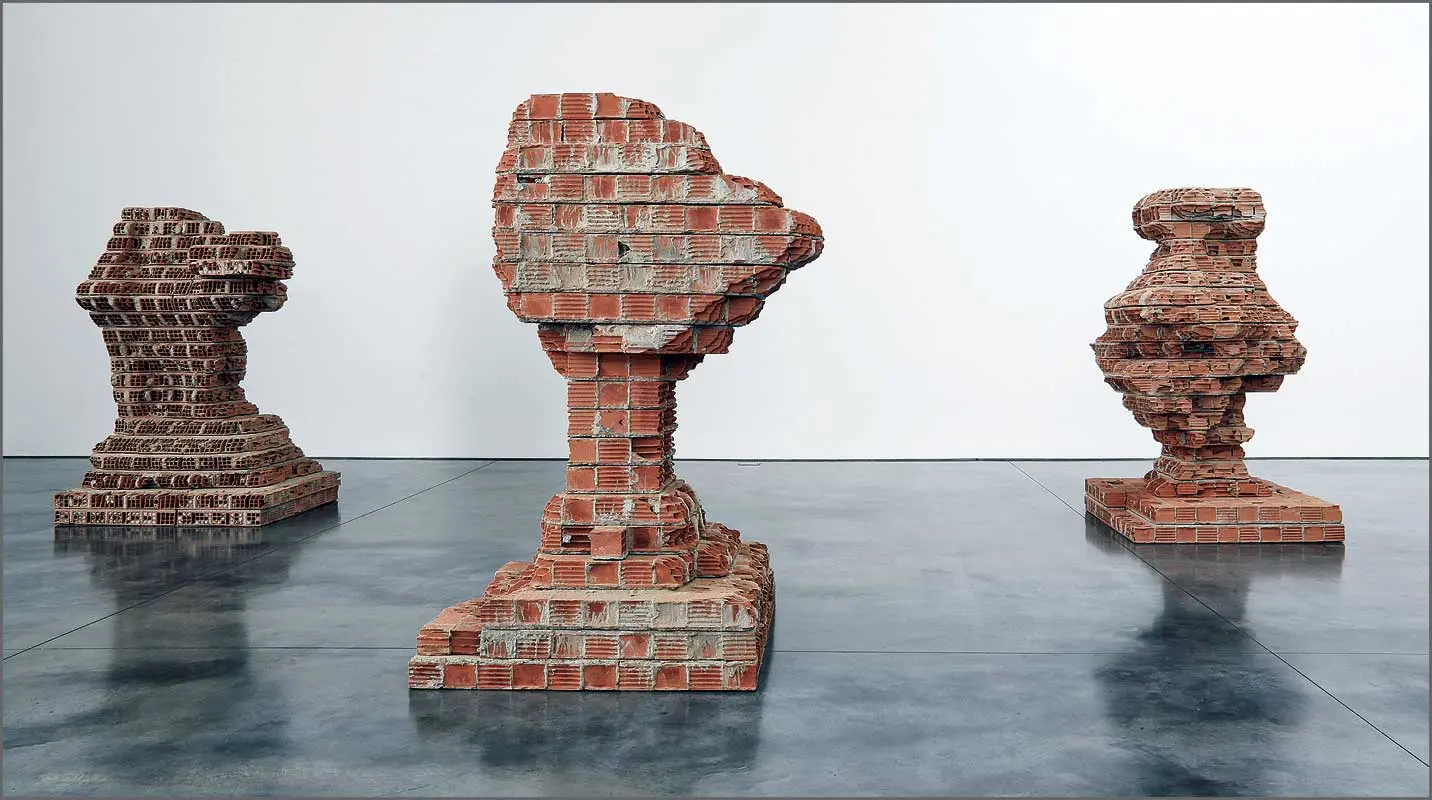
This show is quiet, even poetic. There are five large built forms, or, as Ortega titles them, “buildings”—each about seven feet tall—made from dull red-colored bricks cemented together with concrete and then pressure sanded into eroded and irregular forms that evoke, for this writer, deserted pueblos or mesas chiseled by wind and water over time rather than a post-apocalyptic industrial accident. Their net feeling seems “nature-al”. The success is their gentle formalist evocation of ruins and a sense of time now long ago, perhaps of civilizations lost. But what Ortega wants is what Walter Benjamin called a historical now-time (jeitzeit) where history looks simultaneously back and forward. To help make the connection to current and future time, each brick is constructed and visibly marked by a series of horizontal, irregularly eroded registers, many created by metallic inserts that form small rectangular channels through each piece, meant to recall, according to the press release, “both the regular geometry of modernist urban planning” and “osseous tissue like bone.” In short, Ortega wants it both ways: the organic within the industrial and social or vice-versa.
The reference is important but the problem is that the visual—and to a large extent the conceptual and social—”key” to his metaphoric thinking is in another room, easily missed and not mentioned in the press release. You have to ask, search for it, or leave the exhibition without knowing, all of which raises the cult of the knowledgeable or professional viewer/artist to the ridiculous extreme at the expense of the artwork; i.e. it effectively separates practice, theory, and meaning. It’s not until we see the video titled Treme-treme that we get it!
The three-minute looped video is a rising shot of Ortega’s own large composite photograph (to avoid the skewed perspective of a normal upward camera pan) of a building that one blogger called edificio degradado, located near São Paulo’s Mercado Municipal downtown. Officially titled Edificio São Vito, the fifty-year-old, immense, multi-storied, International Style, honeycomb-cell and the concrete monster is locally known as “treme-treme”, likely because it shakes. (There are other less polite sources suggested for its nickname.) For the last twenty years, the city government has listed it for demolition and replacement and while considered officially abandoned it is home to thousands of “squatters” and some claim it to be the tallest favela in all of South America. Now made specific, the many horizontal registers of ragged, graffitied, and broken windows of this standardized modernist housing structure that was to be our international social solution for housing people in the first half of the 20th century moves the full measure of Ortega’s intention and social meaning into place.
The video not only provides a specific understanding but makes the hitherto uncompleted statement that the ruins are of the modernist dream for responsible government and architectural solutions that we faced then and face in now and future time. Whether you see his strategy as a successful transposition of reality into artistic language or an unrealized relationship that needs to be made more apparent I leave it to each viewer.
Ortega’s strength is—or can be—this combination, and it is a central problem with all such art: to be on message but not literal, leaving room for the power of the imagination in both artist and viewer. And Ortega has often used videos in this way before, as “cognitive maps” to clue you in. But it seems to be the very historical materialism of a critical socialist (dare I say Marxist) position asks for strategies that make the social connection stronger. For those who know his work and ideas before we go, we get it. But the power of the visual evocation is in reaching out more to those who don’t know, those who also (especially?) need to get it. I remain a great fan of Ortega’s work and ideas precisely because he constantly and restlessly searches for new ways to make these connections within the frame of our imaginations.
RICHARD LESLIE