In an exhibition apparently dominated by video, the walls were painted red as a symptom of the anthropophagi that permeates the works and to undercut a coldness that some people appear to be an inherent part of the technological media. Those who know the works by Mauricio Dias and Walter Riedweg also are aware that they address social themes associated with ethnography and that these artists articulate their works by combining installation, video, performance, photography, sculpture, film, and theater – the latter two of these demonstrating experimental characteristics. The exhibition consists of the following five works: Suitcases for Marcel (2006-2008); Throw (Tire) (2004); David & Gustav (2005); Mama (2000), and Os Raimundos, os Severinos e os Franciscos (1998). The museography was shaped to underscore the artists’ focus. Indeed, a certain pressure can be perceived, a somehow disjointed dynamic, as the spectator is alternatingly placed inside and outside to force him-her to face public and private situations, a characteristic of works by Dias and Riedweg.
This transdisciplinary exhibition provides a close look at social interaction. The intensity of the subjective is perceived as soon as one is exposed to the content of each of the works. All of these transcend the visual, but as the exhibit’s title ...And It Becomes Something Else suggests, it also becomes something different. The main exhibition room contains two of the five works shown in the exhibition. The first, Suitcases for Marcel, is a small video-object installation that consists of six open suitcases (each measuring 34 × 30 × 23 cm) placed on sculpture stands and each housing a portable projector and a 7-inch monitor pointed at the ceiling for the spectators' viewing pleasure. This is an overt homage to Duchamp and to his Boîte-en-valise (Box in a Suitcase) by Dias and Riedweg. Something similar unfolds in each suitcase: circulation-rotation-transportation processes that nevertheless vary in duration, location, and the individuals who appear on the screen. There are recognizable areas from Rio de Janeiro during different seasons of the year. The work self-contains its own history. It is also possible to understand the metaphor that has been proposed: just as works of art are circulated around the world, so is the capital. The title and the declaration by the authors establish these Duchampian parameters. Beyond that which cannot be denied, there is the reading that is already tattooed on the contemporary word with respect to the act of transporting, picking up, and dropping off a suitcase or package: the connection with drugs and drug money.
In another installation, a large screen shows an action that unfolds on Park Avenue: a truck parked on the street, in front of the building where the exhibition takes place, contains another work titled Throw. Lasting 39 minutes, it is the longest video in the exhibit. It was recorded in Helsinki and shows people being interviewed in a public place commonly used as a forum for individuals to express their opinions. There, Dias and Riedweg asked people to throw whatever they wanted at the camera, but within certain limitations. There is no doubt that videos or photographs can be invasive, despite all of the people who enjoy appearing in them. Our senses register this weighty combination between the internal and the external, as well as the different unscripted gestures deriving from each interviewee.
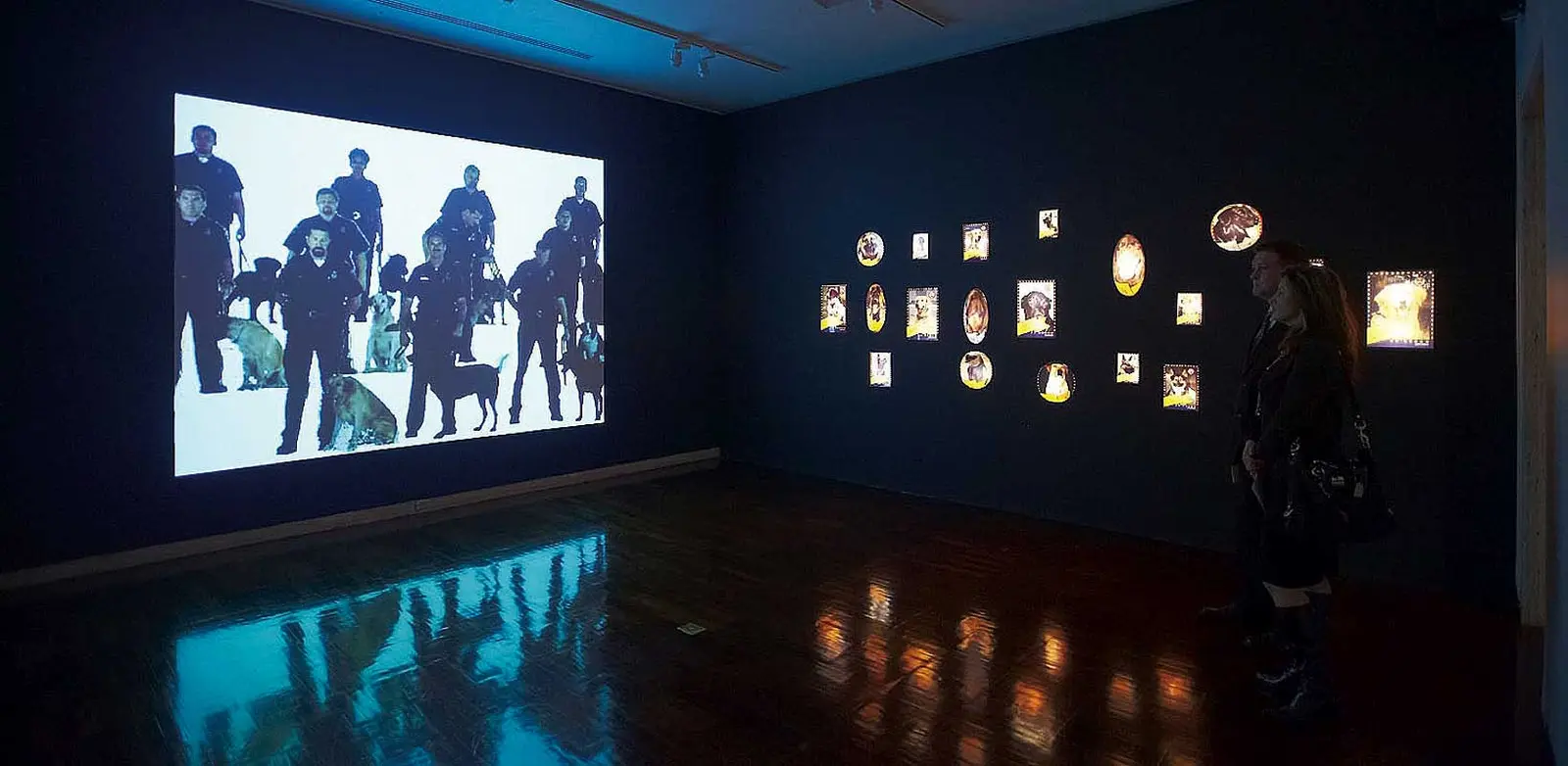
Although the work by Dias, a Brazilian, and Riedweg, who is Swiss, could at first glance be confused with a documentary, it is actually different, in that the format is solely an excuse to transgress the culture of the superficial image. It is no coincidence that Dias is from the place where the Anthropophagic Manifest by Oswald de Andrade originated. The concepts were later rescued by Paulo Herkenhoff, general curator of the XXIV São Paulo Biennial in 1998, in which Dias and Riedweg participated. The transgressive vision contained in the works by these artists is manifested in different ways; they continually change their method. Dias and Riedweg see themselves as outsiders even as they target outsiders. Mama is a virulent installation. The video shows a group of U.S.-Mexico border patrol officers interacting with their police dogs and demonstrating their commitment to the well-being of their animals. This is set in stark contrast to the rough treatment of illegal immigrants from the neighboring country of Mexico. It is a video that conveys highly charged psychological connotations, among these the problems associated with the exercise of power. The installation acquires character when, on entering the darkroom to see the screening, spectators find themselves surrounded by elaborately framed portraits of the trained police dogs. The works David & Gustav and Os Raimundos, os Severinos e os Franciscos command our undivided attention, the latter especially.
...And It Becomes Something Else was organized and curated by Gabriela Rangel, director of visual arts at the Americas Society, with the curatorial assistance of Isabella Villanueva. Mariela Hardy was in charge of coordinating the exhibit. The works belong to the artists and to the Vermelho Gallery. To summarize, the exhibit embodies the concept of peculiar mobility, understood as something physical – art in time – and as a social situation. These concepts are conveyed in different ways and in different sized screens throughout the exhibition, as an accent placed on the action, and like a high degree of contrast between humor and peril is established, under several contemporary ethnographic approaches. These combinations of elements reveal Brazil with strong artistic and conceptual proposals. Although not to undermine the Swiss elements contributing to the works, the Latin American elements surface more frequently, as these are well appreciated by Europeans. This review merits a call from the Anthropophagic Manifesto: "Against the vegetative elites, and in communication with the soil."
GRACIELA KARTOFEL