
It is in Paris, where he has lived since 1993, where Mexican artist Eduardo Zamora (1942) invents a fantastic universe full of reminiscences from his distant past; real experiences lived in his country of birth, vivid memory that he exploits with great gusto. His most recent oil paintings, created between 2008 and 2009, are presented under the title Chroniques (Chronicles) to better convey the narrative dimension of his pictorial mise en scène. Highly complex, Zamora’s world above all conveys his great ability as a painter. His refined work over opaque shades (grays and blues) is strengthened by the white that contributes with a touch of unreality to the entire aesthetic discourse. Across the canvas space, sparkling with details – where women and animals face each other in an oneiric and/or apocalyptic choreography that uses naïve, absurd, or fantasy images, and where, sometimes, a certain climate of violence reigns – the artist creates an imaginary world that is superimposed on the real world and on that, at the same time, dialogues with it. His iconographic “delirium” reveals a total freedom of design and execution, without construction or previous dogma, without preconceived, conceptual, or artistic ideas, with no intention whatsoever. Zamora does not profess to convey any message in particular, and he also does not look to vindicate any metaphor. This visually disorganized discourse is, nonetheless, coherent and filled with a thousand delicious details. Its apparent “disorder” fills us with both fascination and the unusual. Zamora must convey the illusion of a vast space that "surrounds" us because of the way he often circumscribes the scenes in the first planes in the canvas, as he encloses these with semicircular “walls,” or by imagining a horizon with soft and undulating forms.
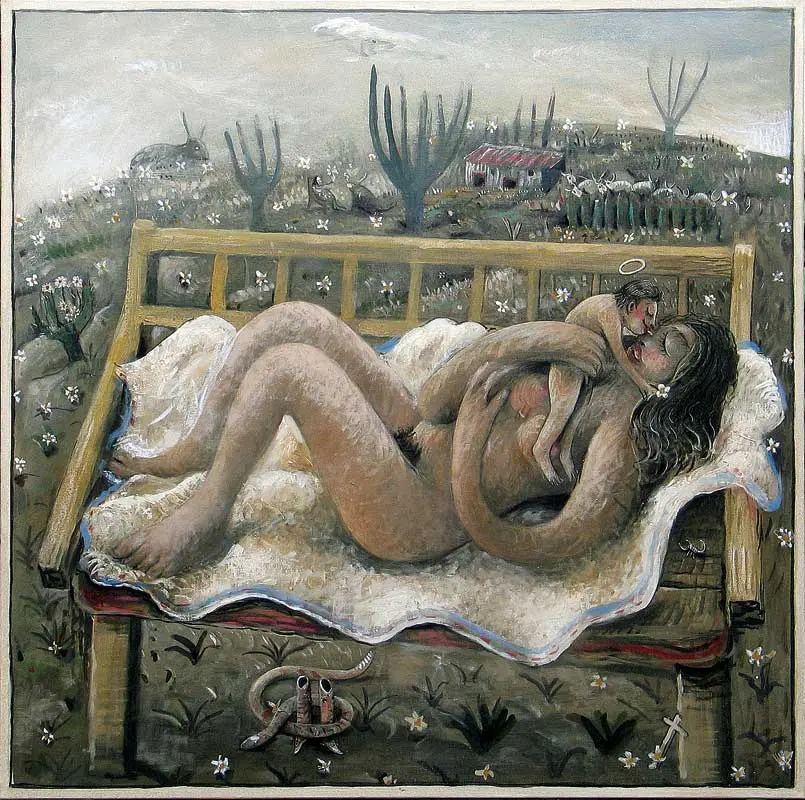
The bullfights that he attended when he was a child impressed upon his retina the circularity of the bullring, while the adobe walls – very present in his canvases, as are the green and rounded mountains – are like those in the town of Tepoztlán, near Mexico City, where Zamora lived during the early 1970s, a place dear to him because of all the memories he has from that period. Thus, the majority of the time, we find ourselves in the face of an everyday landscape, reconstructed from memory, that is populated by flying fish, crosses that multiply, swinging buses, women-mermaids, she-angels, and other hybrid beings. In this universe of the natural absurd, tinted with tenderness and poetry and perhaps, and why not, of nostalgia, nothing stands still, everything is immersed in perpetual movement. The rural Mexico of his childhood exists once again in Zamora’s creative consciousness as the painter embraces its magical qualities. The characters in his impossible stories wander, observe, act, sleep, or die. But they are always transient because they foretell other stories. Some images are strange, black, and bloody, such as Dernières crci-fictions et première fuite (oil on canvas, 80 × 80 cm, 2009), where a figure of Christ is missing one half of his body as his legs run through the countryside. Others, decisively surrealist, like the couple whose heads are replaced by huge hands (Conversation, oil on canvas, 46 × 55 cm, 2009) can be scary. While in others, works such as El Santo Niño (The Christ Child, oil on canvas, 80 × 80 cm, 2008), the artist presents a ghostly love scene that takes place in a landscape of cactus chandeliers, typical of the northern desert of Mexico – where Zamora was born – that contain (improbable) white and virginal flowers. The artist's visual fiction belongs to Latin American magical realism. One must surrender to it and allow it to lead you to wherever it goes, as we do with the oneiric universe of the novels by the Mexican writer Juan Rulfo, to whom the painter is very close, both because of his mentality as well as his relationship with the real-imaginary.
In his most recent works, we re-encounter Zamora’s obsession with crosses and skeletons, but we also see other elements reappear, like serpents and bulls. Death is everywhere and shares the space with angels (L’Inattendu, oil on canvas, 100 × 100 cm, 2008), or Les Anges (vinyl on canvas, 200 × 200 cm, 2009), and the flu pandemic (Dans les Alpes, oil on canvas, 46 × 55cm, 2009). Zamora appears to exercise his images by constructing the fiction as an ephemeral ritual. The more we penetrate his world, the more surprised and implicated we feel. When he talks about his painting, Zamora insists on its obsessive dimension, as such an obsession is to him a source of endless pleasure. Painting to him is true enjoyment. He assumes the role of a storyteller, and he confesses that he needs to tell stories (to himself). Zamora thus delves with gusto into the confusion of the unconscious, as he declares that he “enjoys playing with the improbability of things.” He is fascinated by the magical world that emanates from his imagination, far from the logic that oppresses and limits. He rejects the almighty empire of reason in which we are submerged, often in aberrant form, as he explains that “only in breaking with rationality one can be taken to an imaginary world” (…) “I see many things no one else sees,” he adds, as if to apologize for and justify the wanderings of his images in which with humor and delectation, he untiringly tells us his stories, the old ones as well as the new.
CHRISTINE FRÉROT