
This exhibition is titled Número 2 (Number 2) because it is the second individual show by Pop artist Fernando Gutiérrez, and also because he was always number 2 in relation to his twin brother, who was more intelligent, which made the artist feel he was in second place. With this show, Gutiérrez officially rids himself of the Superchaco character, whom he created 10 years ago. Superchaco was a figure created by the artist to make up comical stories and caricatures for the iconography of his art. Superchaco dressed in a red and blue uniform similar to that of Superman and sought to be the superhero of the chaotic city of Lima, Peru.
“Superchaco is not a superhero. He is a subject who is very aware that he lives in a country where no one does anything to resolve the nation’s problems. It is always hoped that someone will come to resolve the problems, the next president, the next soccer coach. Thus, then, a supposed superhero appears; he gains the confidence of the people, thus creating a work tool for himself because he now sells his souvenirs.”1
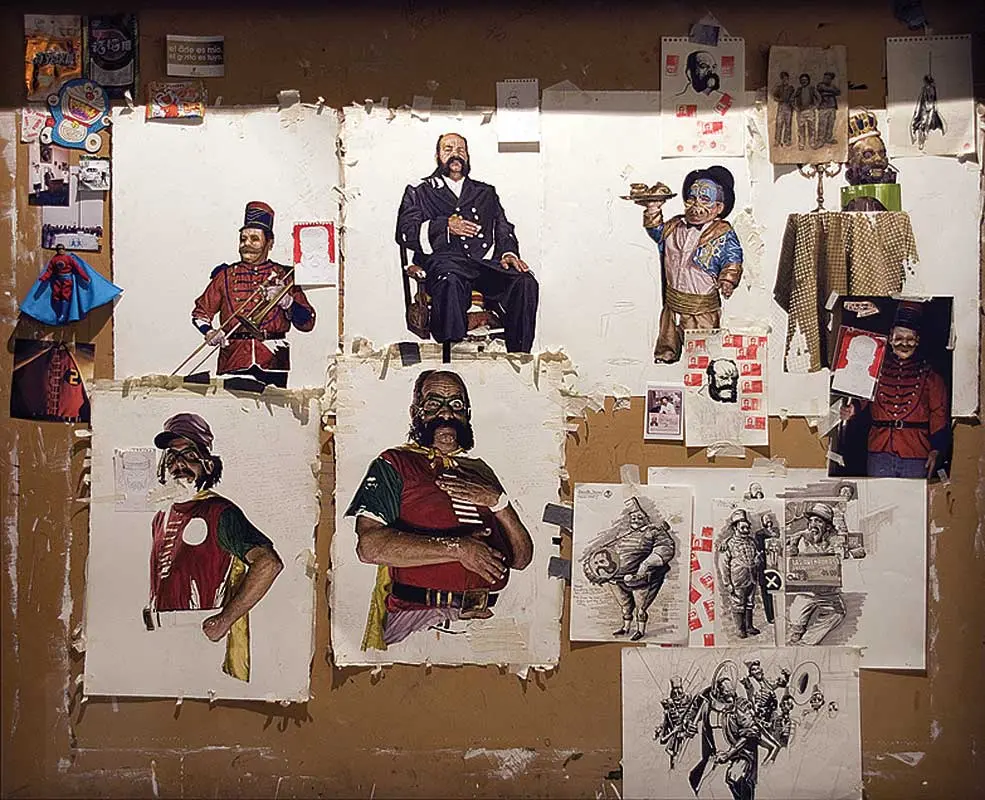
Gutiérrez presents photographs, an installation with glasswork, a video, and a large picture that had formed part of the artist's studio, with small figures adhered with masking tape.
The theme of the photographs comprises performances that the artist conducted during a trip back and forth from Lima and Talcahuano, Chile, in a Volkswagen Westfalia 1979 camper. The photographs served to document the death of Superchaco and the various burials of the Superchaco uniform. Gutiérrez was accompanied on the trip by Germán Seminario, a direct descendent of, and physically identical to, the Peruvian hero Miguel Grau. Gutiérrez and Seminario traveled to Chile to visit the Huáscar, the ship captained by Miguel Grau. Germán Seminario appears in the majority of the photographs, attired in a military uniform of the times of Miguel Grau, the latter's place assumed by Seminario.
In one of the photographs, Superchaco is seated in a chair. He is being shaved and having his long hair cut, not having done so for 12 years. Meanwhile, a military band in uniform plays, and the people who surrounded them applaud. In this fashion, Superchaco loses his identity. The photographs were taken in black and white and later retouched in color. Thus, they are dark, conveying the impression of melancholy and relaxing the observer. The photographs were not taken by Gutiérrez, which leads us to ask: Whose work is it? Is it that of the photographer, or of the person who conceived of them? Similarly, the same occurs with nearly all of the works in this exhibition; the glass piece that was only designed by Gutiérrez; the video that was filmed by another person and edited by a third, so that it would be more objective.
The drawings are very well done, and the themes are happenings that took place during the trip: cooking; walking; going here and there, accompanied by persons whom the two met on their travels. At the bottom of the drawings, the artist writes something having to do with each rendering. All of the photographs have a red seal with the image of Robin, Batman's helper.
The glass piece in the form of a church is very impressive. It is a triptych with Robin as the main figure. Robin is seen with open arms, and his arms and cape cover all three glass pieces. The figures of the piece are very well designed, nearly with details. In the work on the right, Gutiérrez appears, but not as Superchaco, he who died, whose uniform is now buried, he who is now documented in video and photographs.
In the work Pared-Taller (Wall-Studio), the artist removed part of the wall of his studio and framed it like a picture. One day, the artist arrived at his studio and said that, after 4,000 kilometers, he was able to paint no more, because he would no longer be number 2. Making a picture of the wall was to bury Superchaco psychologically and artistically. On observing this work, one asks: What happened here? There are poster boards done in oil stuck to the wall with masking tape. There are also photographs, birthday cards, plastic figures dressed the Superchaco uniform, and even an empty package of candy, such as which one on occasion puts up on the wall, bringing good memories and creating an agreeable visual space, all of this making up work. Hence, something that Gutiérrez did unconsciously came to be the most important work of the exhibition.
The death of Superchaco ended the successful artist's caricature of Gutiérrez. All the works he did of Superchaco have been sold, although “Superchaco is oblique, sly, lewd, and lazy. Incapable of any sacrifice, of any nobleness. Despite his having no skill or superpower, he is wanted by the authorities, admired by children, and loved by the most beautiful women. He is, then, the model to which all pair and aim”.2 In essence, it is the uniform that makes a Superchaco a hero. The life of Superchaco is nearly a reflection of some individuals who are in the government, who are well known and famous despite that the only thing they do is fool others and not work as they should.
Gutiérrez traveled with Germán Seminario because the latter was real; his face was identical to that of his great-grandfather, the hero Miguel Grau, while Gutiérrez was required to disguise himself in the uniform of Superchaco, something real vs. something fictitious. “Why continue to make fiction when the reality is stronger. It was the perfect opportunity to, once and for all, officially rid myself of Superchaco, and what better way than with the officialdom conferred by Grau."3
With this exhibition, Gutiérrez demonstrates that he is cold, sharp, and endowed with a Duchampian mentality, that he can take works that he has not done and present them as his own. Gutiérrez does this very well and has shown that what is to come is much better. This exhibition matured the artist because he has done something that few would dare.
NOTES
1. Interview with the artist, October 2009.
2. Quote taken from his website, superchaco.com.
3. Interview with the artist, October 2009.
AUGUSTO CHIMPEN