
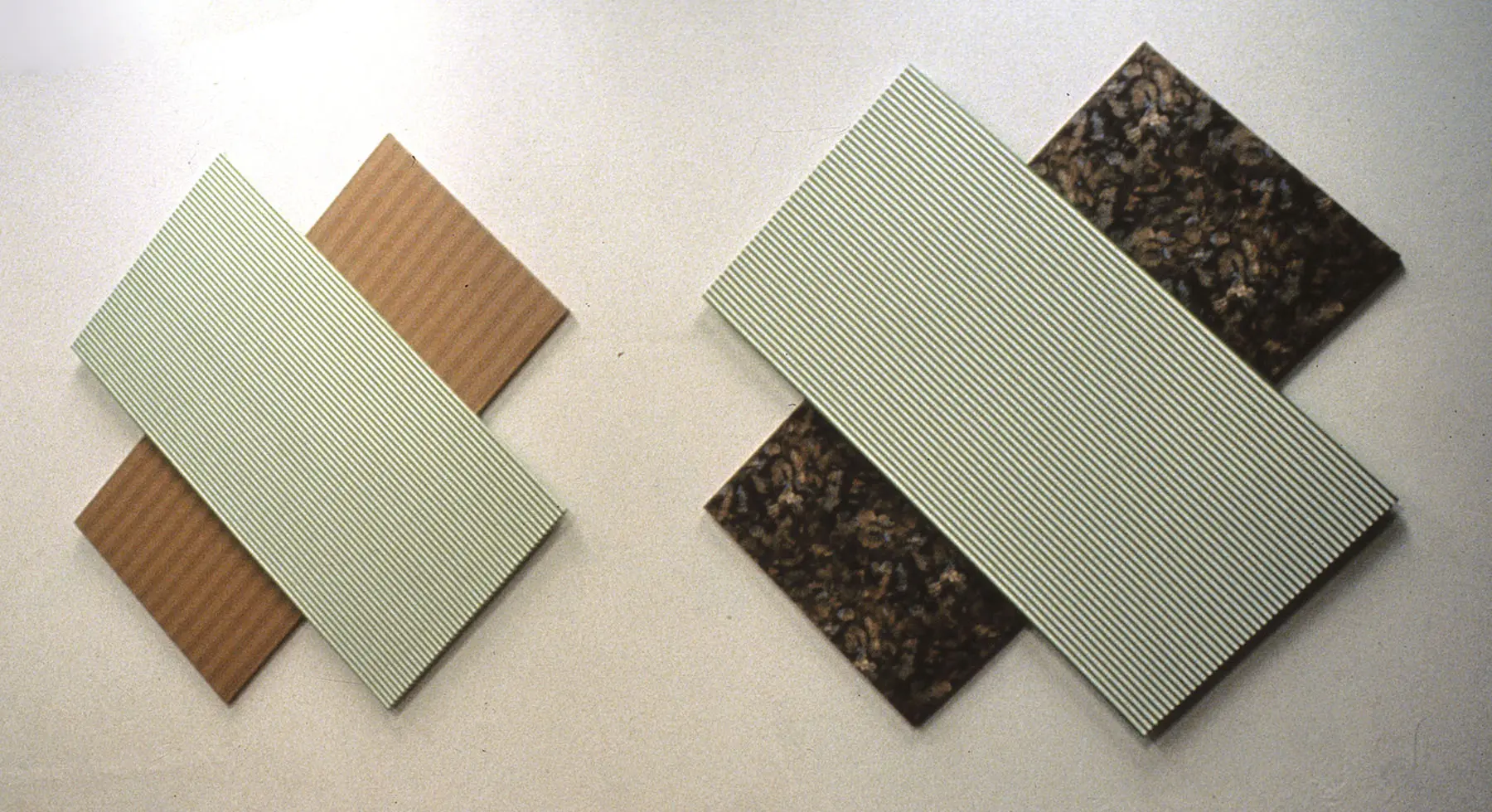
Already in his early works of the 1990s, Fernando Uhía (Bogotá, 1967) displayed the ability to make his viewers consider a perspective in which objects acquire a new dimension by reassembling information that may be known to them. His 1991 Pinturas, despite a title that suggests the use of a specific set of materials, were made on framed oilcloth. The way these works were conceived reveals an engagement with certain debates around the notion of painting that emerged since the 1960s and with the history of Modern art. His oilcloth works All over and Mondrianes referred directly to Concrete painting, to rationality in the use of color, to the weight of mathematics in art. But Uhía’s wasn’t an erudite attitude intent on “showing off” his knowledge of such theoretical and visual issues, but a need to propose new readings based on those cerebral conversations. His oilcloths stressed the new uses, so distant from the original intent, that an image could end up having, becoming for instance the basis for the design of cafeteria tablecloths. Media-based visual culture—a topic that is central to Uhía’s work—ends up soaking up the avant-garde, transforming it into a utilitarian object for a public often ignorant of its provenance.
Uhía wanted to make already existing information visible in order to foster aesthetic experiences based on an approach to the everyday.
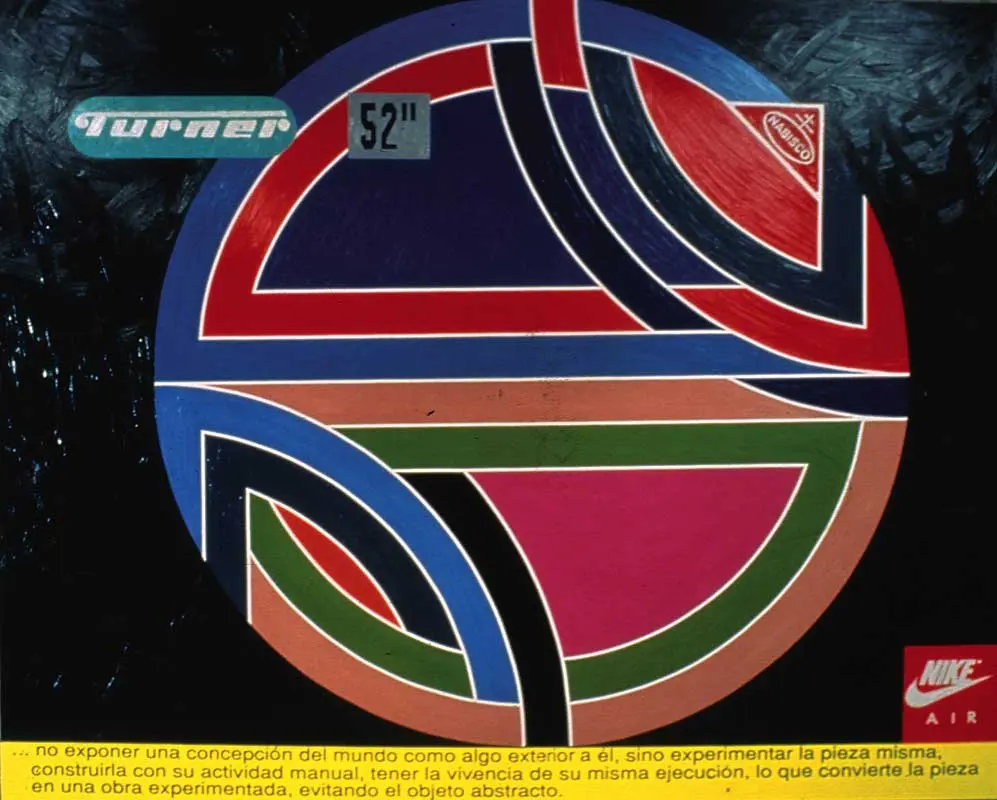
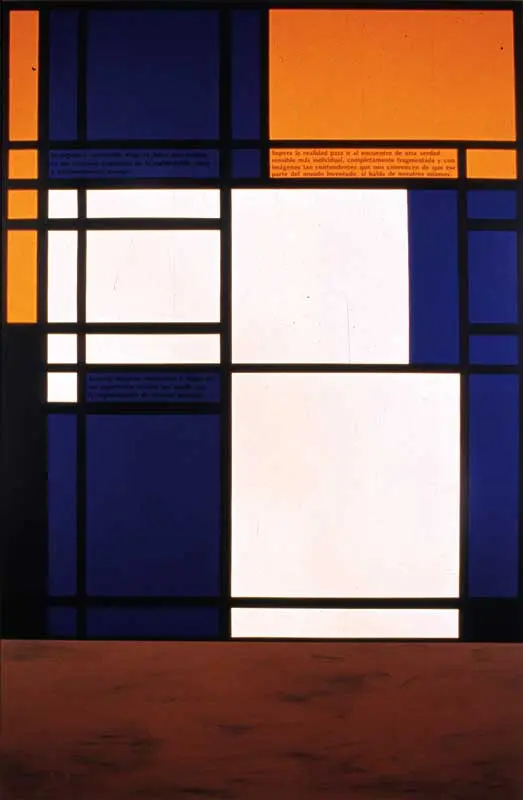
But art also implies writing, not only the kind that construes its history, but also the kind which is deployed in criticism. Texts started to become central in Uhía’s paintings in 1992, and they were a particular type of writing: works by Colombian art critics whose commentary appeared often in the print media.1 Uhía ironized about fragments of texts by a variety of local critics, playing with two interconnected languages: written and visual. Thus, works like Sincronía sintética (1992), about acrylic painting and with reference to Mondrian, incorporate the kind of critical rhetoric that appeared in the local press; Ready-made estilístico 2 (1995), in turn, mixed references to Colombian artists like Marco Ospina with references to international figures, alongside emblematic logos for well-known multinational brands, and critical texts embedded in the space of the work. “My paintings try to fill the absence of a strong and sustained tradition in Colombian visual arts. For this, the appropriate images from the local and international Twentieth-Century tradition, and also simple design patterns combined with texts and logos. The Modern assumption that has as its main goal to “create a style,” still dominant in mass taste—and among artists—is replaced from the start by the copying of personalities and styles. What the work does, in truth, is to fill the gap between what an artist is supposed to be (creator of a style) and the inability on the part of the public and of the Colombian cultural system to provide the required continuity to support such ‘creators of style’. The gap is, then, filled ironically with images from the recent past of Colombia’s fragile visual memory."2
There is a dual interplay of simulation, text, and image, that refers us to Baudrillard’s notion that in the age of simulacra, what becomes essential is not the production of the object but its reproduction. Consumerist society consumes signs and saturates itself with the images created by the mass media. The original/copy relationship is diluted and gives way to the game that kick-starts simulation.
The existence of different levels of information is a given of contemporary society, and Uhía was able early on to delineate what was to be a constant in his work: art is not produced to generate immediate pleasure to the senses; it must have political content.
Uhía’s concern with promoting a relational way of thinking was still present in his late-1990s work. Western painterly tradition, the “critical” sentences uttered by critics, and the widespread reproduction of multinational logos were at the root of works like Ready Zombie (1997). The three elements mentioned above were put together in such a way that it was up to the viewer, after connecting the information offered by the artist, to make conclusions. In that dynamic, the artist lost his condition as the creator of unique images and proposed a re-signification of known referents to experience a new reading.
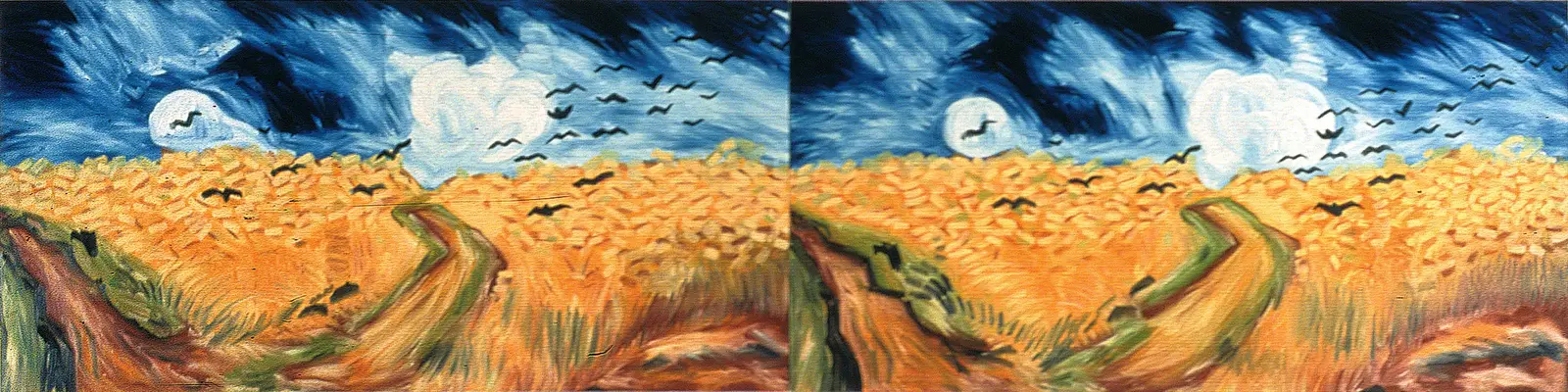
Uhía’s Clon (or is it Clone?) Clowns, paintings that duplicate works by Botero, Van Gogh, Baldasari, and Grandma Moses, follow the same path. Here, originality, appropriation, and a critique of the art world in its supposed role as validator and creator of figures remain at the center of Uhía’s reflection. Uhía was exploring a line opened in Colombian art by personalities like Beatriz González and Álvaro Barrios: the art of the Great Masters is known to us through reproductions. Given the reality of local museums and cultural policies, access to the original becomes impossible, and our knowledge of that art is mediated by its reproduction. Thus the claim on the concept of the clone, not copy, since in the end, it is a question of creating an original as the supposed copy is reinvented.

Fernando Uhía finished his Masters of Fine Arts at the San Francisco Art Institute in 1999. Upon returning to Bogotá, he exhibited work that incorporated his research in the fields of video and sound. Taking as his point of reference Monet’s water lilies, Uhía created a “pictorial video” by bringing the video camera very close to a TV monitor and recording the intro to 16 US TV series. These 16 impresiones sutiles (2001) were the result of capturing images at a very short distance, blurring their focus. What were we seeing? A study of the decomposition of light in the Nineteenth-Century impressionist and post-impressionist manner, or the potential for computer-based explorations of pixels? Painting replaced by digital media, much in the way photography was said to be poised to displace painting in the Nineteenth Century?
Two timeframes, two ways of generating images that for Uhía are not exclusive of each other; rather, there is an interest in showing the weight of media culture, its impact in the creation of images. There is an irony in this approach to TV images, normally associated with explicit figuration; Uhía’s proposal generates uncertainty in viewers accustomed to seeing the medium working with recognizable forms. Here they encountered images that were not easy to read, images that turned abstractly pictorial as if they were painting in movement.
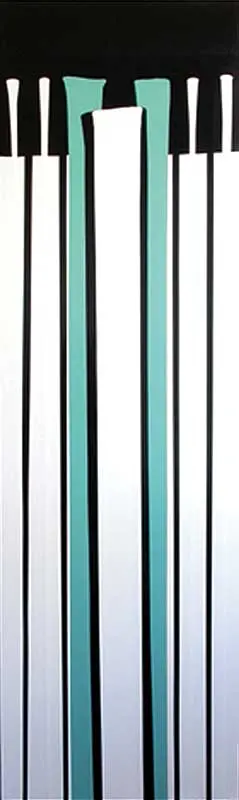
Uhía’s approach to audio-visual media did not result in an abandonment of painting. During his stay in San Francisco, he had continued to work on pictorial exercises that interrogated concepts like originality and authorship, which he had already explored in Bogotá. But these were no longer the “clonings” of his previous work, but an investigation of how artists like Morris Louis and Kenneth Nolan conceived of painting; the key for them was to acknowledge painting’s literal nature, defined by the two-dimensionality of the support—a space where illusionism has no place—and also by their intention to show that, in part, painting makes itself. That concern and his parallel exploration of materials, as Uhía discovered the pertinence of enamel to the creation of his paintings, came together in the Technoesmaltes of 2004.
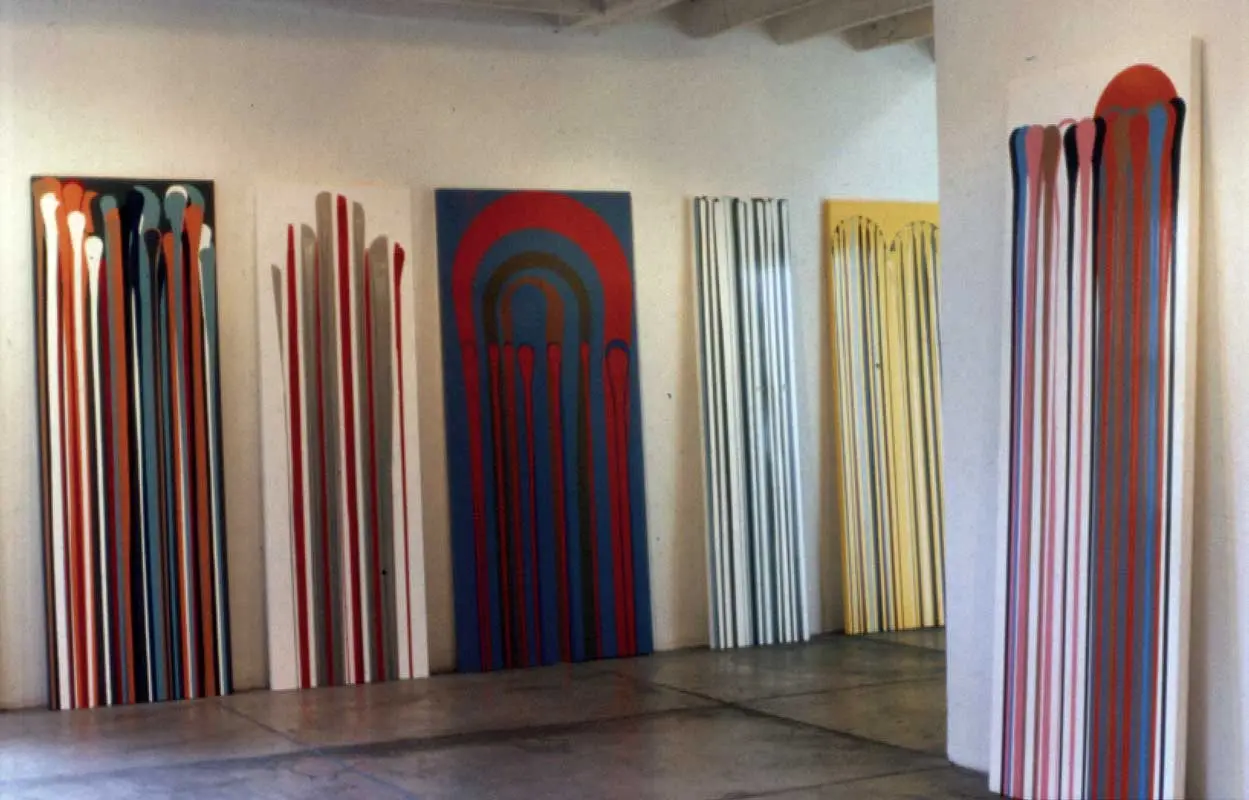
Uhía dripped exterior house paint in different colors on white doors bought at a home-improvement big-box store, and the drippings, due to the effects of gravity, formed images that could, at first sight, be characterized as strictly geometric. On closer inspection, however, we discover they are rather an illusion of traditional geometry since the pigment running down the surface presents irregularities that are made even more salient by the superposition of color bands. We realize then that Uhía is carrying forward his investigation of the impact of globalization on images, the markings, and colorations imposed by fashion, present here by means of his use of a palette that is more often found in the design of sneakers and tennis shoes. Through references to specific brands such as Adidas, Puma, and Nike, Uhía brings into play industries and logos that are already part of our collective memory.
The artist explores the non-contradiction in contemporary painting between the abstract and the figurative. In using either resource, he is not interested in representing the image by committing to one or the other, but in retaining the ability to manipulate historical models in order to incorporate references, in this case, chromatic ones, to contemporary images seen on TV, on fashion advertisements, on video clips.
Uhía’s Technoesmaltes explore the possibilities of a painterly genre that, despite its often proclaimed obsolescence, continues to allow for new investigations that derive not from the author’s inspired genius, but from an arduous effort of trial and error where the presence of everyday elements, advertising billboards, the city and its images, institutional referents, defines a range of colors that the viewer will recognize as familiar.
Uhía says: “A technoesmalte is initially understood as a field of action in the sense that the drippings act by themselves in a rapid process not entirely controlled by the artist. But as the enamel traces its path, it becomes a field of contemplation, in that what is contemplated is ‘continuously’ dripping in front of the viewer in continued retardation that aspires to be allegorically never-ending. The result is closer to Morris Louis’ theatricalization of the kinetic dripping than to anything by any previous artist. With an additional ingredient: the colors of the technoesmaltes do not come from any mystical experience, but from multinational-brand sports gear, which anchors them to the present by way of debates (globalization, neo-liberalism, maquilas, programmatic poverty, etc.) that create a different kind of conflict, one that it’s better, for now, to leave open."3
The game of illusion proposed by Uhía differs widely from the naturalist tradition of the trompe l’oeil based on the reproduction of the appearance of things; here, the question is to use resources that come out of what the artist calls the “multinationals of the image” to open up a more personal world and make us think of a personal space for interpretation, where a seemingly simple pictorial gesture acquires new meaning.
With the occasion of the Luis Caballero Award,4 which he won in 2006, Uhía proposed a project called Masa Crítica. The term, translated as critical mass, has several meanings: in physics, it is used to refer to the amount of matter necessary to trigger a nuclear chain reaction; in economics, it refers to the sufficient number of customers to sustain a market; in sociology, it applies to the number of individuals required for a given phenomenon to acquire autonomy and a dynamic of its own.
What does Uhía transform into a critical mass? The sound/noise of 32 recording devices that reproduce in unison resonances taken from TV broadcasts. How does this operate? Uhía seeks to promote visual references in the viewer by using a minimal amount of sound matter. The sound saturation in our lives, the multiplicity of incessant noises we hear, confront us with the problem of globalization that, by making, media languages homogeneous, impacts the user without his or her awareness. We are part of the critical mass in that we join as spectators in a supposed form of televised entertainment that forces us to consume elements of a globalizing ideology.
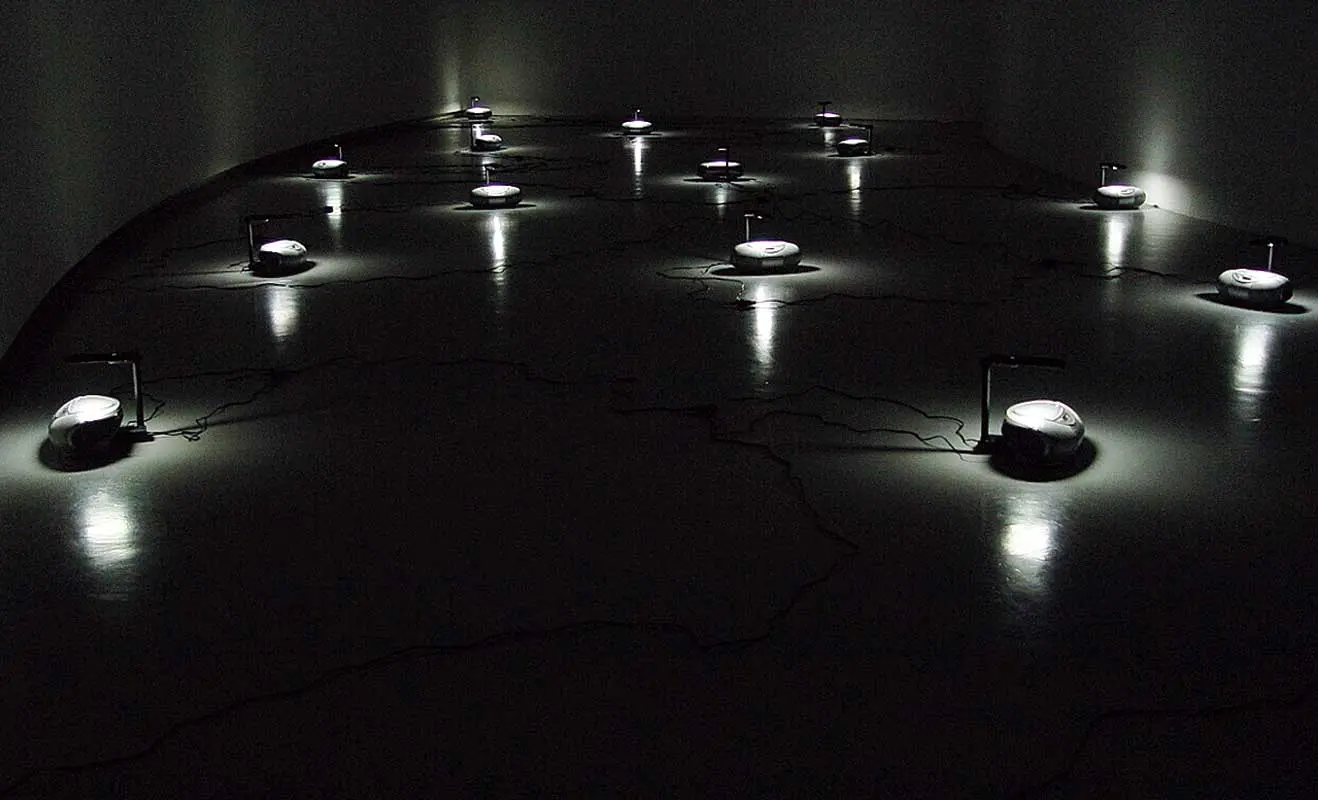
CD players, lamps, and cables are all made in China; they carry films made in Hollywood5 and dubbed in Mexico. The central problem Uhía reveals for us are the strategies used by the mass media to influence their consumers. For Uhía, the viewer is quite often unaware of the ideological meaning of that invasion, harmless in appearance, of his or her everyday space, which generates social and cultural behaviors that are assumed to be valid and slip through unquestioned. An especially significant factor is the strategy the artist uses to pose the problem: he uses the same methodology of media saturation, making us reflect on the unidirectionality of discourse and the attempt to universalize behaviors and values.
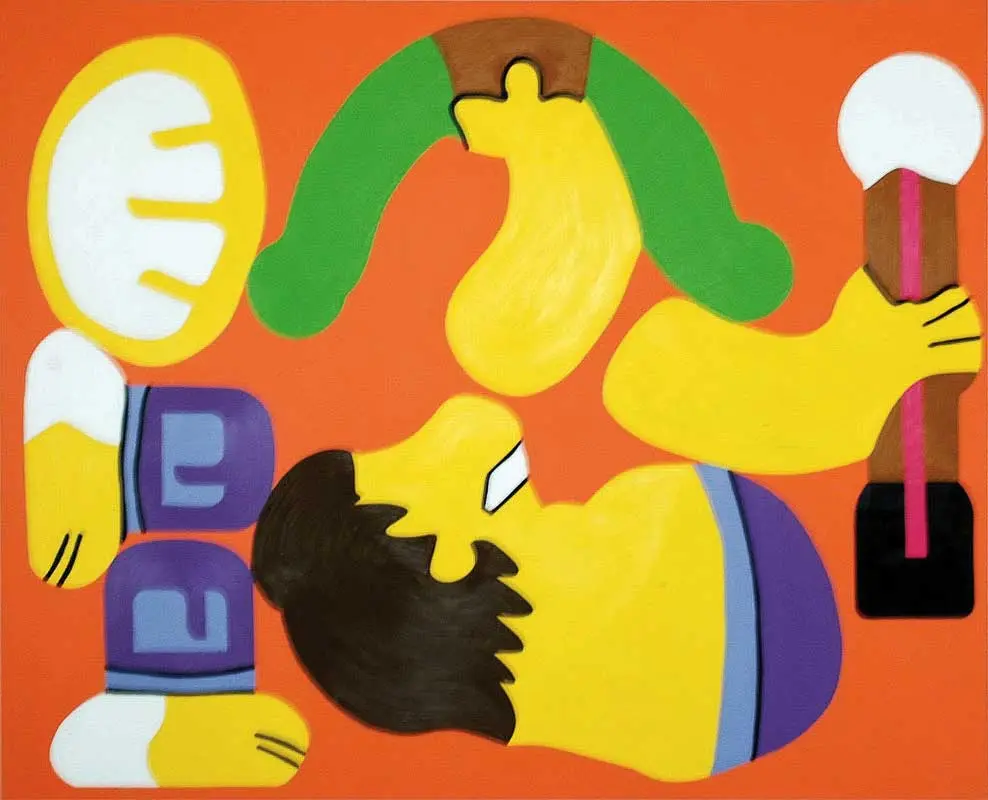
Uhía’s constant interrogation of the globalized world and the impact it has on everyday spaces, as seen in works like the Technoesmaltes and Masa Crítica, is also present in a series of paintings he has titled his Paraguernicas (2008). This series presents three variations with respect to his previous work: a return to oil painting; a shift in format; and a new thematic twist. While references to globalization continue to be centrally present, there is an approach to the specific Colombian situation centered around the issue of paramilitary forces and their treatment in the media. To compose these paintings, Uhía makes use of his deep knowledge of the history of both universal and Colombian art, and of the tragic, terrible images, based on confessions by paramilitary fighters, that are broadcast in the media.
Intermixed with all this we find cartoon characters, allusions to Picasso’s Guernica, references to Colombian artists who have worked on the issue of the period of violence in the 1950s. Figures like the TV characters The Simpsons cross paths with fragments of bodies that suggest paramilitary atrocities, all of it immersed in allusions to the avant-garde and to Cubist deconstructions, and in colors that point towards the chromatic intensity of advertising techniques. Once again, a dual move: on the one hand the uncomplicated use of figures taken from the packaging of a potato-chip multinational, and underneath this apparent divertimento a reference to the horror of violence in Colombia.
The incorporation into his work of the historical avant-garde is not a simple exercise in a citation on Uhía’s part, but a way of recontextualizing and redirecting them towards his own interests. Far from this artist values from the past such as beauty, the sublime, originality, concepts traditionally associated with the arts and the role of he artist; what he proposes is a manipulation of those codes in order to cross them with the contemporary mass-media images that inundate our everyday space and promote the consumerist ethos.
Uhía’s appropriations look out in several directions and connect with different aspects in order to construct a critical visual discourse based on his knowledge of both the history of art and the excess of images that our media-dominated society bombards us with. A globalized world that impacts art and everyday spaces, cultural models that aspire to overtake others, at times in a sly and underhanded manner that catches us unawares and, in that way, makes us all the more vulnerable.
NOTES
1. This interest in critical texts and their implications was revisited in Armagedón Nacional, work presented at the 39th National Artists Salon and the Cali Performance Festival (2004-2006.) There, an actor mimicking the voice of an emblematic Colombian politician of the 1940s, Juan Eliecer Gaitán, reads several pieces of criticism published in the country between 1950 and 2000. These text fragments, from a variety of periods, make evident the rhetorical exaggeration, lack of true content, and excess of technical terminology in which critics are liable to fall. Once again uncovered was the difficulty in building a critical tradition for Colombian art.
2. Fernando Uhía in Iregui, Jaime, “Arte y Ciencia en Internet,” Bogotá, El Espectador Sunday magazine, April 21, 1996.
3. Fernando Uhía in catalog 40 Salón Nacional de Artistas, Bogotá 2006, p. 160.
4. The Luis Caballero Award is designed for the participation of Colombian artists over 35. A jury selects eight projects to be exhibited over a year, and a winner is chosen among them.
5. Some films from which the audio is taken are The Planet of the Apes, Mission Impossible II, Deep Rising, Vampires, and Monolith. A common feature among them is their appeal to a language of violence, using machine guns, car crashes, and explosions.
IVONNE PINI
Executive editor for ArtNexus, teaches at the Universidad Nacional and Universidad de los Andes in Bogotá, Colombia.