Galería Botello presented Excavaciones sosegadas, an exhibition by Jorge Sierra. The show reiterates Sierra’s mixing of media: woodcut, collage, and painting, composing a poetical image at the antipodes of cynicism. Sierra’s work operates on the basis of contrasts, both formal and content.
In La Cantautora, one of the larger-format works in the show, Sierra sets image and language against each other, turning the latter into a visual element that cannot be represented through understandable linguistic signs within the balloon that contains them. Figurative elements like the bird, the hat, and the fence are described by their outlines, the flat drawing, and the incisions in the woodcut, while the verbal element is represented by an amalgam of undecipherable brushstrokes and prints. The bird is a singer-songwriter while the man featured in the diptych Mal Habla a positivo. Mal Habla a negativo is a malhablado a speaker of bad words. We don’t know what he says, but what is said translates into a negative/positive representation. The image brings together what we see and what is “said,” reverting communication into a paradox. It could be surmised that in contemporary times, the visual universe constitutes the disappearance of writing, of language, and of thought. However, the identification of both works with the genre of the comic books, thanks to the dialog balloons they include, brings to mind an image connected to the verbal and to the narration. Given that the artist uses titles to label his works, our reading and interpretation of the works are directed and guided, confirming the idea proposed by some semioticians that verbal language dominates all languages, including the visual, since to understand is always to say or to name.
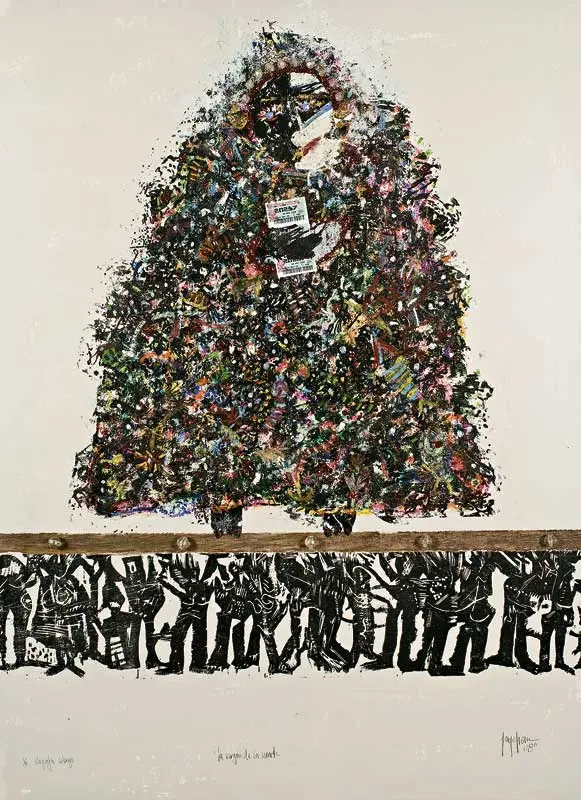
Sierra’s poetic vision dazzles us in compositions like Cirque du Soleil. Connecting the circus to a circle is another way to contrast visual and linguistic signs. The lightness of the composition elements imposes a contrast between the white background and the Sun, from which a child’s swing hangs. The Sun is present in works like Paisaje Ecológico, Paisaje Extraño, and Paisaje Sosegado It is in landscapes where the Sun appears as a meeting zone for prints, loose painting, and collage, elements that replace their radiant luminosity with the extravagance and explosion of dissimilar markings.
Like the landscape, the family realm is a quiet space that is nonetheless inhabited by strangeness. There, Sierra has excavated not only the familiar but that which, in the absence of any human presence, becomes playfully animated. Hay duendes en mi sala reminds us of a child’s suspicions about beings that appear when the house is left empty. Three-dimensional paper figures hanging from threads emerge from small paintings that decorate a wall, like alternative realities coming into life. The pictorial realm (the paintings), the realm of play (the gnomes), the family realm (the living room) all converge on a flat image, faithful to the look of an engraving. The paintings that decorate the living room in Hay duendes en mi sala appear complete, while a chair, the sole piece of furniture in the room, is only a fragment that situates the pictorial within the home. The private space is not represented in full but suggested by means of an incomplete visual sign. Yet, those paintings framed within the boundaries of the work can be seen in their entirety, becoming referents for a reality that comes to life in the gaze of the viewer but not in the gaze of the house’s inhabitants.
Jorge Sierra insists on the planimetry of the work of art, connecting gouge marks, loose brushstrokes, fragments of collage, and prints. His selective rigor translates into the economy of means, and the image’s strength is anchored on a poetic vision that says yes to life. Jorge Sierra seems to suggest in his work that art is our guide towards a deeper understanding of reality.
INGRID MARÍA JIMÉNEZ MARTÍNEZ