
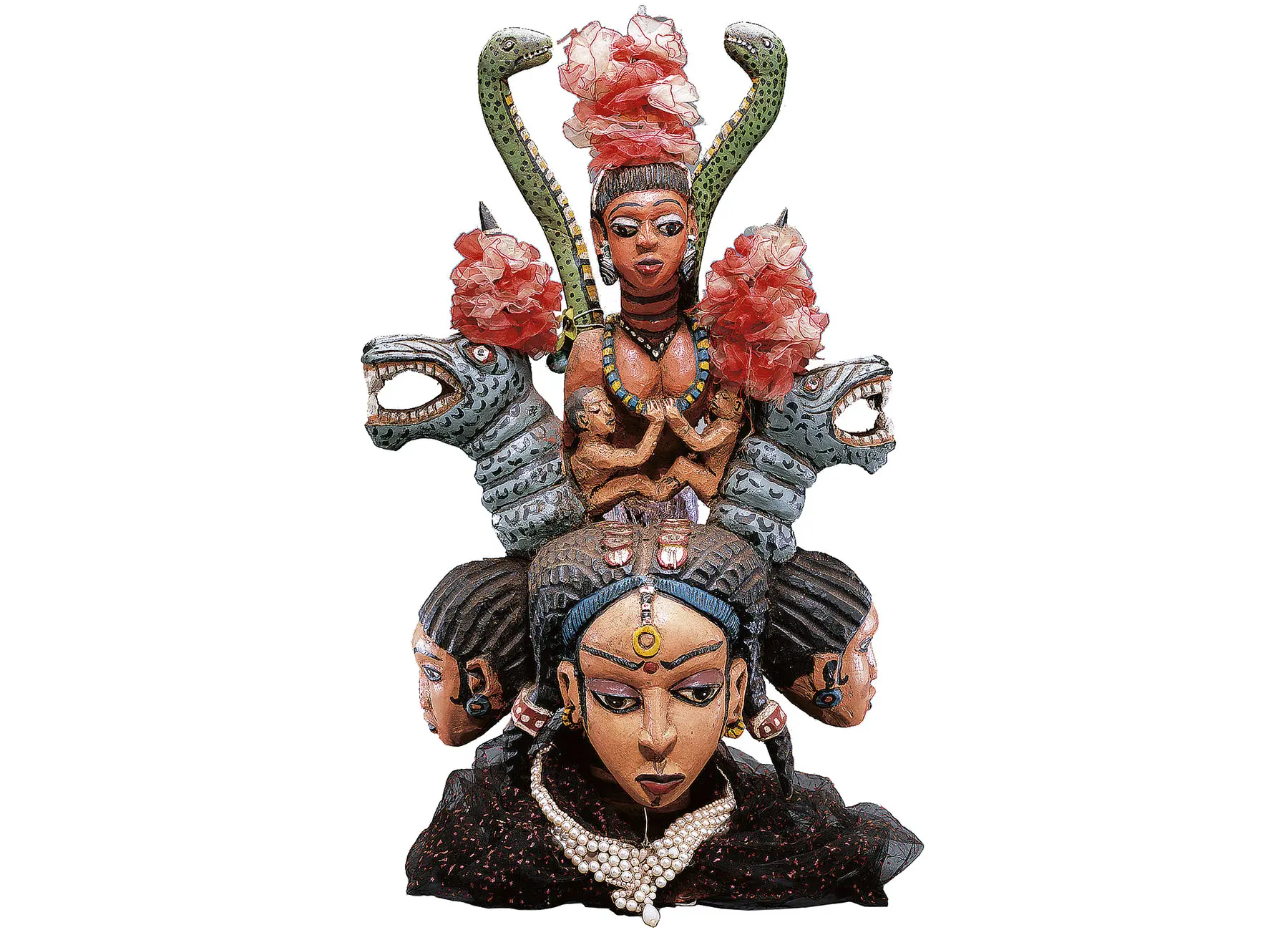
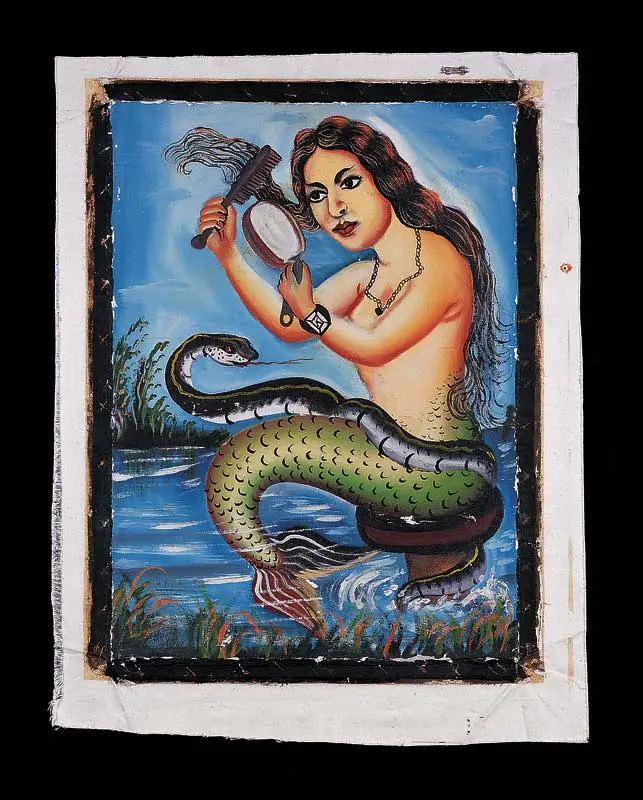
Who is Mami Wata? Most visitors to the Mall in Washington, DC, have probably never heard of her, at least not when she is called Mami Wata. She may be more familiar as a mermaid, a snake charmer, a bizarre composite creature that appears in many places in the world with many personalities, some endearing, and some the stuff of dreams and fantasies. That is her charm – she can be so many things, adapt to so many contexts that span the real to the ritual, appeal to young and old, male and female, innocent and initiated. She is a hybrid who appears in many guises in many parts of the world, most significantly in Africa, where she was probably born, and the Americas, where she was brought by slaves and immigrants who crossed her sacred waters. Mami Wata or Mammy Water or Mama Wota or La Sirène has many names, and many styles of interpretation by her artist worshipers. She is admired for her beauty, her long hair, and her ravishing eyes. She carries a mirror to assure its maintenance, and she combs her hair to the rhythm of the waves. She is a water spirit and she tames the serpents of the earth and sea, which wrap around her body or crown her head; lured by her charms and forever under her control. She conquers her snakes as she conquers the hearts and souls of her followers, and even those who may not believe but must admit a certain fascination for her skills.
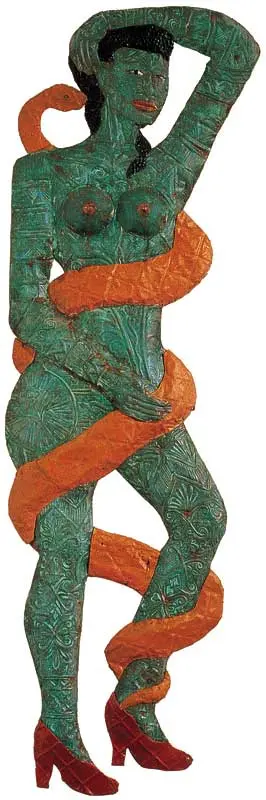
The exhibition dedicated to her, rather appropriately installed beneath the earth in the inner recesses of the African Art Museum, was organized by Henry John Drewal, a professor of Art History and Afro-American Studies at the University of Wisconsin, who admits that he has been under the spell of Mami Wata for over 30 years since he first encountered her in Ghana on a research trip. She has since lured him to many places and he has mastered her story, if not her secrets (something she would never allow). It took years to discover, collect, and research the many objects that make up this remarkable selection of 110 works of art, popular culture, and ritual that tell the story of Mami Wata.
The sound of the surf pervades the quiet of the spaces, as a giant screen placed above the galleries shows the ever-changing seas in Watertime, a video installation by California artists David and Hi-jin Hodge that captures changing patterns of waves, colors, light, and reflections of the same stretch of the ocean over the span of an entire year. Other videos create the ritual context of her worship from Bahia to Santo Domingo and bring the exhibition to life. The objects, paintings, altars, offerings, and costumes range in time and place from Africa, where aspects of traditional worship of the water spirit manifest themselves in carved figures, small objects of offering and divination; to the nineteenth-century German chromolithographs that Drewal believes were the inspiration for the snake-charming aspects of her personality; to the syncretized interpretations that emerge from combinations with Christian saints and Hindu gods and goddesses; to the shores of the Americas, where a new generation of artists falls victim to her allure.
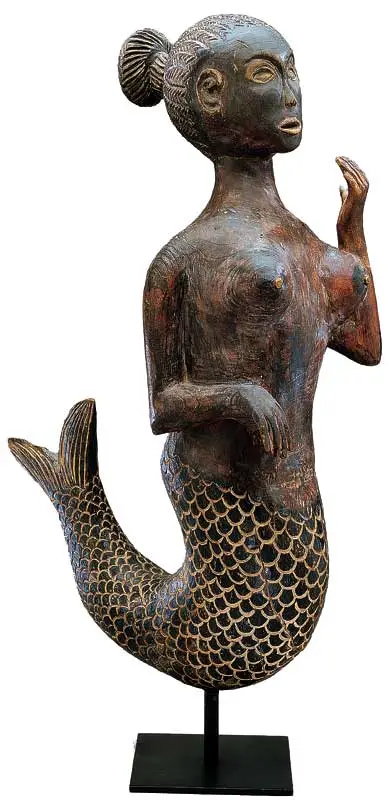
“Mami Wata, often portrayed with the head and torso of a woman and the tail of a fish, is at once beautiful, jealous, generous, seductive, and potentially deadly.” One of the first figures in the exhibit, and catalog, is of Dona Fish, a wood creature from Angola that evokes fear as much as attractive power and sets the tone for her mysterious and seductive powers. A selection of shrine figures, masks, headdresses, and ritual objects captures the many facets of her personality. Historical counterparts from Europe or directly influenced by European traditions, add to her complexity, especially evident in a Figurehead from a vessel that found its way into a shrine of the West African coast. The mermaid or siren is appropriated and Africanized within the context of local water spirits and becomes another image of Mami Wata. The many manifestations of Mami Wata throughout Africa reveal her local interpretations and her similarities. Not surprisingly, the same phenomenon occurs when she reaches the shores of the United States, Caribbean Islands, and Brazil.
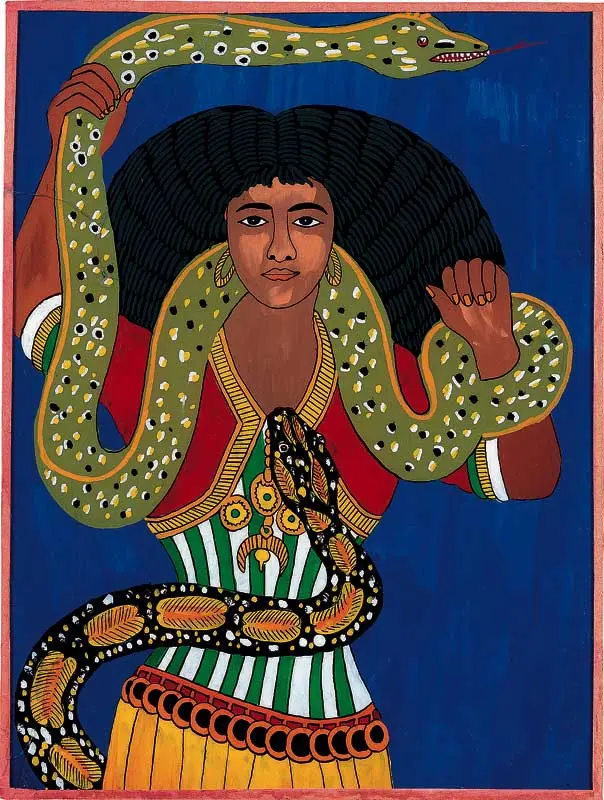
Mami Wata descended from cultural history to become a truly modern personality of multiple forms with numerous names and innovative magnetism. The exhibition tells the story through the creations of her followers and with an excellent catalog that places her into a historical and social context, we are brought to the present (even with a chapter dedicated to Mami Wata on the internet). Contemporary artists from Africa, Europe, North America, and the Caribbean still find Mami Wata intriguing as they address current issues of gender, race, morality, identity, economics, environment, and politics through her story and that of her consorts and other aquatic divinities. Nigerian artist Bolaji Campbell’s beautiful blue canvas, Yeye Idi (Mother Water), 1996, pays tribute to Oshun, the goddess of cool waters, and opens the door to many other interpretations of her power in the ever-inventive mind of the artist.
And so her story continues. Just as she is constantly changing and adapting, her image and ritual construct have reached and continue to reach other shores and other nations. One hopes that Professor Drewal will also continue to expand the narrative and organize another exhibition that will include the extraordinary Afro-Cuban syncretic creatures that are her cousins in the guise of Yemaya and Ochun in Cuba and in the Diaspora. The beauty of this exhibit can be found not only in the fascinating objects and their story but in the provocative character of Mami Wata herself that leaves the visitor wanting more.
The exhibition was organized by the Fowler Museum at UCLA and will travel to the Iris & B. Gerald Cantor Center at Stanford University (August 4, 2010, through January 2, 2011).
CAROL DAMIAN