
Since the mid-Eighties, Marylee Coll has been recognized for her artistic proposals. Her creative process has become more refined thanks to the maturity that only the passing of time can bestow. Her last solo show took place in Maracaibo, at the Moro Gallery, in 2001. Since then, Coll’s artistic production has evolved greatly, and her pursuits and experimentation have expanded beyond painting to the point she no longer relies on the later expressive medium to create her images.
There is a “before and after” in the work by Marylee Coll. It is a slow and incremental process that has taken her, as we have already pointed out, from the painting to the non-pictorial. This includes her interventions of space. It is important to offer a brief recount of this process, given that her work today is connected to this pictorial past. During the early part of her career, Coll grows as a painter, as she is able to condense interior energy through the resonance of shape and color contrasts. At that time, this was concerned with an “informal” geometry created on a monochrome surface that also had a specific value. On other occasions, the artist worked with color contrasts, between a monochrome background and silhouettes with the same characteristics. Later, she introduced words as she formed pictorial images that permitted our discursive thoughts to resolve unknowns or suggestive ideas. Paint and concept were integrated as a pretext by the artist to question aspects of reality and its representation. Concurrently, she evaded the traditional painting format, because she now relied on its two-dimensional support to create volumes. This was a consequence, according to Coll, of “a desire to go beyond two-dimensionality without renouncing two-dimensional work”. At other times, she integrated abstraction and figuration by using decals with figurative motifs on a neutral and abstract background. Through this approach – according to Ruth Auerbach – Coll defied “the pictorial as an impure and bizarre element” in a search for a repertoire of figures that remind us of “the decorated kitchen tiles from another era, the ‘kitsch’ of domestic iconography, memories from prosperous times”. These inquiries that the artists had been undertaking for more than 10 years are important to know in order to understand the works that Coll has just exhibited at La Cuarta Gallery, in Caracas.
In this exhibit, Coll presents “paintings” without the technical utilization of paint. She investigates and reinterprets the Twentieth Century geometric tradition as she conceives pieces with a strictly organizational sense in connection with forms in which the behavior of color is essential. This leads to absolutely brilliant and contrasting images that somehow represent a new reading on that tradition. There is a ludic intention as well in each one of these pieces, in that they produce nearly kinetic visual effects that arise from the sinuosity of the resulting image created with various colors of adhesive tape. Incidentally, the material defines the title of the exhibition: Plástica. The flat and, at the same time, volumetric planes reveal the continuous experimental will that has characterized work by Coll.
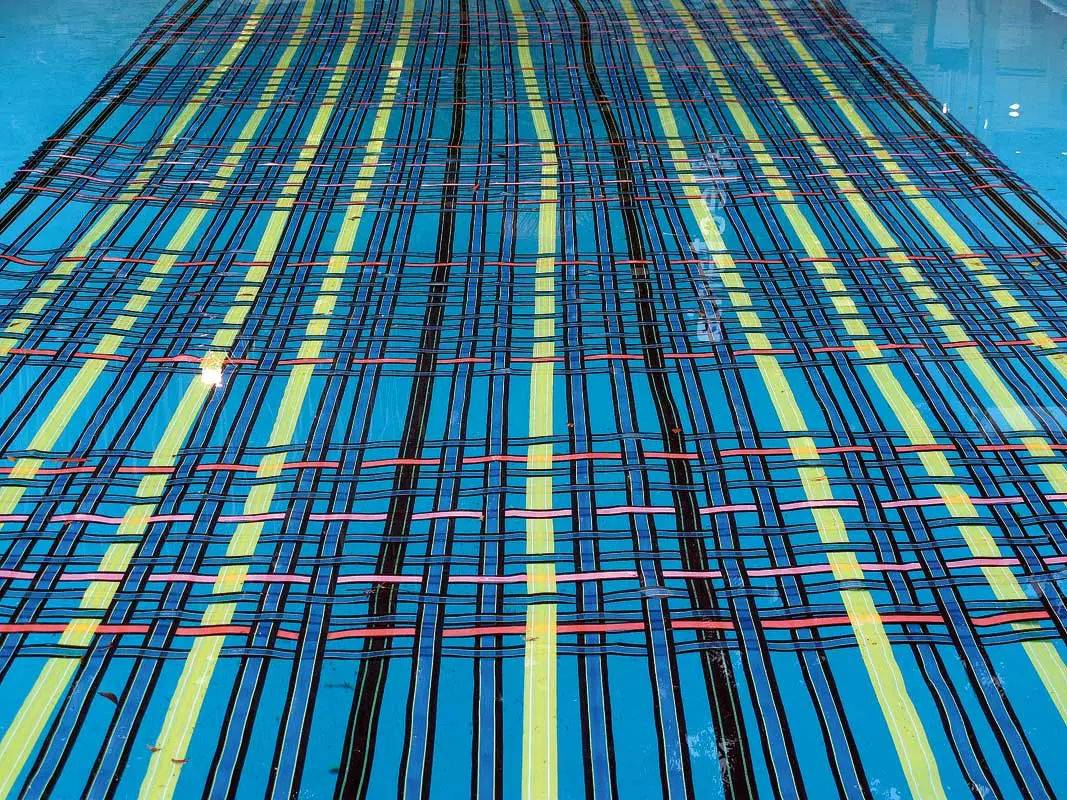
With Plástica, Coll once again surprised us with a piece that defies scale: the intervention of the swimming pool adjacent to the gallery. In this work, the artist employed tape to fashion beach chairs in order to create a “ceiling” over the pool. This produced mimesis or play of equivalencies between the work and the water by means of color; a dichotomy between the natural (water) and the industrial (plastic), and the idea or concept of expansion through the creation of a chair with an area almost equivalent to that of the pool. The horizontally disposed of material, the filtering of light through the holes of the weave, and the movement of water and light are a reinterpretation of the kinetic effect that can be observed in an installation.
I believe that the dominion of space and of scales is another of the relevant aspects in Coll’s creative process. In 1997, she placed a strip made from pieces of painted fabric to cover the Santa Ana Church in the city of Bolívar. In 2000, she intervened all the walls of the Tácata Church, in the estate of Miranda, with machine-made embroideries and extensions that – according to the artist – “came out from the wound in christ’s heart and expanded over the walls”. Then there are the multiple interventions of house façades during the Velada de Santa Lucía (The Evening Party of Santa Lucía), an event that takes place every year in Maracaibo, organized by artist Clemencia Labin. And last, the installation she created for the exhibition titled El hilo de Ariadna (Ariadna’s Thread), in which she created a metaphor of the glass façade of the Alejandro Otero Museum with plastic ribbons used – usually on baseboards – and colored light. These experiences had helped her evolve to the point that today, the artist can intervene urban and architectural spaces – as a result of her will to transcend those first two-dimensional works – to achieve spatial pieces that represent a challenge due to their dimensions and the difficulty if integrating them into a new scale.
SUSANA BENKO