
A wildly imaginative mural has opened like a storybook’s centerfold on a legendary street corner in New York. The epic painting is on the site of Keith Haring’s famous 1982 mural and like its predecessor, it’s a delight to most passersby. People often stop to reflect or photographically inject themselves into the myriad scenes in this captivating tapestry by Brazilian twins, Otavio and Gustavo Pandolfo who go by the tag Os Gemeos (twins in Portuguese).
At 51 feet wide and 17 feet high, it’s on the scale of a movie screen. Yellow Submarine could be its grandfather. Yet the comparison to an inviting children’s book persists. A seam even bisects the concrete panels (donated to the display by Goldman Properties in collaboration with Deitch Projects).
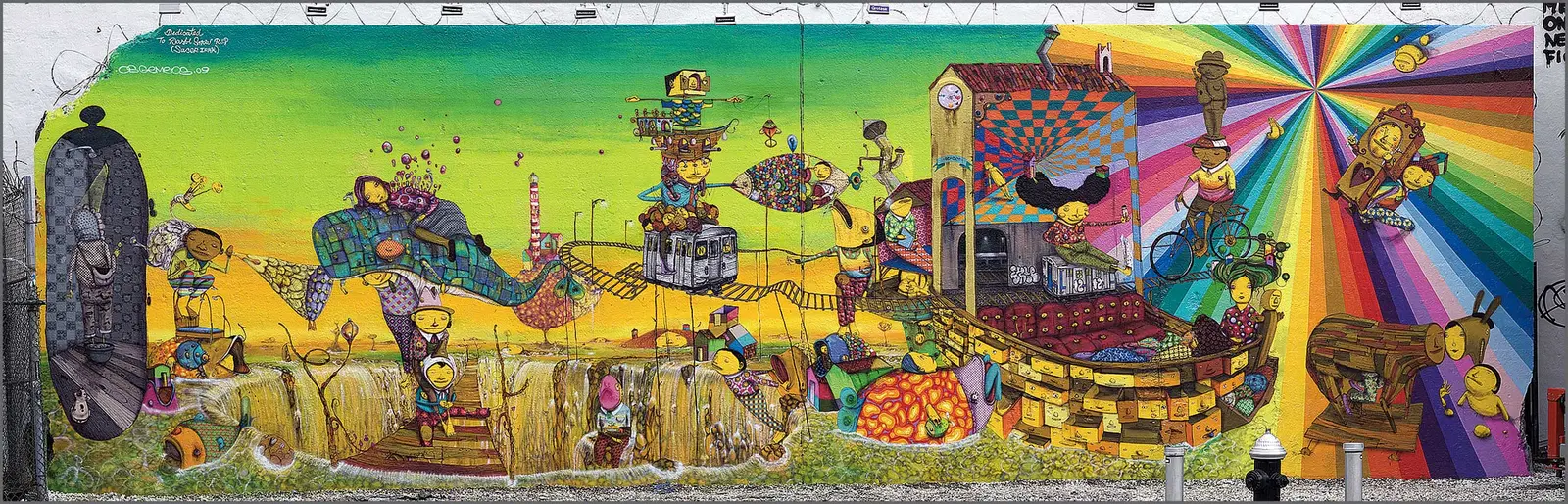
The mural is dedicated to the recently deceased multi-media artist Dash Snow. Historic referents include the inventive, overall activity of Bosch, the spatial distortions of Escher, and the brooding locales of De Chirico and Dalí.
The piece can be read as a day in life. Beginning on the left, a cutaway capsule shows a figure in a shower being bathed by a sliver of morning sunlight. Outside the cocoon, an assortment of anomalous characters navigates a strange world. Ending on the right is a kaleidoscopic rainbow that evokes a transcendent dream state.
The cartoony figures are a part doll, part marionette. A brut simplicity fosters a semi-primal response, taking one back. This backward look recalls our dependence—on others and on forces we don’t understand. The cast of whimsical folk implies invisible hands pulling strings behind the green and golden vista, orchestrating events that take on fatalistic symbolism.
Issues of sustainability are intimated in three scenes of “totem poles.” Near the center, an N train rolls toward us on ropelike tracks in the sky. A boy looks out from the window, his moon-like yellow face mirroring the bright yellow circle of the N line logo. On top of the train, a giant jester straddles the car. A slew of disembodied heads hangs around his waist. His outstretched hand disappears inside a fish’s mouth.
On top of his jester’s cap wee galleon perches, cannons protruding from open gunnery portals. As a viewer, one transfers personal circumstances in order to read the meaning. The jester becomes a commuter headed to work. Is it his job to collect heads? “Headhunter” in this context has dual meanings, both primitive and capitalistic associations.
Extending upward from the ship’s deck, the main mast’s crossbeams become outstretched arms. This stick figure, wearing a multi-colored tabard, has caught a fish, which dangles from his pole. On top of the mast, a box head opens like a cuckoo clock to reveal another face inside. This uppermost person resembles an iconic folk art weathervane. Which way is the wind blowing, we should well ask.
Nautical references abound throughout, and the metaphorical possibilities are exponential. Are we in over our heads? Are we becoming fish out of water in an environmental holocaust? Countering a grand metaphor of doom is a grander, overarching metaphor of hope.
Much of the foreground depicts an inescapable waterfall. Floating island faces drift perilously closer. Atop a totem pole of implausible equilibrium, a girl is fizzling away into bubbles. She lies on a blue and purple patchwork whale, a trope for the topsy-turvy artificiality of our existence. The whale is being hefted on the shoulders of a man. He is balancing on an adolescent who, in turn, is being carried by a boy crossing a bridge and headed toward you.
Reclining in the prow of a vessel, another character commands your look. A marvelous odalisque, she stares and transfixes you. She is part of the “STATION” where trains are not all that switches. The station recedes into Vasarely-like checkerboards of sumptuous color combos. A fanned spectrum of brilliantly hued rays recedes to a point. This psychedelic mandala appears as a quantum alter-space, where figures both emerge and submerge.
A porter in exquisitely stenciled cream and blue pants wades knee-high through the vortex of colors. He eyes us from under a grandfather clock that he carries on his back. The smiling clock anthropomorphized further by sprouting arms and holding out candles, echoes his face. This is an ultimate aggregation of spirituality, supplication, and support. Nearby, praying hands poke out of the wall.
In his book The Mechanical Bride, Folklore of Industrial Man, Marshall McLuhan could be describing Os Gemeos’approach when he writes about an artistic strategy that would “ignore all the national and local time-trappings of comfort, fashion, property, and utility in order to seize upon the master forms of human responsibility and community.” This strategy “calls for a proportionate extension of arduous vision.”
In this vision of imagination, Os Gemeos stamps your passport, welcoming you to their homeland of Magic Realism.
JEFFREY CYPHERS WRIGHT