
Pedro Terán is recognized as one of the creators of the greatest consequence in Conceptual Art in Venezuela, with a broad trajectory throughout which the artist has explored the broad possibilities of the idea as a means of potentiating the deed, as a construct that is transformed into denotative images, due, to a greater extent, to its intention than to its visuality. This very brief introduction permits us to “tell” of Terán's most recent exhibition, of his Casas de oro (Gold Houses), presented in Periférico Carácas from August 16 to September 13. Twenty-eight pieces, between photographs and photocollages, are brought together here.
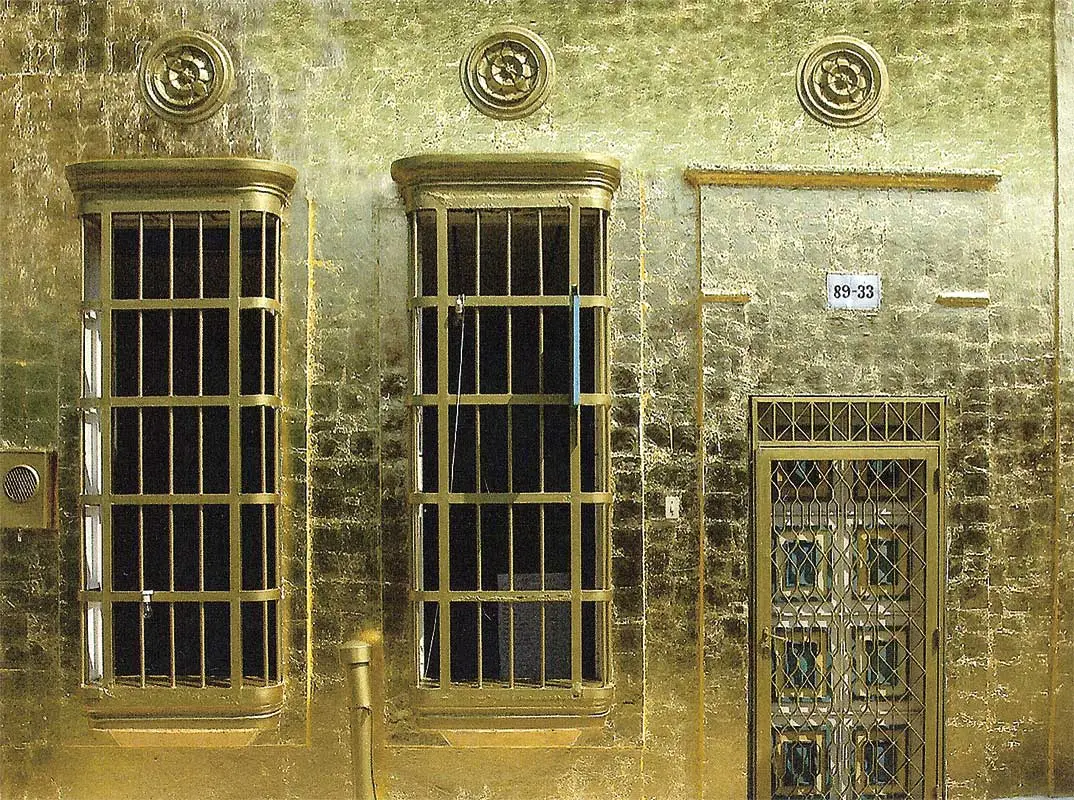
Two moments were proposed in the show, two scenarios coinciding in space but proceeding from differentiated times: the canvas, and the images that are properly identified with the title of the exhibit, both joined through the idea of the veil, of this subtle materiality that covers the form, and that in this case is associated with the artist for the National Art Gallery in the year 1981. The underlying intention in these "veiled" pieces seeks more to suggest than to show. In the first case, the photographic registry demonstrates to us in successive images a piece of canvas, a cloth that in its formality reveals that which is absent, that which is not there, but that which continues to be present in all that is revealed in the material's subtle folds, in the traces of what has already taken place. The second part, the most numerous, is the result of an experience conducted in the city of Maracaibo, in western Venezuela, as part of the artist's participation in the Night of Saint Lucía, 2008, an event during which Terán intervened two things: one of these with gold leaf, and the other, with asphalt.
Gold, a material that has given rise to the most persistent myths in the history of human civilizations and that has captivated and continues to arouse passion in artists, one of the fables most beloved by creators, I would say, has a continuous presence in Terán's work. In response to the inexhaustible need for communication, the artist has collected, studied, and assimilated many of these myths, to covert them into a discourse of their own, in components that are inherent in his work, from the legendary story of King Midas to the no less dazzling legend of the city of Manoa, fables having to do with gold that inspires the creative work of Pedro Terán.
The experience of the resident of Maracaibo, the marabino, gives rise to insistence on the theme, to the reconstruction of ideas, of bringing notions up to date. A type of modern, tropical version of the ancient kingdom of Frigia, Maracaibo has for decades been the black gold capital of Venezuela, the place in which there was a time when everything turned into gold and when personages, in the manner of the legendary princes of Manoa, covered their bodies in the golden metal, but not in the ceremonial sense of that territory of the fable, but rather as an expression of wealth and power.
From the ambit of the concept come our distinct images of houses as the expression of what the artist defines as the presence of two significant scenarios: the urban intervention carried out in a moment, and the particular context, and in the scenography of it, the expositive proposal, that "reinvented idea," which comes to life in another experience, in another discourse.
In the photographs, which are also intervened, Terán incorporates another element, an unexpected protagonist: the dollar, the indisputable symbol of prosperity and domain, but something that is not foreign to the central idea that is debated in the images; contrariwise, the dollar is its popularized version, the possibility of richness attainable by the multitude, by the masses; thus, the contemporary image of the myth of gold.
From its appearance, Conceptual Art has driven with a passion that which it is most like, affirming in discursive components and subordinating to these the values of formality. However, in Terán's proposal, in his Casas de oro, both components achieve an enriching equilibrium that highlights for the viewer the importance of the concept, as the semantics of the form reaffirms, with regard to the plastic deed and reference to the idea. Observed together, the photographs become, in a first approximation, eloquent images in themselves, but from the space of the art, they are transfigured into languages that express from the form, as well as from the concept that changes them into critical discourses. In the recreated house fronts of the St. Lucía homes, the metaphoric encounter between dazzling gold and the dark hydrocarbon, both exhaustible resources, come to be esthetically, in a plastic expression that is based on the regularity of the constructions and the contrast between brightness and opacity, the significant image, in as much as this comprises the fragile balance that mediates between form and concept.
FREDDY CARREÑO